When the Picture Changes and the Jaguars’ ‘Thunderstruck’ Keeps Going
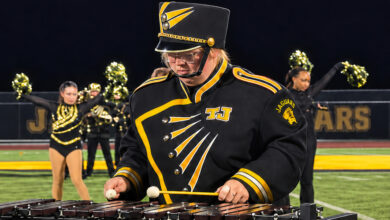
A viewer watching Layla Clark’s “Thunderstruck” focused on a moment when she appeared to push up her sleeves. The line of notes kept going. It is a good detail to bring to a replay, because it asks the audience to separate what the picture follows from what the microphone picks up. The video gives viewers a view of one player. The sound has room for everyone playing the same opening figure.
The performance came from the Thomas Jefferson High School Jaguars’ 2025 season. Clark was stationed at a marimba, playing the line AC/DC fans associate with Angus Young’s guitar. The fast-moving mallets are easy to track in a close shot, especially when the rest of the band has yet to make its full entrance. A tiny change in her movement can look significant even when the pulse coming through the recording stays consistent.
Clark described the opening to the Pittsburgh Post-Gazette as a part played by five mallet percussionists. That makes a shared sound a better starting point for hearing the passage. The audience can identify when Clark reaches for a bar more easily than it can tell which player supplies an individual attack in the mixed recording. More of the section may be contributing to a moment than the shape of the image suggests.
The sleeve detail works as an observation, not a measurement of anyone’s playing. A phone microphone gives the listener the sound in the area around the camera. It cannot give us individual tracks or tell us exactly whose mallet struck a note. The best guide is a combination of Clark’s account and the wider ensemble you can hear as the performance opens out. The footage supplies a question that the band’s own explanation helps answer.
A section can make a doubled part sound strikingly close to one line. The players have to agree about when the notes begin, how firmly to strike and how the rhythm should feel. A clear attack can make differences in timing audible, which is one reason keeping the figure neat takes work. If the attacks fit, a viewer may follow a single stream of sound even with several musicians responsible for it.
Replaying the video with that possibility in mind changes what you notice first. A moment that looked as though it ought to interrupt the riff can become a cue to listen beyond the center of the image. You can still appreciate the precision you see in Clark’s hands. The ear also has a chance to notice the stability of the group playing around her.
Listen before you look
Try one pass with the picture out of sight. Locate the point in the pattern that keeps returning and listen to how the other notes move around it. With no screen to draw your eyes to the same pair of hands, you may be able to follow the repeated attacks as a section sound more readily. Play it again with the image and the two kinds of attention begin to work together.
The pattern is particularly useful when the rest of the Jaguars enter. The audience already knows its pace, and the wider band can add a new layer without disturbing that sense of movement. On a football field, that clear change in scale has to be felt over distance. In a phone recording, the same effect turns a small scene at the bars into something that suddenly feels wider than the screen.
An additional field recording offers a way to think about what the close-up leaves out. A camera farther away cannot show every detail of a mallet stroke. It can show the distance between the people who are keeping time together and how the sections enter during a show. The two views are useful because they tell you something different about the same band’s work.
The frame and the mix give different clues
A concert guitarist can fill a screen while a bass or drum part just outside the shot explains why the phrase feels complete. The Jaguars clip gives a variation on that experience. Some of what the camera leaves out is another part of the same repeating figure, and there is more to hear when the rest of the ensemble arrives. The picture points to a player. The timing points to the group.
The note about sleeves became an invitation to watch for something besides speed. Following it can get a viewer closer to what an audience hears in a field show. The early part of the clip can seem to have one visual subject, while the rhythm is already a collective responsibility. A strong section gives that rhythm enough presence to carry from the keyboard area to the seats.
There is a similar lesson for any short performance footage. The camera operator has to pick a place to stand and a point to watch. That decision explains why a detail becomes memorable. A replay lets a viewer make a different decision about where to look, and listening beyond the frame lets the rest of the people who made the sound enter the story.
There is a reason this sort of detail often becomes a conversation among musicians. When you learn a section part, the frame you think in is the shared pulse. Someone viewing it cold may be thinking in individual gestures. Both are paying attention to the music, but they are paying attention at different scales. The replay lets the viewer switch scales. First you can follow the sleeve or the hand, then follow the repeated note as it passes through a stretch of sound that involves more players than the camera can keep in view.
Clark’s account is what makes the sleeve question useful even if viewers disagree about the precise instant. The section had the opening together. That tells us why a frame devoted to one person is always going to leave some of the performance out. Keep watching past the detail that drew your eye, and the rest of the Jaguars become much easier to hear.