The Hard Part Keeps Going: A Percussionist’s View of Layla Clark’s AC/DC Cover
An AC/DC fan can identify the beginning of ‘Thunderstruck’ almost immediately. A percussionist may keep watching for another reason. Responding to Layla Clark’s performance, @misterbum1 wrote: ‘As an old percussionist, I can tell you that what she did is hard as hell.’ The remark singles out an achievement that becomes clearer the longer the opening continues.
The writer’s praise centers on maintaining a repeating pattern consistently over time. That shifts the listening task. Instead of waiting only for the band to enter, follow the repeated returns through the figure and the hands that have to deliver them. Recognizing the tune takes seconds; keeping its pulse in place is the ongoing work.
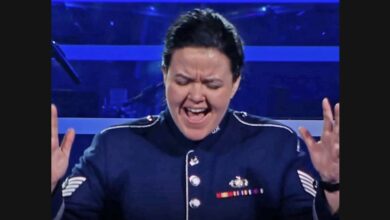
Clark plays with the Thomas Jefferson High School Jaguars in western Pennsylvania. The close-up was filmed by her mother during the school’s 2025 marching band season, KDKA Radio reported on November 6. She was a junior when it was recorded and is a senior as the renewed attention brings the performance to a wider audience.
The camera makes the physical part of that work unusually visible. Each mallet lifts and comes back toward the bars while the next strike is being prepared. The notes have a distinct beginning and a different texture from Angus Young’s electric guitar, but the opening’s shape remains familiar to listeners who know the original.
Other viewers in the discussion focus on related details. One who describes a background in drum line praises the execution; another draws attention to hand-eye coordination. Timing, concentration and coordination give the comments a common thread. Their interest goes beyond the novelty of finding an AC/DC song in a school halftime show.
Watch the returns through the riff as the arrangement grows around them. The exposed opening has to keep moving until it connects with the larger sound of the Jaguars. Its consistency gives the other instruments somewhere to arrive. The band’s entrance is the musical destination of the control the commenter is praising.
Keeping the pattern consistent
A repeating passage gives an audience a useful reference point. Once the first cycle is familiar, the next one can be heard against it. A listener does not need notation to follow that relationship. The physical movements recur alongside the notes, making the link between motion and pulse visible in the recording.
That is why a short burst of speed tells only part of this story. The passage continues beyond the first impression, and each return asks the player to keep placing the notes. The comment from the self-described older percussionist directs attention to duration as well as pace: the pattern has to remain consistent while it repeats.
The close-up lets viewers compare those returns. One hand is already preparing while the other completes a strike. There is little visual distance between the musical result and the movement producing it. Watching becomes a way of listening more carefully, even for people who have never held a pair of mallets themselves.
The ensemble gives the opening its destination
The arrangement also allows the part to be heard clearly. Before the fuller sound comes in, the repeated attacks remain in the foreground. That space matters to the response: listeners can hear the figure and see how it is made. A demanding passage is given enough room for its demands to register.
The field behind Clark keeps another part of the performance in view. The close framing draws attention toward her instrument, but the ensemble supplies the change in scale. Once the other instruments enter, the repeated line is heard within a broader arrangement rather than as an isolated musical exercise.
The local story behind the close-up
A separate upload on the Jaguar Marching Band channel places ‘Thunderstruck’ in the October 31, 2025 halftime program against Mars. The program also lists ‘Crazy Train,’ ‘Back in Black’ and ‘Hey Baby.’ It is a different recording from the short close-up, giving a wider look at the band and its show.
That wider view is a useful companion because a phone clip naturally favors the player nearest its lens. The complete program restores the scale of the ensemble around the mallet part. The opening’s role becomes easier to hear when it is followed into the rest of the music and the movement across the field.
Compare the original guitar figure
CBS Pittsburgh’s report brings the attention back to Clark and Thomas Jefferson High School. An interview with the student accompanies footage from the school, adding a local perspective to the playing. After following a pair of hands through the same passage, viewers can hear from the musician who learned it.
The report and the performance serve different purposes. The close-up shows the detail that made viewers stop scrolling; the interview gives that detail a person and a place. Together they make the praise more specific than a general reaction to a fast instrumental passage discovered online.
AC/DC’s official ‘Thunderstruck’ video supplies the natural final comparison. The opening guitar line has space around it before the arrangement fills out. Switch back to Clark’s mallets and the attack changes, while the familiar line continues to connect the two versions.
The older percussionist’s observation is a useful instruction for a replay: stay beyond the first recognizable notes. Keep listening as the pattern repeats, then hear what happens when the ensemble joins it. The performance’s appeal includes the opening’s speed, but it also depends on the control that carries those notes forward.