The Night Prince Took the Last Solo: Inside the 2004 George Harrison Tribute
There is a moment near the end of the 2004 Rock & Roll Hall of Fame tribute to George Harrison when the evening acquires a second center of gravity. Harrison’s song is still the reason everyone is there. Tom Petty and Jeff Lynne have carried its words; the band has given it a familiar shape. Then Prince takes the closing guitar passage, and the performance becomes the scene that will carry this gathering far beyond the room in which it happened.
The date was March 15, 2004. The venue was New York’s Waldorf Astoria, not the Rock Hall museum in Cleveland. Harrison was being inducted posthumously for his solo career. Prince was entering the Hall that same year. The official induction records place Harrison’s recognition alongside Prince’s own induction; the ceremony’s location and date are also documented in The Current’s account of the event.
What followed has accumulated its own folklore: an unexpected solo, an airborne guitar, a supposedly recent magazine snub. The history is more interesting when those stories are placed beside the surviving recording and the musicians’ recollections. It contains preparation as well as surprise, a supporting band as well as a star, and a tribute whose emotional purpose never disappears beneath the spectacle.
Two inductions, one shared stage
Prince was not an unannounced musician who wandered into somebody else’s ceremony. He was one of its honorees, introduced into the Hall by Alicia Keys and Outkast. Harrison’s induction was presented by Petty and Lynne, with Olivia and Dhani Harrison accepting on his behalf. The arrangement brought together a living artist receiving institutional recognition and the family and collaborators of an artist being remembered.
That distinction changes how the closing performance reads. Prince’s presence belongs to the evening’s structure. Harrison’s absence gives the gathering its purpose. There is no need to turn the scene into a contest between the two to understand its force: the musicians are using a composition associated with one inductee to make room for the unmistakable voice of another.
For Prince, the ceremony also arrived during an unusually visible stretch of 2004. His estate’s official history of Musicology places the Rock Hall appearance between his February Grammy performance with Beyoncé and the album’s April arrival. The same account pushes back against the easy “comeback” narrative: he had continued recording and releasing music, including directly to his audience through the NPG Music Club.
Seen in that context, the Harrison tribute was a concentrated demonstration of a working musician’s range. A television viewer might have arrived with the singer, songwriter or pop image foremost in mind. The ensemble setting put a different skill at the front of the frame without requiring Prince to abandon any of those identities.
A song already built around a guest guitarist
While My Guitar Gently Weeps had appeared on the Beatles’ self-titled double album in November 1968. Harrison wrote it; Eric Clapton played lead guitar on the released recording. Those basic credits are preserved on the Beatles’ official song page. Long before the 2004 tribute, the composition already held a place for a distinctive guest voice on guitar.
Watch the complete performance
The Rock Hall’s 2021 presentation above preserves the full tribute. The original official upload is retained later in this feature, allowing the two presentations to be viewed separately. Both document the same 2004 occasion.
That does not make Prince a replacement for Clapton. It gives the performance a useful historical frame. A song can retain its identity while the player carrying its instrumental voice changes. The melody, the recurring harmonic movement and the return of the vocal give an improvising guitarist something to lean against; the solo can expand without becoming an unrelated piece.
This is also why beginning the clip only when Prince steps forward leaves something out. The opening establishes the emotional scale of the song and the relationships between the performers. The ending becomes more expansive because that foundation has already been laid. The tribute’s dramatic arc depends on the passage from one kind of attention to another.
Harrison’s own career makes the choice more resonant than a convenient Beatles hit. His Hall of Fame recognition concerned his solo work, while the song reached back into the catalog through which many listeners first knew him. The performance could therefore connect different parts of his musical history within a single shared reference.
The people making the space around the solo
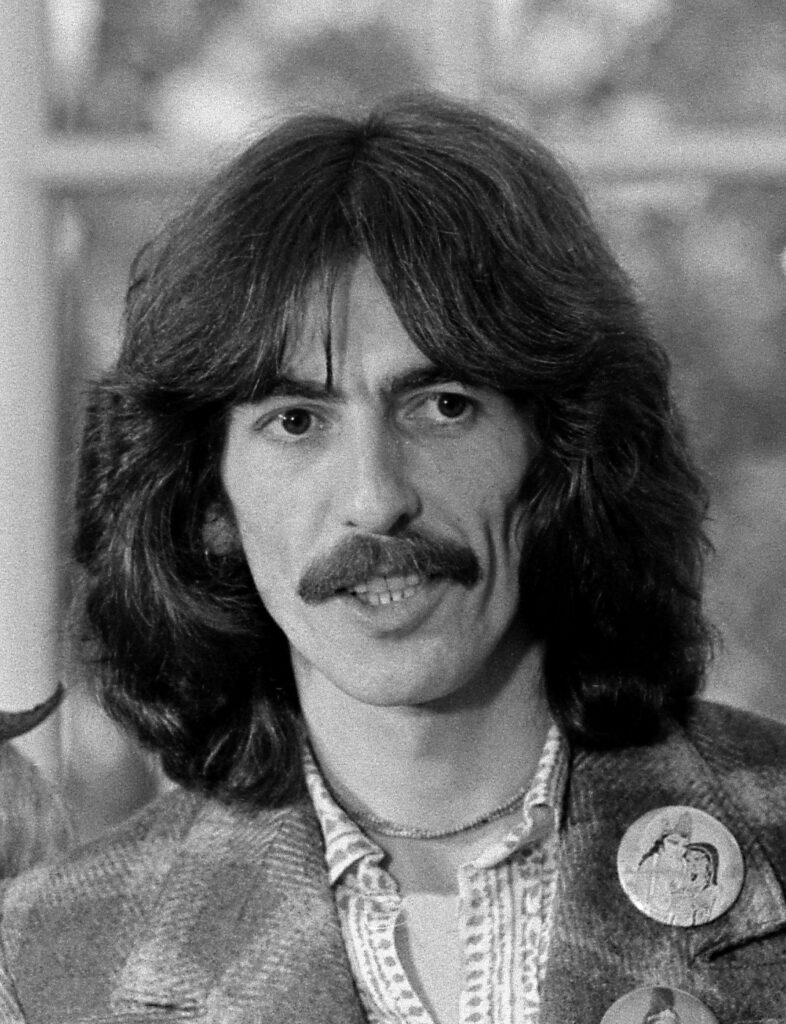
The most circulated image is Prince alone with his guitar. The actual performance is an ensemble. The Rock Hall’s official video credits name Petty, Lynne, Steve Winwood, Dhani Harrison, Marc Mann and Steve Ferrone alongside Prince. Petty’s near-contemporary recollection supplies further detail about the band assembled for the tribute.
Speaking to Paul Zollo on March 31, 2004, Petty identified Ferrone on drums, Scott Thurston on bass and harmonica, Winwood on organ, Dhani on acoustic guitar and Jim Capaldi on percussion. He also said that he and Lynne had worked on their vocal harmonies. Asked about playing with Prince, Petty called him “really inspiring.” The interview survives in the Petty Archives.
Those names are more than supporting credits. A closing solo needs musicians who can hold the song’s pace and shape while one player stretches its foreground. The steadiness of that shared frame is part of what makes a lead passage feel free. The band’s work does not stop being expressive when the camera moves away from it.
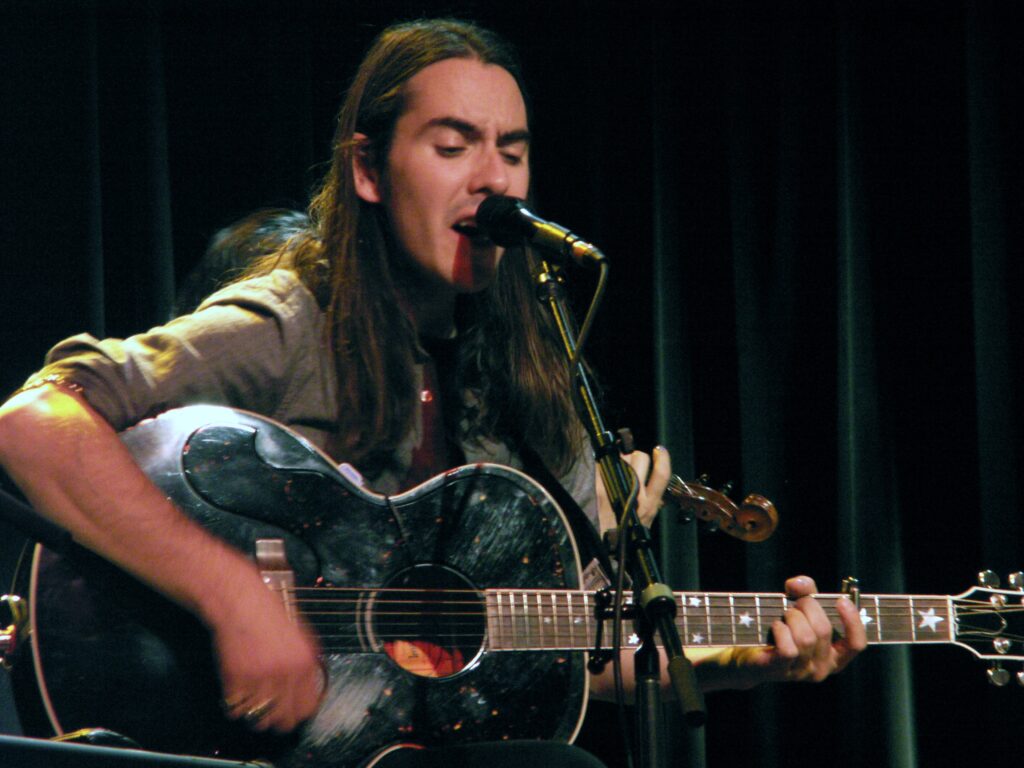
Dhani’s place on the stage carries another kind of continuity. He is both a participating musician and Harrison’s son. The performance places him among people associated with his father’s musical world, while a fellow inductee contributes a very different guitar voice. The resulting scene contains family history and musical exchange at the same time.
What the rehearsal account actually says
The best-known backstage account comes from Joel Gallen, who produced and directed the ceremony. In recollections reproduced by Best Classic Bands, he described a rehearsal in which Lynne’s guitarist played the solo passages while Prince mostly stayed with the rhythm part. Gallen then spoke privately with Prince about how to divide the space.
According to that account, Prince proposed leaving the middle passage to the other guitarist and taking the ending himself. Gallen did not get a rehearsal that revealed the complete closing solo audiences would eventually see. His recollection describes uncertainty about what Prince would deliver, not an absence of rehearsal for the entire song.
The distinction matters. “Nobody rehearsed anything” makes a more dramatic anecdote, but it erases the vocal preparation Petty described and confuses an unrevealed solo with an unprepared ensemble. The musicians could know the song and its framework while still leaving room for a final passage whose details were not fixed for the director.
It also leaves no reason to manufacture a feud. Gallen’s account concerns the practical problem of allocating guitar parts. The later performance can be understood through that arrangement without assigning resentment to Mann, Petty or Lynne, or treating every glance on the film as evidence of a private argument.
When the ending becomes Prince’s
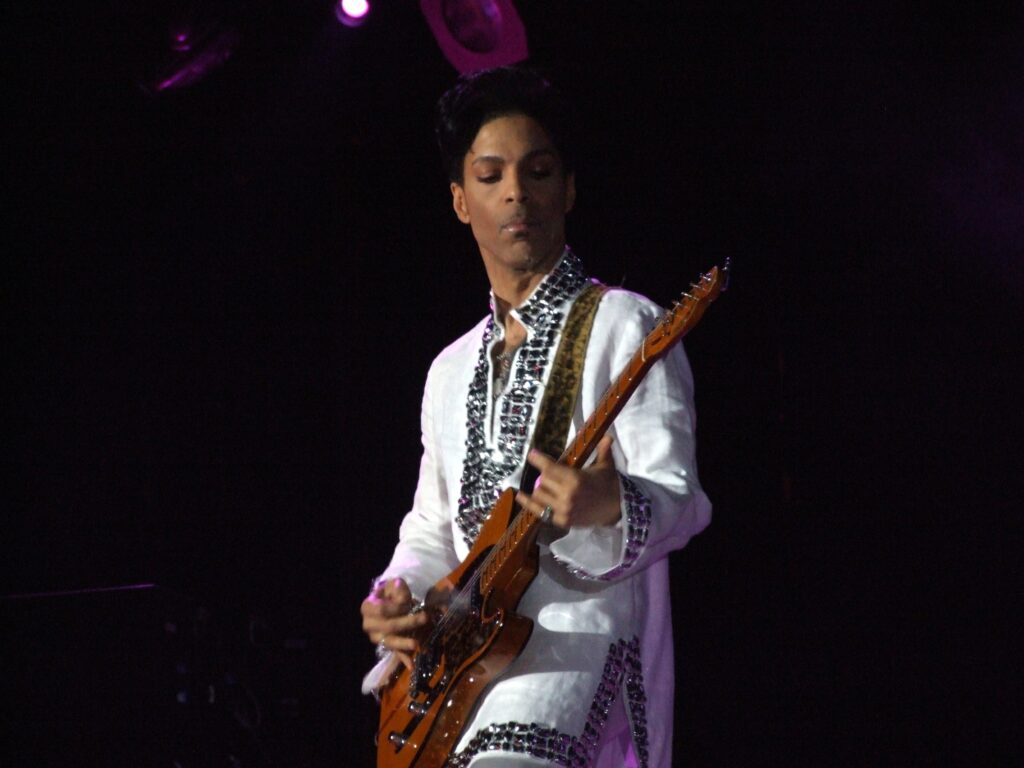
The preserved film gives the closing passage its visual signature: the red hat and shirt, the dark suit, the light-colored guitar and the movement toward the front of the stage. Prince becomes the focus without the band leaving the song behind. His physical presentation and the guitar line are parts of one performance rather than separate musical and theatrical events.
There is a useful difference between describing virtuosity and explaining its effect. Speed can fill a space; a sustained tone can make the same space feel suspended. A solo acquires direction when these gestures answer one another. The interest lies in the relationship between phrases, the background they move across and the moment at which the song’s shared structure returns.
The camera adds another layer. A close view can make a gesture feel private and immediate; a wider view restores the other musicians and the scale of the stage. Watching both kinds of shot keeps the solo attached to its circumstances. Prince is the center of attention, but the event remains a group performance dedicated to Harrison.
Calling the passage a defining live moment is an editorial judgment supported by its continuing place in the performance’s reception. Calling it objectively the greatest solo ever would turn that judgment into a measurement that music history cannot supply. Its particular achievement is easier to hear when it is allowed to be specific.
Was it an answer to Rolling Stone?
A widely shared caption says that Rolling Stone left Prince out of a list of the hundred greatest guitarists a week before the show, and that he delivered this solo as his answer. It combines a real omission with a faulty timeline and an interpretation of motive.
The omitted-Prince story is discussed in Audacy’s account of the rumored snub. The relevant David Fricke ranking belongs to 2003, as Glide’s retrospective on the magazine’s lists also establishes. It therefore predates the March 2004 performance by months, not one week.
The stronger claim—that the solo was a deliberate act of revenge—needs a different standard of evidence. Audacy explicitly presented the connection as an unconfirmed rumor. A recording can show what Prince played and how he presented himself; it cannot, by itself, establish that a magazine ranking was the reason he chose those phrases or gestures.
It is possible to discuss the omission without pretending to know his private intention. The performance is an emphatic example of the guitar playing the list failed to recognize. To a later viewer, it can feel like an answer. That is an interpretation of its significance, rather than proof that Prince planned the evening as a response to an editorial slight.
The corrected history preserves what makes the anecdote compelling: a celebrated musician had been overlooked in a particular ranking, and a later public performance made the limitation of that ranking conspicuous. It does not need the false one-week countdown to work.
The guitar did come down
The exit supplies the scene’s last visual punctuation. Prince sends the guitar out of the camera’s familiar space and walks away, allowing the television image to leave its destination unresolved. The apparent disappearance became part of the performance’s folklore.
There is, however, a reported account of what happened. In 2018, The Current traced the story to guitar technician Takumi Suetsugu, who spoke at the 2017 Celebration at Paisley Park. In the account relayed by panel moderator Andrea Swensson, Suetsugu caught the instrument and, following Prince’s instruction, handed it to Oprah Winfrey.
That account should be attributed to the person who described it, rather than presented as something the standard camera angle proves. The visible exit and the later technician’s recollection are different kinds of evidence. Together, they explain how a practical piece of stagecraft could become an apparently impossible ending.
The distinction does not diminish the performance. Showmanship often depends on deciding what an audience sees, what remains outside the frame and when to leave. The final gesture gave the musical ending a visual counterpart that could survive as a short clip or a still image.
One evening, more than one screen history
The event took place in 2004; the official video’s online publication and subsequent remaster belong to later dates. In 2021, Gallen revisited the footage with additional access to the recorded camera feeds. He told Best Classic Bands that he wanted to change shots that had continued to bother him and include more close views of Prince.
A new edit is not a new performance. It can change which face, hand or reaction carries a moment for the viewer while preserving the same underlying occasion. This is why precise timestamps copied from one upload may not describe another version as neatly as expected. The version being discussed is part of the historical reference.
The clip also acquired renewed memorial significance after Prince’s death. PBS NewsHour used the performance on April 21, 2016, returning to the Harrison tribute as an image of Prince’s musicianship. A performance made to honor one artist had become a way to remember another.
That later use helps explain the film’s unusual emotional weight. Viewers now encounter several layers of time at once: the Beatles song, Harrison’s posthumous induction, Prince’s own recognition and the subsequent loss of musicians whose presence once made the gathering possible. The recording holds them together without making them the same story.
A short chronology
- November 1968: Harrison’s composition appears on the Beatles’ self-titled double album.
- 2003: The guitarist ranking that omitted Prince circulates months before the ceremony.
- March 15, 2004: The Waldorf Astoria hosts the induction evening and Harrison tribute.
- March 31, 2004: Petty discusses the musicians and preparation in his interview with Paul Zollo.
- 2012: The Rock Hall publishes the official performance upload linked below.
- 2017–2018: Suetsugu’s account of catching the guitar is relayed through The Current.
- 2021: A new edit brings a different camera emphasis to the same performance.
Return to the original official presentation
The Rock Hall’s other official upload provides the ensemble performance in its earlier online presentation. Hearing the song from its opening gives the closing guitar passage the context that an isolated solo clip cannot provide.
The additional upload retained below also presents the 2004 tribute. Its different uploader and picture presentation do not make it a separate concert.
What the moment leaves behind
The strongest version of this history does not require a score to be settled or a supernatural instrument to disappear. It requires a song with room for another musical voice, collaborators capable of sustaining it and a performer who knew how to make an ending count.
Prince’s solo remains the scene’s unforgettable foreground. Harrison’s composition and the ensemble remain its foundation. Keeping both in view turns a spectacular clip back into a historical performance: a gathering made for one night, preserved long enough to become part of how later listeners understand everyone on that stage.