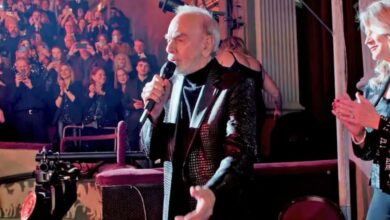
LeAnn Rimes and a Chorus Share the Long Lines of “The Rose”
LeAnn Rimes’s lead voice meets the sound of the Gay Men’s Chorus of Los Angeles in “The Rose.” The song’s extended phrases give the soloist and ensemble room to connect, creating a performance shaped by the relationship between one voice and many.
Part of what makes the performance so memorable is the song itself. “The Rose,” written by Amanda McBroom and made famous by Bette Midler, has always been one of those rare ballads that sounds simple until someone truly commits to it.
The setting adds another crucial layer. Putting that song beside the Gay Men’s Chorus of Los Angeles changes its emotional temperature immediately. A piece that can sometimes be delivered as a solo spotlight suddenly becomes a collective statement. The chorus does not merely support Rimes from behind.
Rimes herself sounds especially effective here because she avoids oversinging. That is one of the smartest things about the performance. She had more than enough vocal ability to push the song into grand diva territory, but she resists that temptation. Instead, she lets the feeling accumulate naturally.
The performance also resonated because of what it symbolized. Over time, many viewers came to see it not simply as a strong vocal collaboration, but as a deeply felt expression of solidarity, grief, dignity, and compassion. That interpretation is a huge part of its afterlife.
Watch the performance
Another reason it holds up so well is that it never feels trapped in one genre. Rimes comes from country, the chorus brings choral grandeur, the song itself lives comfortably in pop and adult contemporary tradition, and the entire presentation has something almost spiritual about it.
There is also something striking about the visual feel of the performance. Rimes is not presented like an untouchable star descending into a special event for a dramatic cameo.
By the time the song reaches its final stretch, the performance has moved far beyond novelty. At that point it no longer matters whether a viewer arrived because they loved LeAnn Rimes, because they loved “The Rose,” or because they were drawn in by the chorus.
Going back to the original Bette Midler recording is essential because it reminds listeners just how durable the song’s foundation really is. Midler’s version remains one of the great ballad performances of its era, and its emotional directness helped establish the song as a modern standard.
A later live Bette Midler performance offers another revealing comparison because it shows how the song grows when carried by experience. Midler’s live interpretations often bring a deeper, more weathered emotional texture, and that quality helps underline what makes “The Rose” such an enduring composition.
Westlife’s version provides yet another useful contrast because it shows how the same song can become more polished and pop-leaning without losing its melodic appeal. Their recording presents “The Rose” with smooth, accessible emotionality, emphasizing comfort and familiarity.
Even Conway Twitty’s country interpretation is worth thinking about because it reveals how adaptable the song is across very different vocal traditions.
What finally makes this version endure is that it feels generous. Some performances ask the audience to admire them. This one seems to invite the audience in. It leaves room for grief, comfort, memory, and even quiet hope.
LeAnn Rimes has had plenty of powerful vocal moments across her career, but this one occupies a special corner of her legacy because it shows what happens when skill, humility, and emotional purpose line up at exactly the right time.
The singers’ shared presence also gives the song a distinct visual identity. A solo voice remains easy to follow, while the chorus makes the musical support visible around it.
In the end, this performance lasts because it transforms a beloved standard into something that feels both timeless and newly urgent. It honors the song’s history without becoming trapped inside nostalgia.
More videos to explore
For a companion recording, Jawhitney123 presents “Bette Midler – The Rose [Live 1995 – Emotional Performance].” This video offers another musical setting to explore alongside the featured performance, with attention to its own arrangement and the performers’ delivery.
For a companion recording, The United States Air Force Band presents “”Hallelujah” – Performed by The United States Air Force Band’s Singing Sergeants.” This video offers another musical setting to explore alongside the featured performance, with attention to its own arrangement and the performers’ delivery.
Further reading: Performance background and source.