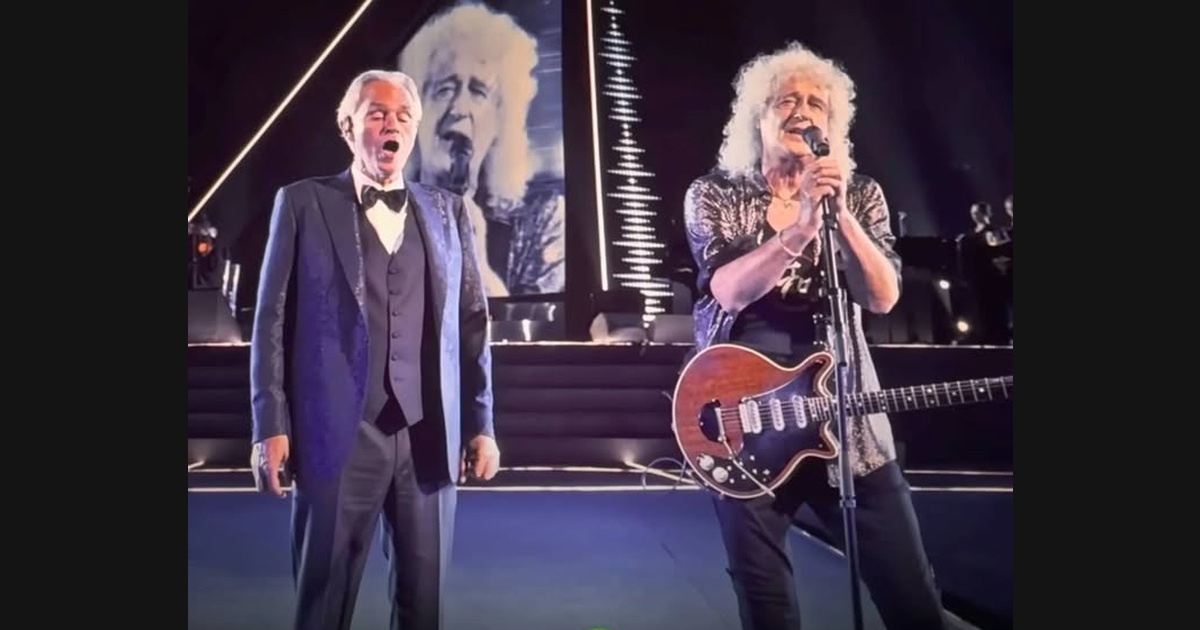
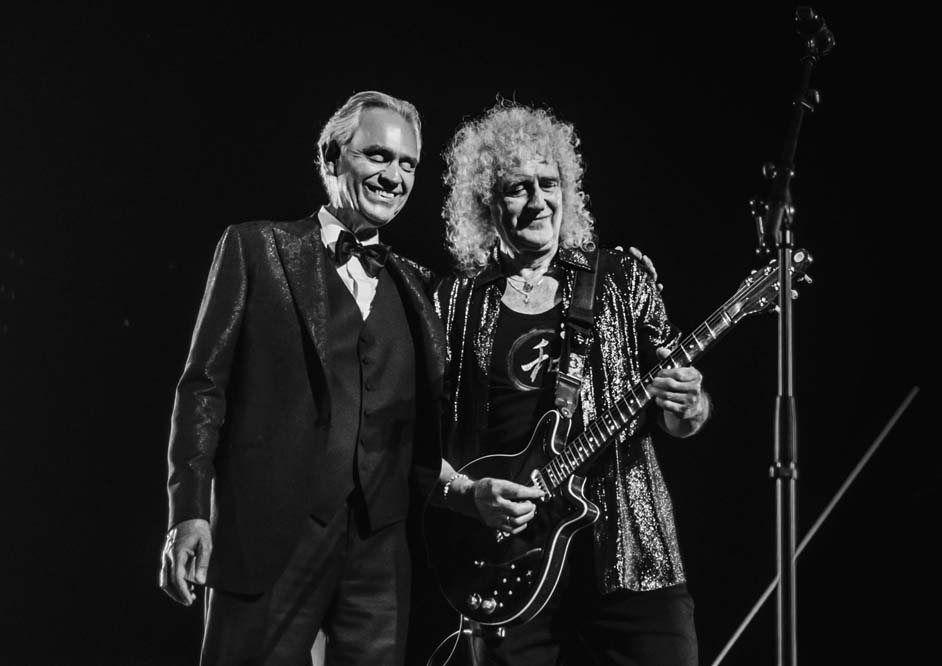
LAJATICO, Italy — On July 19, 2024, Andrea Bocelli and Brian May brought Queen’s “Who Wants to Live Forever” to Teatro del Silenzio, pairing the Italian tenor with the guitarist who wrote the song. Performed during Andrea Bocelli 30: The Celebration, the duet placed a ballad about love and mortality inside an evening celebrating a living artist’s career. May’s presence gave the occasion a direct connection to the composition’s origins.
The setting was Bocelli’s hometown in Tuscany, where his thirtieth anniversary was marked by concerts on July 15, 17 and 19. The programme brought together performers from classical music, pop and rock, including Ed Sheeran, Shania Twain, Plácido Domingo and José Carreras. Fathom’s original announcement established the three dates and the plan to turn the celebrations into a concert film.
The footage subsequently reached audiences on a different timetable. Bocelli’s official YouTube channel published the standalone performance on August 29, 2025; the corresponding live single carries the same release date on Apple Music. The concert and its later online release are separate events: the video documents a 2024 performance, even though many listeners first encountered it the following year.
July 19 also happened to be May’s seventy-seventh birthday. Contemporary reporting from Il Tirreno places his appearance on the final evening, while May’s own account records Bocelli and the Tuscan audience singing birthday wishes. He described it as a birthday he would never forget, adding a personal dimension to the formal anniversary programme.
The choice of song had musical logic as well as emotional appeal. May wrote “Who Wants to Live Forever” for the 1986 film Highlander, and Queen’s original recording already joined rock musicians with the National Philharmonic Orchestra. Michael Kamen’s official catalogue identifies Kamen as co-arranger with May and as conductor. An orchestral setting was therefore part of the song’s identity long before Bocelli sang it.
In the filmed duet, May’s restrained opening gives way to Bocelli’s fuller tenor sound. Their contrasting voices establish the movement from intimate reflection towards a broader declaration, while May’s guitar supplies another expressive line. The interest comes from that exchange: a composer returning to his own material alongside a singer whose phrasing changes its scale. The official performance from Teatro del Silenzio follows below.
A homecoming built for the concert stage and the cinema
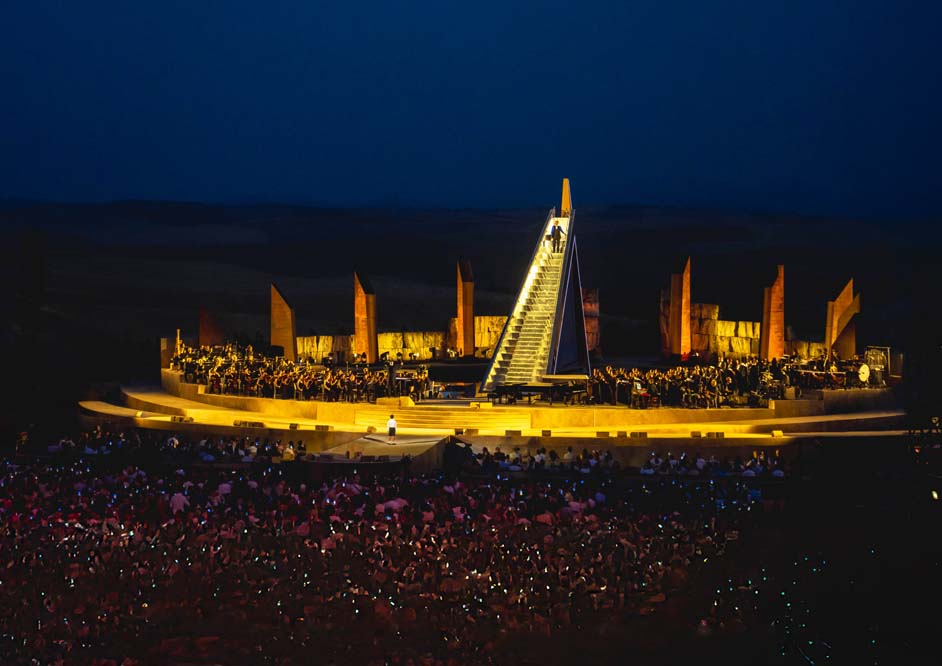
Teatro del Silenzio matters to this story as more than an attractive backdrop. The open-air venue is in the countryside around Lajatico, the town Bocelli calls home. The anniversary concerts brought an international guest list into that local setting, turning the celebration into both a career retrospective and a homecoming. The venue’s 2024 archive preserves the scale of the staging and the variety of artists who appeared.
According to the film’s November 2024 release announcement, more than 30,000 guests attended across the three-day event. That is a total for the celebrations, rather than an attendance figure for the May duet alone. The distinction helps convey the size of the project without inflating the audience for one individual performance.
The resulting film, Andrea Bocelli 30: The Celebration, was directed by Sam Wrench and opened in US cinemas on November 8, 2024, with international distribution through Fathom. Wrench had also directed Taylor Swift: The Eras Tour. The film gave the July concerts a second life before the Bocelli–May song appeared as a standalone official video in August 2025. Those successive releases explain how one evening could keep finding new audiences over more than a year.
Why a Queen ballad belongs in an orchestral programme
“Who Wants to Live Forever” appeared on Queen’s A Kind of Magic, released in the UK on June 2, 1986. As Queen’s published history of the album explains, the record developed alongside the band’s work for Highlander. Several songs grew out of that film project, but the finished release was presented as a Queen album rather than a conventional soundtrack collection.
Its cinematic background gives the ballad a particular dramatic problem. Highlander places an immortal character in a world where the people he loves remain mortal. In a retrospective interview with director Russell Mulcahy, he described showing Queen a twenty-minute reel and praised the way the band’s songs and Kamen’s orchestration expressed the film. The ballad’s subject is consequently broader than an abstract desire to live indefinitely: it asks what permanence means when love cannot be made permanent with it.
The original orchestral contribution is essential to understanding the Bocelli collaboration. Kamen’s catalogue credits Queen and the National Philharmonic Orchestra together, with the arrangement developed alongside May. The sustained accompaniment and expanding melodic phrases already provide space for a classically trained voice. Bocelli’s involvement brings that possibility to the foreground; it does not require the song to acquire an entirely new musical foundation.
The UK single followed on September 15, 1986, a date recorded in May’s official historical archive. It reached No. 24 on the Official Singles Chart. That chart placing supplies useful perspective on its history: the song’s long afterlife in concerts and reinterpretations extends well beyond the scale of its original singles-chart peak.
What Bocelli and May bring to the same melody
May’s role combines authorship, singing and guitar. His opening places a familiar voice inside a performance billed around Bocelli, making the collaboration feel like a conversation from its first section. Bocelli’s entry broadens the vocal texture, while the two retain noticeably different tones. Their partnership is most persuasive when those differences remain audible rather than being absorbed into a single blended sound.
The staging makes that relationship visible. The singers stand together on the forward section of the stage, with the larger ensemble behind them. Close views of their individual contributions alternate with wider shots of the venue. Within that substantial production, the contrast between the two performers remains easy to follow, giving the filmed version a clear human centre.
The live audio release credits L’Orchestra Filarmonica Italiana and Nuovo Coro Lirico Sinfonico Romano, with Steven Mercurio and David Carreras listed among the conducting credits. Those names appear in the Universal Music Group recording metadata. They are worth including because the voices and guitar sit within an ensemble performance: the sustained orchestral and choral sound is an active part of the arrangement, rather than incidental accompaniment.
A 2024 concert with a documented 2025 afterlife
The standalone release gave the duet an identity outside the full anniversary film. Apple Music lists it as a live single by Andrea Bocelli and Brian May, issued on August 29, 2025, through Decca Records, Decca Records US and Mercury Studios. The title explicitly identifies the recording as Teatro del Silenzio 2024, preserving the performance year even as the release itself belongs to 2025.
There is also a measurable record of the video’s later attention. Official Charts records a No. 26 peak on its Official Video Streaming Chart, with a first chart date of September 11, 2025, and one week on that chart. This is a video-streaming result, distinct from Queen’s No. 24 position on the singles chart in 1986. Treating them separately gives a more accurate account of the two recordings’ reception.
The partnership continued beyond the Tuscan anniversary. Queen’s official report dated October 18, 2026 confirms that May and Bocelli performed “Who Wants to Live Forever” at the opening concert of Starmus VIII in Santa Cruz de Tenerife on October 17. That later appearance is a separate concert, but it shows that the song remained part of their shared repertoire. The main video in this article is the earlier Teatro del Silenzio performance.
Seen in that chronology, the Lajatico duet connects several strands of musical history: May’s writing for cinema, Queen’s use of orchestral forces, Bocelli’s anniversary at home and the subsequent circulation of the concert film. Its emotional effect can be personal to each listener. Its documented context is equally compelling: two established musicians meeting inside a song whose original design already left room for both of their musical worlds.
Two related performances to hear next
Queen — “Who Wants to Live Forever,” official video. The original Queen recording provides the closest point of comparison with the Tuscan duet. Hearing it alongside Bocelli and May makes it easier to distinguish the composition’s enduring features from the vocal character of a later interpretation. It also returns the listener to the song’s original place within Queen’s 1986 work.
Josh Groban and Andrea Bocelli — “We Will Meet Once Again,” official live recording. This offers a different context for Bocelli’s collaborative singing. It is a companion performance rather than footage from the May duet or the same concert. The pairing provides another way to consider how Bocelli shares a melody with a partner while retaining the clear identity of his own voice.