How the Jaguars Moved Angus Young’s ‘Thunderstruck’ Riff From Strings to Bars
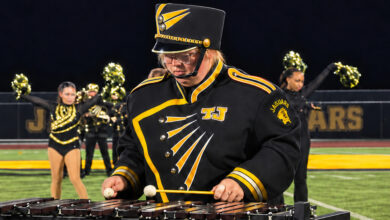
Angus Young’s opening to “Thunderstruck” is so closely associated with the electric guitar that the first few notes from a school marimba can feel like a trick. The melody is in the right place. The sound has changed completely. In the Thomas Jefferson High School performance, Layla Clark and the front ensemble carry the part with mallets, turning an AC/DC introduction into the cue for a football field full of players.
A listener praised whoever put the guitar line in the hands of the mallet section. That is a response to an arrangement decision as much as to a player’s speed. The students had to keep the musical information that tells an audience what song they are hearing. They also had the chance to make the notes behave in a way that suits the band’s own instruments and the space it plays in.
The original leads off AC/DC’s 1990 album The Razors Edge. Its pattern depends on recurring notes that keep the line anchored while other pitches move away and return. Listeners can follow that movement at high speed because the repetition provides a reference point. Moving the figure to bars changes what happens at the beginning and end of a note. The relationships among the notes remain clear enough for an audience to identify the tune.
Where the guitar gives the recording a pointed edge, the struck bars put a small, clear attack in front of a more resonant tone. It is easier to hear each note begin, which is helpful for a section playing the figure in the open. You can follow an individual strike in the image and still hear the notes fit into a continuous rhythm. The pleasure is partly in hearing a sound you recognize by shape before you recognize its new source.
Clark’s mallets move between physical targets. A pitch that seems almost effortless when a guitarist reaches for it requires a different kind of movement when it sits on another bar. That change does not make one instrument universally harder. It changes what the player has to coordinate. In this version, the audience can see the distances Clark crosses and hear how little effect they have on the timing.
The feature is shared. Clark said in an interview with the Pittsburgh Post-Gazette that five mallet players played the opening. The framing makes one of them look like the whole source, while the microphone hears a section. Try listening for the way the attacks have the weight of one line. A good section sound lets the figure read clearly even when more than one person is responsible for it.
A clear opening buys the rest of the band room
Every adaptation has to decide how to balance recognition and a new idea. Leave the figure exactly where listeners expect to hear it and there is less surprise. Change too much of its rhythm and it may stop working as an introduction people immediately know. Here, the new sound is obvious and the repeated pitches give listeners a way to keep their footing. That balance makes the transfer sound natural once the initial surprise wears off.
A field show needs to make that effect work over distance. There is no recording engineer controlling what a spectator hears in each part of the stands. At the beginning, the exposed figure is easy to pick out before the larger band takes its place around it. The switch changes the scale of the sound without making the piece start over. The section has already given the audience the part it needs to understand what comes next.
Watch for the moment when the mallets stop being the only obvious subject in the recording. The background becomes easier to hear, and you can sense how the rhythm pulls more players into the same piece. The entrance rewards listeners who have stayed with the exposed opening. It makes the choice to use percussion feel like part of a whole design, because the first sound has created a clear role for the second.
Two ways to hear the same opening
Put the AC/DC recording next to the school clip and try to follow only the returning pitch. After a few notes, the point of similarity is clear. Then listen again for the attack of each instrument. That is where the two versions begin to behave differently. The comparison explains why someone can recognize the tune at once and still want to replay what the Jaguars did with it.
The wider footage of the Jaguars is useful for a different comparison. From farther back you can appreciate how much space the rest of the ensemble occupies and how carefully its entrances have to fit. The close recording makes the problem of transferring a guitar part visible. A field view shows the group that has to carry the adaptation beyond its first successful idea.
The experiment has a familiar place in music education. Students often encounter songs first as a set of parts to translate, rather than as the exact sounds that were recorded. A distinctive guitar line can give a percussionist a problem to solve and give an audience an immediate way to tell whether the solution works. The Jaguars let the first few notes make that case for them.
The viewer’s compliment gets at both jobs. Giving a famous guitar figure to the mallets was an idea worth trying. Playing it clearly enough for everyone to recognize, then building a show around it, was the more substantial piece of work. In the clip, the two jobs arrive together so quickly that the arrangement can sound like it belonged on the bars from the start.