From Genesis to Mike + The Mechanics, Nic Collins Finds His Own Moment Behind the Kit
There are several ways to get an audience to look at a drummer. You can make the kit the loudest thing in the room, build a section around a recognizable fill, or give the other players time to step aside while the drummer takes the music somewhere. Nic Collins gets that third opportunity with Mike + The Mechanics in the footage from De Montfort Hall. The performance was recorded in Leicester on April 22, 2023, during the Refueled! tour. Once the solo is underway, the interest is in what he chooses to do with the space.
People with a long memory of Genesis have a particular reason to be curious about Collins. He had played the drums on Phil Collins’s solo tour and later behind Tony Banks and Mike Rutherford on Genesis’s farewell tour. That meant spending a lot of time with parts that audiences knew well enough to anticipate a change before it happened. A drummer can keep a familiar song recognizable by getting its timing right and understanding the role of the quieter notes between the big ones. Those are useful skills to carry into a solo, where the audience has to learn the shape of the next stretch as it happens.
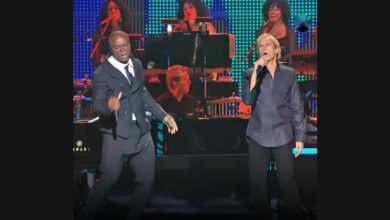
The picture of Nic in a blue shirt surrounded by cymbals gives you a sense of how much there is to follow. An arm can move across several instruments in the time it takes your ear to register the first sound of a phrase. Yet the clearest parts of the Leicester solo are often the ones where you can hear a new idea arrive. The attack of a hit changes. A figure gets a little wider as he moves around the kit. The force of the playing comes across most clearly when there is enough space to notice what has changed.
That quality makes the family resemblance interesting. Phil Collins had a way of making a drum phrase feel as if it belonged to the composition, with its own outline and a place the listener could wait for. Nic makes use of that same kind of clarity. A fast passage can leave you with one detail to remember because the individual accents still have a shape. You can hear an approach to playing the drums and still appreciate how much of a musician’s touch comes from his own physical choices.
Mike Rutherford connects the two parts of the story. Playing in Genesis gave Nic experience sustaining a particular repertoire beside him. Mike + The Mechanics asked him to bring that ability to another catalog, where a good groove makes room for some very direct vocal melodies. A player in that position has to make different kinds of choices in the middle of a song than he would make on his own. By the time the solo comes, you hear a drummer who has spent much of the night making room and is now able to decide how much to take.
Watch where he is looking at the start of a new figure. The attention moves to the part of the kit he is about to use, and the next sound turns the movement into a cue for the people watching. That makes this footage a useful way into the performance even for somebody who could never name the drums in front of him. You get to see one action set up another. After a few bars, the solo starts to feel less like a succession of individual hits and more like a phrase being played across instruments with different voices.
Watch the performance
The way a drummer builds a few minutes into a scene can tell you quite a lot about what he brings to a band. A steady phrase buys the audience time to hear a change when it comes. A strong accent describes how much that change matters. A move out to the cymbals can briefly give the music a wider sound. There is an exchange between keeping a pulse available to the listener and taking just enough liberty with it to make the next part feel like an event.
It is also worth thinking about where a touring musician learns to make those choices. Playing beside Phil gave Nic a chance to hear how a singer uses the space between hits. Genesis asked him to fit the movement of the drums around parts that players had lived with for decades. A Mike + The Mechanics show put him beside musicians who had their own way of getting from one song to the next. The kit remains visible at the back of the stage in all three settings, and what a drummer does from that position changes considerably according to who else is playing.
The Leicester performance keeps all of those roles in the background of a single short appearance. A listener drawn in by the Collins name can recognize a sense of timing and then spend more time with the person playing. There is enough going on in his motion, his emphases and the pace of the solo to make the moment enjoyable on its own. The familiarity becomes the thing that gets you through the door. The detail of his playing gives you a reason to stay there.
Two more versions
The official video for Better Strangers’ “But I Don’t Know Your Name” is a chance to hear Collins in music his own band shaped. Notice how much simpler the role of an accent can become when there is a vocal section to support. The drums help define the way the song turns, and the playing also makes more sense when you think about how much he had to create for himself in the Leicester solo.
Drumeo’s “The Grooves of Genesis” leaves room for him to take apart the patterns that people remember from his father’s work. Seeing where Nic puts the accents and hearing sections handled at the kit is a good way to appreciate one of the skills that travels through all three bands. Catch the pulse in one of those examples and then go back to the solo to see how long you can hold on to it.