A Percussionist Heard the Control in Layla Clark’s “Thunderstruck.” Watch the Space Between the Notes.
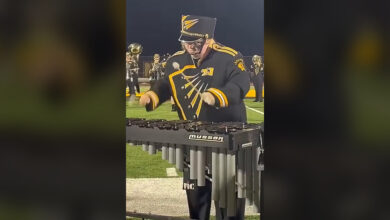
“As an old percussionist, I can tell you that what she did is hard as hell,” @misterbum1 wrote under Layla Clark’s “Thunderstruck” video. The remark had about 12,000 likes when recorded on November 8. The writer went on to praise how steadily she kept the pattern going, which gives the clip a specific detail to look for on a second viewing.
Watch what happens just after a strike. A mallet has to leave the bar in time for the hand to move again. The next note may be in a different spot, so there is a small trip to make before the next contact. At the tempo of the opening figure, those trips come fast enough to look like a single stream of movement.
The sound makes the timing audible. When a pitched bar is struck, the note has a defined beginning. In a repeating figure, any uneven space between those beginnings can change how the pulse feels. The camera gives you a way to connect what you hear with the little movements that set each note up.
Control starts with the height of each stroke. Lift too far and the mallet has a longer trip back to the instrument. A compact stroke keeps the mallet close to the bars when the next note arrives quickly. The close-up lets you watch Clark make those small adjustments while keeping the notes part of one repeating figure.
Another way to follow the movement is to watch where the hand goes immediately after the sound. When a note rings, the hand is already setting up the next attack. That short interval is easy to miss at normal speed, but it is where much of the work of keeping the riff steady happens.
There is also a reason to listen beyond the individual strikes. The opening leaves the mallet players exposed, and they have to agree on a tempo that will still feel natural when the band joins. The percussionist who commented was praising how long Clark sustained the pattern. The difficulty accumulates with every repetition.
The motion between strikes
The River Plate recording makes the contrast easy to see. Angus Young works along a string, with the repeated figure coming from a series of small finger movements. Clark has to cover the spaces between separate bars. Both performances invite the audience to hear a familiar pattern long enough to expect the next note.
Compare Angus Young’s guitar technique at River Plate
In the wider Mars halftime video, the focus shifts from the individual strokes to the way the band comes in around them. The clip from next to Clark’s instrument tells you how the sound is made. A wide angle makes it easier to hear what that sound is doing for the arrangement.
Hear the mallet figure in the full Mars field show
Try alternating between sound and movement on a replay. First follow the spacing of the attacks with your ears. Then watch the mallets during the gaps. It is the connection between those two details, repeated at speed, that gives the percussionist’s reaction its point.