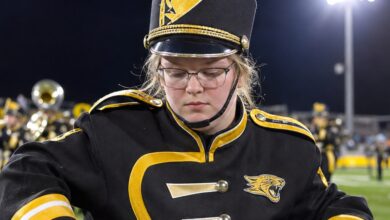
“That Was a Cardio Workout”: Watching Layla Clark Keep “Thunderstruck” Moving
The listener’s verdict was short: “That was a cardio workout! Mad respect!” Watching Layla Clark play “Thunderstruck,” it is easy to understand why the movement caught their attention alongside the music.
AC/DC’s opening repeats across the bars in front of the Thomas Jefferson student. The line remains familiar while the mallets make the physical route between notes visible. The recording gives the audience time to follow that route again and again.
The comment is enthusiastic language about the performance, rather than an assessment of exercise. Its useful observation is the sustained activity: the opening keeps returning, and Clark keeps preparing another precise landing while the Jaguars wait to broaden the sound.
The next strike is always arriving
A fast passage can look like a blur from the stands. Here the camera is close enough to show the relationship between a note sounding and a hand already moving toward the next one. The repetition makes those movements easier to notice on a replay.
The same listener described the riff as easier to play on guitar. That is their comparison, not a universal scale of instrumental difficulty. Guitar and mallet percussion present different physical tasks. The interesting feature of the school version is how openly the movement between pitches becomes part of the experience.
There are two kinds of continuity to follow. The arms and hands keep moving, while the sound must still form a phrase the listener recognizes. Simply reproducing a series of notes would not provide the same sense of direction if the shared pulse disappeared.
The band’s contribution matters for that reason. The opening belongs to an arrangement with a larger entrance ahead. Clark is the visible focus, but the ensemble gives the repeated line a musical destination and changes what the audience hears around it.
The live “Thunderstruck” by 2CELLOS offers a comparison in another instrumental language. The recognizable phrase survives, while strings and bows give the viewer a different set of movements to follow. It is a chance to notice how a familiar song can reveal new work when its instrumentation changes.
Replaying the opening can make the demand look different without changing anything in the recording. When the tune is the main focus, the movements support something the listener already knows. When the hands become the focus, the tune supplies a reference for watching those movements remain connected.
That second view is what the workout reaction points toward. It is possible to enjoy the familiar song and, at the same time, notice more of the sustained physical activity involved in giving it this particular sound. The applause is for the result and the work made visible within it.
Give the wider band a turn in the frame
The Jaguars’ separate halftime recording at Trinity shows more of the school program. The band’s channel identifies the occasion as October 3, 2025. It is a companion show, included for its broader view of the group rather than as another angle of the phone recording.
The wider frame makes different details available: the ensemble’s place on the field, the performers around the featured part and the way the music carries across the show. The short close-up remains better for watching the mallets themselves.
Putting those views together prevents the performance from becoming only a test of stamina. Its interest is musical as well as physical. The repeated figure creates anticipation, the student maintains its motion, and the ensemble supplies a fuller sound at the point the arrangement needs it.
Try a replay with a different focus each time. First hear the tune. Then follow the movement from one strike into the next. Finally listen past the front instrument for the band’s entrance. Each approach adds something to the listener’s compact expression of respect.
The “workout” description has its force because the effort is visible for more than a fleeting moment. The phrase comes round again, and the musician meets it again. What stays with the viewer is the combination of that continuing control and a rock opening they can recognize immediately.