The School Marimba That Made an AC/DC Intro Sound New
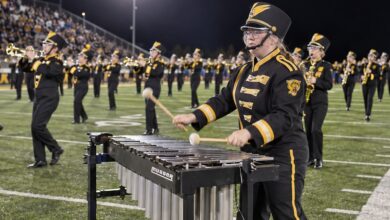
The opening of “Thunderstruck” has a way of identifying itself before you have time to think about the band that made it famous. At a Thomas Jefferson High School game in Pennsylvania, the tune gives itself away just as quickly. The object producing the sound takes a little longer to register. There are no strings in the close-up. Layla Clark is standing over a marimba in the Jaguars’ black and gold, and the riff is coming from the two mallets in her hands.
The surprise prompted one viewer to say they had never imagined hearing AC/DC on a xylophone. The word gets across the visual idea of bars and mallets. Clark is playing a marimba, whose ringing tone is one reason the switch feels so pronounced. The initial impact is clean, and there is a bit of sound left after it. Turn the picture off for a moment and the resemblance to the guitar part is still there, even though the color of the sound is completely different.
The game footage comes from the Jaguars’ 2025 season. A close camera makes that fact feel almost incidental at first. It keeps the keyboard, Clark’s hands and a piece of the uniform in view, while the larger field waits at the edges. A person in the stands gets a wider sense of the show from the outset. The phone clip gives viewers a more gradual discovery, from a familiar tune to an unexpected instrument to a school band coming together around it.
AC/DC made the song the opener of The Razors Edge in 1990. Much of its identity is present in the first figure. There is a pitch the ear keeps finding again and a sequence of other pitches moving around it. That relationship still comes through when each note is made by striking a bar. The familiar outline gives the school band some freedom with the sound. A new instrumental color can call attention to the shape that has been there all along.
Marimba bars are laid out in a pattern similar to a piano keyboard. On the field, that orderly surface can make a demanding line look deceptively simple. Each note is a physical place Clark has to reach on time. Watch how often the two mallets return to nearby targets as the sequence loops. A great deal of the recognizability comes from keeping the distance between strikes even enough for the listener to hear a coherent phrase.
There is also an arrangement decision that becomes audible before you can see its full result. The other parts have room to enter because the opening is exposed. You can spend the first few moments listening to a single musical idea. By the time the rest of the band responds, the figure has given the crowd something to recognize and a pulse to hold on to.
A riff strong enough to leave its original instrument
Compare the beginning with the one in AC/DC’s recording. In the original, the repeating pitch has the bite and edge of an electric guitar. On marimba, the articulation is lighter and easier to separate into individual attacks. What survives across the change is the movement of the notes and the expectation each repeat creates. The school arrangement gets much of its force by letting listeners hear those similarities and differences for themselves.
Even a highly recognizable part can get lost if the rest of the arrangement gives it no room. A recording studio lets a producer adjust the balance after the musicians have played. A field show has to make the balance work in the open, with instruments coming from different places and listeners spread along the stands. Giving the mallets the first stretch of the piece lets a relatively small sound establish itself before the band begins playing at full scale.
Clark told the Pittsburgh Post-Gazette that five mallet players had the opening. The video makes her work easy to see, while the people elsewhere in the section make up part of the sound arriving at the phone. Listen to a repeat with that in mind. Something that looks like a solo in a portrait frame can function as a group feature. The collective part is what sets up the entrance beyond the edge of the frame.
The scale changes when the band arrives
There is a useful contrast between the close-up and a wider field recording. Up close, a viewer can follow the path of a mallet from one pitch to the next. At a distance, it is easier to appreciate how the rest of the group holds its place in the show. The two views emphasize different kinds of timing. One keeps the rhythm steady from note to note. The other determines when an entire field of sound should change.
The choice also makes sense for listeners who are hearing the band in passing. A recognizable opening can turn heads before a spectator has figured out who is playing. What keeps those heads turned is the physical evidence of the new arrangement. The clip lets you see a riff make that trip from the record to the field one strike at a time.
That gives the song a second source of excitement. A listener can recognize AC/DC immediately and still have something new to notice when the band comes in. On a replay, try listening for how long the small sound holds your attention before the larger one changes it. Clark and the Jaguars use a famous opening to invite the audience in, then let a school halftime show give the riff a place it never had on the record.