A School Band Put AC/DC in Its Halftime Show and Made Alumni Wish They’d Played It
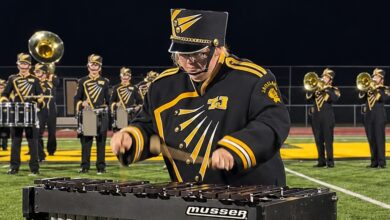
Hearing Layla Clark start “Thunderstruck” put at least one viewer back in their school-band years. The wish that followed was easy to understand. Imagine walking out for halftime and getting to play AC/DC. The Thomas Jefferson High School Jaguars did just that in their 2025 season, and they gave Angus Young’s opening figure to a section of the ensemble that audiences might have expected to hear later.
Rock works as halftime material partly because a good riff gets to the point before the crowd knows what the formation is doing. A football audience is spread out, and plenty of people are still following the game or talking. The figure in “Thunderstruck” can break through that scattered attention. Once spectators have recognized the song, the band can use a change of color to make them listen for what it does next.
The surprise is that Clark is striking a row of wooden bars. The pitched percussion gives the opening a clear outline, with a quick attack at the start of each note. A person who grew up with the original can identify it almost by reflex. A student watching from the stands might recognize the pattern without knowing its entire history. Both are ready for the same band entrance by the time it arrives.
A program that borrows rock songs still has to work as a school show. The arrangement has to give enough of the ensemble a part worth learning. It needs a sense of order on the field and a pace the students can carry all the way through. A strong riff solves only the first few seconds. What the band does with that head start makes the difference between a familiar tune passing by and a show worth remembering.
The close-up of Clark has reached much farther than the full set. That may be why the viewer’s comment singles out the thrill of the song choice. They can see one member of a real band take on something they recognize, and imagine how it would have felt to be given that part. The image brings the idea of a school rock program down to a decision about who is standing at the front and what sound starts the piece.
There is a good reason to keep listening when the opening is over. The rest of the band changes the scale of the arrangement. A part that sounded self-contained begins to feel like the leading edge of a much larger performance. You can hear that transition even in the phone footage, and it helps explain why an old band student might remember the group they played in as quickly as they remember the record.
How rock repertory changes the way a crowd listens
The Pittsburgh Post-Gazette reported that “Thunderstruck” was part of a wider slate of rock music for the Jaguars. That matters because it makes the clip one example of a continuing musical choice. The musicians had a program to learn, with different pieces demanding different textures and pacing. A viewer who comes for AC/DC can watch more of the show and pay attention to what happens as those demands move around the ensemble.
Every familiar song gives a band an opportunity to shift the center of attention. The sound people know from a singer may become a line for brass. A guitar part can end up on a keyboard with bars, as it did here. The work is in deciding which musical details carry recognition and which ones can change. In “Thunderstruck,” the recurring figure is enough to tie the field arrangement to the original while leaving plenty of space for the Jaguars.
That choice has something for the students, too. Performing a popular tune gives a young musician the chance to make a part an audience has already heard countless times sound convincing in a new setting. It can be demanding precisely because people know what it should feel like. The payoff comes when the group makes the audience forget about the work of arranging it and starts to feel like the natural way to hear the song at a game.
Watch the formation as well as the mallets
The wider field recording gives the close-up a context the viral clip cannot fit. The musicians are occupying different parts of the field, and the sound has to hold together while the show keeps moving. From that distance, you get less of Clark’s hands and more of the program those hands are part of. The two views make a useful pair for anyone wondering what it was like to see the show from the stands.
School-band memories often come back through a sound or a particular entrance. A song shared with a whole stadium gives those memories another route in. The viewer who wished their band had done something like this could probably picture the experience with little help from the caption. The arrangement starts clearly enough to supply the missing scene in their head.
It is easy to picture what hearing the song might have meant to someone whose own school played a very different kind of halftime music. The record was already part of their life. In the clip it becomes part of somebody else’s band memory, with a new instrument and a different crowd. That is a small but durable reason the song keeps getting another audience.
For the next watch, stay with the song beyond the instant you recognize it. Listen for the response to the mallets and look for who is making the show move. There are two pleasures in the footage. One is the sudden thrill of AC/DC in a setting you might have associated with other music. The other is seeing how many students it takes to make that song feel at home on their own field.