The Student Behind Layla Clark Changes Where You Look in the Viral Clip
The opening of “Thunderstruck” gives viewers a reason to look directly at Layla Clark’s hands. A comment under the clip suggests spending a replay somewhere else. Watch the student behind her, the viewer said. They read her expression as pride in a bandmate. The recording leaves the student’s feelings to interpretation, but the shift of attention is worth trying. It makes you notice how many people are sharing the moment that has been widely remembered through one player.
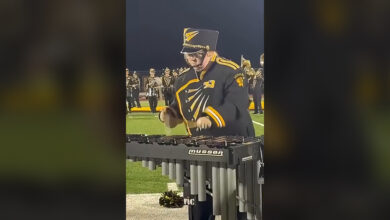
Clark is standing at the marimba in the Jaguars’ black and gold. The camera makes it easy to see where her mallets are headed and how fast they return to the bars. The other students are farther away and have less of the frame. That is a normal limit of the perspective, but it changes the story a short recording can tell. The person whose actions are clearest becomes the person a viewer is most likely to remember.
Background movement is easy to miss when the sound is already doing so much. The riff brings AC/DC to mind, and the bars explain why its attack sounds different. Then the whole arrangement starts to grow. Look behind the instrument and the football field returns as a setting. There are bandmates to watch, space between the players and a performance continuing outside the camera’s narrow center.
A viewer can read a look as encouragement without having to turn it into a claim about what the student said or felt. The appeal of the observation is what it does to the next watch. You start looking at another person’s part of the image and seeing a group where your memory of the clip may have supplied only the marimba. That simple act gives the surrounding students a little more of the attention the first watch put on Clark.
The audio makes the same change possible. Clark has described the opening as the work of five mallet players. What comes through the phone as an organized stream of notes belongs to a section. Later, the other Jaguars make it easier to hear that more of the band is involved. There is often a point in a replay when the frame still looks centered on one person but the sound has already shown you how much larger the event is.
The video was made during the Thomas Jefferson High School band’s 2025 season in Pennsylvania. For the musicians the piece was part of a prepared field show. For a viewer encountering only the clip, the piece can feel as though it exists for the brief stretch the phone captured. Paying attention to a bandmate in the background is one way to recover something of the original occasion without needing the camera to move.
What the second watch makes visible
Follow one part of the background for a few seconds. You might notice people preparing to come in, or simply remaining in place while the front ensemble establishes the figure. That quiet is part of the shape of the music. The audience needs to hear the opening as an idea of its own before other sections answer it. Students who are barely visible in a tight crop can still make an important choice about how that timing works.
The details also make the clip different from a video shot for a solo performance. Clark is close enough to the camera to look like a featured artist on her own, yet the uniform and the people behind her keep identifying the group she belongs to. The field keeps the musicians in relation to each other. It gives the viewer plenty of evidence that the clear mallet line is the start of a larger event.
Clark credited her bandmates when she talked about the response. That account fits both parts of the recording. The first is the visible work of returning to the right bars at speed. The second is the ensemble sound that places her work inside the show. The camera makes one piece easier to study, and her explanation gives viewers a reason to spend some time on the other.
A wider recording puts the focus back on the band
In the Ringgold field-show video, students who looked like fragments of the picture are once again part of a formation. It is a different view of the program, useful for seeing how a strong opening and a response can work across the space. The close-up is better for following a player’s hands. The wider angle gives the viewer a chance to consider what the rest of the band had to keep track of at the same time.
The two recordings make a good pair precisely because the strong part of each is different. A person who comes to the short clip to watch technical skill can see the practice in Clark’s steady movement. A person looking for the atmosphere of school band can watch beyond her and start to see what it is like for students to share a performance even when their responsibilities are different.
The same approach works with the interview. Once Clark describes the shared opening, the camera stops being the only authority about what happened. Her account adds people the viewer might never have picked out. On a replay, even the people who stay out of the central shot are easier to imagine as participants with their own timing and parts.
The next replay can be as simple as looking a few feet behind the marimba. The comment called that look pride. Whatever the moment meant to the student herself, the suggestion gives an audience a more generous way to see the video. Clark’s riff remains the first thing you hear. There is room in the same recording to find more of the band that gave it an answer.