The Young Musicians a Football Crowd Hears Before the Rest of Us
A reaction to Layla Clark’s “Thunderstruck” wondered how many students play something this good every week without anyone outside their school ever hearing it. The clip invites that question because its starting point is so ordinary. A band was performing a halftime show for the people who came to a football game. One family recorded part of it. Much later, a far larger audience could hear something that had first belonged to the local stands.
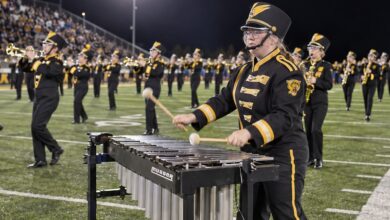
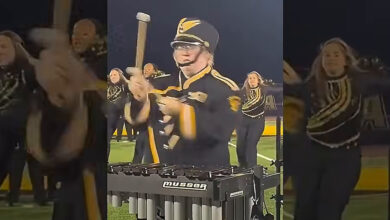
Clark is at the center of the frame because the opening part is where the recording begins. The melody comes from AC/DC, but the way it is played is specific to the Thomas Jefferson High School Jaguars. In black and gold, Clark moves along a row of marimba bars and keeps an exposed part moving while the arrangement waits for its full entrance. The picture makes one task visible. The group around it has several more tasks under way.
Music at a school game has an audience assembled for a different reason. Some spectators spend halftime talking or heading for the concourse. Others know the band’s material and have come to listen. A song that begins with a figure as recognizable as “Thunderstruck” can give both kinds of spectators something to notice. It only takes a few clear notes to get people’s ears back on the field.
The performance was filmed during the Jaguars’ 2025 season. A recording taken by Clark’s mother found an audience that could watch it without having ever visited the school. The camera did something useful for people far away. It gave them a specific person and movement to follow while the song was becoming recognizable. At the same time, the players behind the center of the shot had to make their sound work in the field’s much wider space.
In her account of the performance, Clark credited the musicians around her. Five mallet players were involved in the opening. A close recording may lead the eye to a single pair of hands, but it is the group playing the part that gives the riff its clarity. Then other instruments expand the sound. One of the simplest ways to understand the difference between the clip and the show is to watch how quickly more players become audible than visible.
The remark about overlooked musicians is about more than the reach of one video. It suggests a new way to listen at a school event. Even an ordinary football game can include a piece of work prepared over weeks, with the students thinking about timing, tuning, movement and whether a particular entrance will come off. None of that requires a camera in order to matter to the people doing it.
What the phone let people find
A video can travel faster than the name of the school, the town or the group that made it. That makes the beginning especially important. Viewers hear a familiar guitar figure and see it played on bars. In a few seconds they have enough to identify the music and enough surprise to keep watching. What the family recording carried out of the stadium was an intelligible piece of a much larger show.
The geography changes when the clip is shared. A group that has mostly played in front of neighbors and visiting schools can be heard by people who grew up with AC/DC in another country. Other viewers are musicians and can point to what looks difficult. Some are former band students and remember the pace of a halftime performance. The comments show people coming to the same footage through different parts of their own lives.
Success outside the school can also narrow the story. The player whose face is visible is easy to identify, while the people who help carry the opening may stay beyond the frame. Clark’s remarks about the section give people a way to look again. When the pulse stays clear as the band enters, that is a result you can hear from the people the camera did not have space to show.
A wider frame changes the story
The separate Ringgold recording puts the Jaguars in view at the scale of the field. The angle is useful for noticing how parts are distributed and how the musicians keep the show moving. You give up some of the view of Clark’s hands. In exchange, you can see how an audience in the stands might have taken in the sound and the formation at once.
It is possible to appreciate both things that made the performance travel. Clark’s command of the figure gave the family video a strong focus. The rest of the Jaguars turned that tight figure into a full sound. Viewers who reach the wider recording through the short clip have a chance to meet more of the people who were already doing the work when the audience was local.
A successful school show is often easy to miss because it is part of the rhythm of the season. The musicians might be learning another entrance by the time outsiders first hear about the last one. A wider watch gives the group a little of the attention that tends to fall to the few seconds the internet knows best.
The best answer to the question about unseen school talent may be to keep watching after you recognize the song. Try following the part that enters after the mallets instead of replaying only the famous opening. It makes the clip less like an isolated feat and more like an entrance into a program. Clark was the player millions could see. Behind her, the field was already full of students with something to play.