Why Band Kids Claimed Layla Clark’s ‘Thunderstruck’ Moment
A comment on Layla Clark’s “Thunderstruck” made the rounds because it said something a former marching-band student might already be thinking. Somewhere, band nerds were watching and deciding their time had come. The feeling has a point in the music. The opening gives the mallet players an idea everyone in the stands can recognize, then lets them hold it long enough for the rest of the field to take its cue from them.
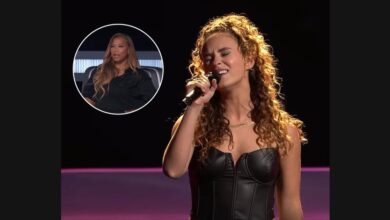
Marching-band footage often gives an audience a sense of scale before individual parts are easy to pick out. This clip does the opposite. The portrait view puts one front-ensemble player and a set of marimba bars within reach of the eye. You can follow the places where her hands land and hear the pattern repeating. The larger scale arrives when the other Jaguars begin to be heard and there is more to follow than the one musician in the middle.
For anyone who played in a school band, the familiar detail might be outside the center of the frame. It could be someone waiting through a passage for their first entrance, or a musician holding a position while another group carries the tune. School players learn to have something to do even while they are quiet. The part has to make sense in relation to the timing of everyone else.
The Jaguars were playing a song that had already made its opening famous. What changed was who got the first word. In an AC/DC recording, the guitar’s attack is part of the attraction. For the school show, the mallet sound puts that figure somewhere different and asks the audience to take pitched percussion seriously as the first thing they hear. The placement makes the visual focus feel earned, because the music has put the section there already.
Clark has described the opening as a shared mallet part. Viewers who hear it as a solo may be responding to the tight frame as much as the arrangement. When five percussionists play a figure together, the result can be a remarkably unified sound. It takes agreement on the timing and force of the notes, particularly with an instrument that makes the start of each strike so easy to hear.
The joke also has a foot in two audiences. People who know the AC/DC original have something to recognize. People who remember school band know how much repetitive preparation can be hidden in a convincing entrance. You can belong to either group and understand why the recording feels satisfying. For listeners in both, the combination may be enough to send the clip to someone else before the performance has finished.
A familiar job becomes the featured part
In a complete halftime show, different groups can supply the melody, pulse, weight or movement that holds the scene together. The player at the front might spend one part making a texture more interesting, another reinforcing an entrance, and another waiting. The clip brings a moment when a recognizable opening makes the front ensemble’s job plain to people watching a band of this size for the first time.
Students also have to trust the arrangement enough to let the music take its time. A member of the group may spend a long stretch quiet on the field, but that space has a purpose. With the riff exposed, every return to the central pitch becomes easier to hear. When the larger group enters, there is a firm line for it to build around. The band gets a bigger effect because the first players were given enough room to establish the pulse.
A phone clip makes one face the easiest to recognize. Clark has given her bandmates credit for the performance, and the sound explains why. In the first section, the other mallet players contribute to what a close-up makes look solitary. Later, more of the ensemble becomes audible. The reaction belongs to a group of players even though a single student makes the recording easy to remember.
An invitation to watch the rest of the show
Watch the wider recording after the close one. It puts the players on an actual field again, with the distance and arrangement a spectator would see. The view can make you notice parts that never entered the frame during the riff. You might find yourself following a row of musicians for a few seconds and realizing that their work was part of what made the big entrance convincing.
The difference between the recordings is a little like the difference between knowing one player’s part and hearing the whole band. There is a pleasure in knowing exactly what two mallets are doing. There is another in feeling the work arrive together from multiple places. The students who learned the show got to know both sides of that feeling long before the footage brought it to an audience outside the school.
That thought also reaches people who were never the player a camera singled out. They might recognize what it takes to give a featured section room, or the pleasure of hearing a difficult entrance land from somewhere behind them. The video lets those quieter pieces of the work find an audience through a joke about being seen.
The comment works as a small celebration of that experience. People who spent a school season doing the careful jobs inside an ensemble got to see those jobs receive attention in a clip that could travel. The opening is short enough to replay and open enough for a new listener to understand. Give the rest of the performance a little time, and the band kids behind it become easier to hear.