They Thought They Had Made a Mistake: The Rehearsal Behind Layla Clark’s Viral Intro
There is a rehearsal story behind the quiet around Layla Clark’s ‘Thunderstruck’ opening. The close-up follows her hands, but five Thomas Jefferson High School mallet percussionists played the introduction. At a run-through, they began the part and heard no one else join. Believing they had made a mistake, they stopped.
Clark explained what happened in her Pittsburgh Post-Gazette interview. Director James Mirabella had not warned the percussionists that the introduction would be theirs to carry alone. When the players fell silent, his response was direct: ‘No, no, no. Keep going.’ The silence around them belonged to the arrangement.
Realizing that changed how the opening felt. Clark recalled looking toward the other players as the nerves arrived. Their section had to sustain Angus Young’s figure until the full band’s entrance. The space that seemed to signal an error was actually room for their instruments to lead.
The arrangement featured in the Jaguars’ 2025 halftime program, Mirabella’s final season before retirement. Clark recalled AC/DC’s ‘Back in Black’ and Metallica’s ‘Enter Sandman’ elsewhere in the show. For ‘Thunderstruck,’ the mallet section had to give an electric-guitar opening enough presence to begin a performance on a football field.
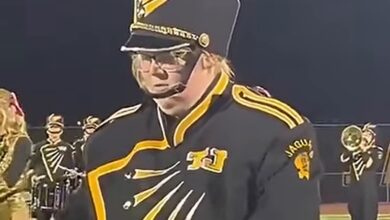
The camera position can hide how collective that task was. Clark’s marimba and moving hands fill the foreground, making it easy to miss the other four players. Listen for the way the section holds the pace together before the larger group changes the texture of the music around it.
The full band’s entrance is the payoff. By then, the repeating figure has given the audience a clear pulse and a recognizable tune. On a replay, follow the handoff between the exposed section and the broader sound. The opening that made the percussionists stop at rehearsal is what gives that arrival its weight.
The four musicians beyond the close-up
Clark has been careful to explain that five mallet players were involved. A close phone recording naturally makes the nearest musician look like the entire opening act. The section’s job required shared timing: the spacing of the strikes had to stay together so the repeated notes would continue to sound like one coherent figure. The introduction also required the players to trust the space around their part. An empty moment at rehearsal could sound like a missed entrance until the director explained it. In the finished arrangement, that same space allows the audience to hear the section clearly before the other instruments add their weight.
She also told CBS Pittsburgh that the part took a long time to learn and still offered room to improve. Watch the preparation between notes and that assessment becomes easier to understand. A hand has to reach the next bar while the other finishes its strike, and that process has to remain dependable across many repetitions.
How AC/DC give the opening room
AC/DC’s River Plate performance offers a useful comparison. Angus Young establishes the guitar line with space around it before the sound of the full band arrives. The instruments and venue differ from the school field, but both arrangements allow an audience to settle into the pattern before broadening the sound.
The same line on a different instrument
2CELLOS change the technique again by putting the figure on strings. Its identity remains clear even with another kind of attack. Heard beside the Jaguars’ performance, the different versions show how much momentum lives in the opening itself—and why giving the percussion section that stretch of space could work so well.