Zach Top Brings Real Country Roaring Back to the ACM Awards With Explosive “Honky Tonk Till It Hurts” Performance
The 61st Academy of Country Music Awards delivered no shortage of polished performances and emotional speeches, but one artist walked into the MGM Grand Garden Arena and completely changed the atmosphere of the night. Zach Top didn’t just perform at the ACM Awards in Las Vegas — he transformed the massive venue into a roaring, old-school honky tonk packed with energy, twang, and unapologetic country attitude. At a time when many fans feel mainstream country has drifted too far from its roots, Top arrived with a sound and presence that felt ripped straight out of the golden era of the 1990s, and the crowd immediately knew they were witnessing something different.
Held on May 17, 2026, and hosted by Shania Twain, the ACM Awards featured many of country music’s biggest names, including Lainey Wilson, Cody Johnson, Miranda Lambert, Blake Shelton, and Kacey Musgraves. Yet despite the stacked lineup, social media quickly exploded with reactions centered around Zach Top’s set. Long before he walked onstage, anticipation had already been building among viewers who saw him as one of the few rising artists fully embracing traditional country music rather than blending heavily into pop production trends.
Top entered the night carrying enormous momentum. The Washington-born singer had become one of the most talked-about names in country music after the breakout success of his album Ain’t In It For My Health and the multi-platinum rise of “I Never Lie.” His classic influences — from George Strait and Randy Travis to Keith Whitley and Alan Jackson — helped separate him from many younger artists in Nashville. Fans craving steel guitars, fiddle-driven melodies, and straightforward storytelling quickly embraced him as a torchbearer for a revival of traditional country sounds.
The ACM Awards only amplified that reputation. Before taking the stage, Top teased that he planned to “turn it into a honky tonk for a minute,” promising a louder and more “raucous” atmosphere than viewers might expect from an awards show performance. It turned out to be exactly that. As the lights dropped inside the MGM Grand Garden Arena, giant marquee-style letters spelling out his name illuminated the stage, instantly giving the performance a retro country aesthetic that stood apart from the more modern visual presentations throughout the evening.
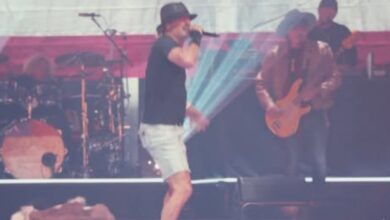
Then came the song choice that sent the crowd into overdrive: “Honky Tonk Till It Hurts.” The track, already becoming a fan favorite from Ain’t In It For My Health, exploded through the arena with loud guitars, pounding drums, and a swagger that felt pulled straight from a smoky dancehall somewhere in Texas in the early 1990s. The audience reaction was immediate. Fans inside the venue could be seen standing, cheering, and singing along as Top leaned fully into the performance with confidence that made him look like a seasoned arena headliner rather than a rapidly rising newcomer.
One of the night’s most talked-about details was Top’s outfit. Wearing a sharp jacket inspired by George Strait’s classic style, he visually reinforced the traditional country image he has become known for. In an era where many award-show performances lean heavily into flashy crossover aesthetics, the choice felt intentional. Everything about the set — the lighting, the wardrobe, the stage arrangement, and even the band’s live sound — seemed designed to celebrate the roots of country music rather than reinvent them.
For many viewers, that authenticity became the defining reason the performance resonated so strongly online afterward. Across social media, fans repeatedly described the set as “real country music” returning to a major stage. Clips from the performance quickly circulated across Facebook, TikTok, Instagram, and X, with countless comments praising Top for refusing to abandon classic country influences while still feeling fresh and exciting. Some fans even compared the moment to the rise of country superstars during the genre’s commercial boom of the 1990s.
What makes Zach Top particularly fascinating to longtime country fans is that his success does not feel based on nostalgia alone. While his music clearly channels the spirit of earlier generations, many listeners believe he brings enough charisma and modern energy to avoid sounding like a tribute act. Songs like “I Never Lie,” “Sounds Like the Radio,” and “Honky Tonk Till It Hurts” feel familiar without sounding dated, which has allowed him to bridge the gap between older country audiences and younger fans discovering traditional sounds for the first time.
His rapid rise over the past two years has also been remarkable. After earning attention with earlier releases, Top’s profile exploded following his Grammy win for Best Traditional Country Album. That victory positioned him as more than just a niche revivalist artist. Suddenly, he became one of Nashville’s most commercially promising young stars while still maintaining a fiercely traditional identity. By the time the ACM Awards arrived, expectations surrounding his performance had become enormous.
The ACM performance also highlighted how much country audiences have been craving a return to live-band energy. Rather than relying heavily on backing tracks or elaborate production gimmicks, Top’s set focused on musicianship and stage presence. The guitars rang loudly through the arena, the rhythm section pushed the tempo aggressively, and the entire performance carried the loose, rowdy feeling of an authentic honky tonk rather than a tightly controlled television production. That rawness helped separate it from many other performances during the broadcast.
Industry insiders have increasingly pointed toward Zach Top as one of the artists reshaping the future direction of mainstream country music. His popularity arrives during a period where many fans openly debate the genre’s identity, especially regarding the balance between pop crossover appeal and traditional instrumentation. Top’s success suggests there may be a massive audience still hungry for steel guitar-heavy country rooted in storytelling, heartbreak, dancehall swagger, and old-school authenticity.
Another major factor behind Top’s appeal is his background. Growing up on a ranch in Sunnyside, Washington, he developed a deep connection to classic country artists from an early age. Rather than treating those influences as temporary aesthetics, Top openly speaks about them as the foundation of his identity as a musician. That sincerity becomes obvious during live performances, where he appears far more focused on delivering songs honestly than trying to chase trends or viral moments.
Ironically, the performance itself may have become one of the biggest viral moments of the entire ACM Awards anyway. Video clips from the set spread rapidly within hours of the broadcast, and fans began labeling the appearance as a “turning point” for modern country television performances. While award shows often generate temporary buzz, many viewers argued that Top’s set felt genuinely memorable because it carried personality, confidence, and a clear musical identity from start to finish.
There was also something refreshingly rebellious about the entire atmosphere of the performance. At a time when polished production and genre blending dominate much of country radio, Zach Top walked into one of the biggest nights in country music and proudly leaned into fiddle-heavy, beer-soaked honky tonk energy without compromise. Rather than modernizing his style to fit the awards-show environment, he forced the environment to adapt to him instead. That confidence became part of what made the moment feel so explosive.
By the end of the night, many fans and critics agreed on one thing: Zach Top had not simply delivered another ACM Awards performance. He had made a statement. “Honky Tonk Till It Hurts” felt less like a single song and more like a declaration that traditional country music is not fading quietly into history. Judging by the reaction inside the arena and across the internet afterward, a huge portion of the country audience seems more than ready for its comeback.