Dave Grohl & Norah Jones Turn “Maybe I’m Amazed” Into the Most Intimate Moment of the Kennedy Center Honors
The Kennedy Center Honors has a particular kind of electricity: part gala, part love letter, part high-wire act. The room is filled with people who have done everything, seen everything, and applauded everyone, yet they still lean forward when the lights dim because they know what is about to happen is built for that one night only. In 2010, the list of honorees was a reminder of how wide the performing arts can stretch—Paul McCartney alongside Oprah Winfrey, Merle Haggard, Jerry Herman, and Bill T. Jones—five careers that don’t even live in the same lane, yet somehow belong in the same sentence. The ceremony was recorded in Washington, with the President and First Lady in attendance, and it carried that unmistakable sense of national occasion without losing its warm, human heartbeat.
When the McCartney segment arrived, the temperature in the room shifted in that subtle way only legends can cause. Everyone there already knew the outline of the story: the Beatles years, the songs that rewired pop culture, the solo chapters that proved it was never just a band phenomenon. But the Honors format is never about repeating the résumé. It’s about translating a lifetime into moments—short, vivid, emotional snapshots that land in the chest. McCartney’s tributes that night were stacked with star power, and they came fast: No Doubt bringing a punchy, skanking energy to a Beatles-flavored medley; Steven Tyler taking on the “Abbey Road” run with the bravado of someone who’s lived inside stadium volume for decades; and later, the communal lift of “Let It Be” and “Hey Jude” to close things out. In the middle of all that spectacle, one performance stood out by doing the opposite.
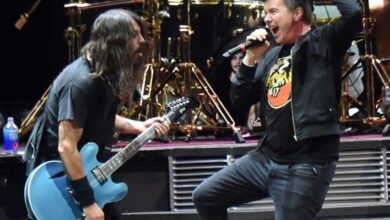
Dave Grohl and Norah Jones walked onstage with the quiet confidence of people who understood the assignment: don’t over-decorate a song that already knows how to break hearts. “Maybe I’m Amazed” is a love song that doesn’t pose as poetry—it speaks plainly, almost breathlessly, like someone trying to say the truest thing before the moment passes. And on a night built around grandeur, Grohl and Jones approached it with restraint, choosing intimacy over fireworks. It was a bold move at the Kennedy Center Honors, where it’s easy to go for the big belt, the big orchestra swell, the big “look at us” ending. They went for something riskier: an honest, stripped-down feeling that made the room feel smaller, closer, more personal.
The magic starts with the pairing itself. Grohl carries the reputation of a relentless live-wire, the kind of performer who treats a stage like a battlefield and still manages to grin like he’s having the time of his life. Norah Jones brings a different gravity—smooth, grounded, quietly devastating when she leans into a melody. Putting them together could have felt like a novelty booking if the chemistry wasn’t real. But from the first lines, it’s clear they are not competing for space. They’re building a single emotional lane and staying in it. The result is a rare kind of balance: rock muscle without aggression, elegance without softness, two artists meeting in the middle and letting the song do the heavy lifting.
What makes their rendition feel special is how it respects the original while still sounding like them. “Maybe I’m Amazed” was written as a confession and a thank-you, and the performance leans into that core emotion rather than trying to modernize it. You can almost feel the room listening for breath between phrases, because the song’s power lives in its pauses as much as its peaks. Grohl’s voice brings a lived-in grit, as if the lyric has been carried around for years. Jones adds a kind of clarity—those harmonies that don’t shout for attention, but quietly reshape the emotional color of each line. Together, they make it feel less like a cover and more like a message being passed from one generation of artists to another.
The Kennedy Center Honors audience is not a typical concert crowd. It’s a room full of peers, mentors, and icons—people who know exactly how hard it is to make something look effortless. That’s why a performance like this lands so deeply. You can imagine the collective thought: they didn’t need a production trick, they didn’t need to raise the tempo, they didn’t need to make it louder. They just needed to tell the truth of the song. The camera cuts during moments like this tend to catch micro-reactions—the slight nod, the softened eyes, the half-smile of someone recognizing sincerity. In a tribute setting, those reactions are everything, because the real story isn’t just what happens onstage. It’s what it pulls out of the people watching.
And then there’s the central figure, sitting in that famous spot, being honored and slightly cornered by gratitude. The Honors can be overwhelming for recipients because they have to receive love publicly without hiding behind performance. McCartney has always been a master of charm, but even charm has its limits when a room is essentially saying, you mattered to my life. As Grohl and Jones move through “Maybe I’m Amazed,” the song becomes less of a hit and more of a memory—one that belongs to McCartney, but also to every person who ever used that melody as a way of saying, I don’t know how to express this, so I’ll let a song do it for me. The performance is gentle enough to feel like a private moment, but strong enough to hold the weight of the entire hall.
Part of what makes the duet so replayable is its emotional pacing. It doesn’t sprint toward the chorus as if the chorus is the only payoff. It treats every line like a step on a staircase, letting the intensity rise naturally. That approach is particularly powerful with a song like this because the lyric is filled with awe—real awe, the kind you feel when someone’s love has steadied you. The performance carries that awe without turning it into melodrama. Grohl doesn’t oversell it; Jones doesn’t sweeten it into background prettiness. They let it remain slightly raw. That rawness is what makes it feel “live” even when you’re watching on a screen years later.
It also fits perfectly inside the broader arc of the McCartney tribute that night. You had No Doubt launching the segment with bright, punchy energy, proving how elastic Beatles-era melodies can be in a modern pop-rock frame. You had Steven Tyler taking on the “Abbey Road” medley with theatrical swagger, a reminder that these songs can handle a full-bodied rock reinterpretation. And then, right in the middle, Grohl and Jones slowed everything down and reminded the room that McCartney’s catalog isn’t only about sing-along choruses and iconic riffs—it’s also about private devotion, quiet gratitude, and the kind of songwriting that survives any era because it’s built on human truth. In a lineup full of crowd-pleasers, theirs was the emotional anchor.
If you’ve ever wondered why “Maybe I’m Amazed” keeps returning across decades, this performance offers a clue. The song sits at a crossroads: it’s personal, but not obscure; romantic, but not syrupy; musically rich, but not cluttered. That makes it a perfect canvas for artists with very different styles. Grohl brings the feeling of someone who’s spent his life in loud rooms but still understands the hush that happens when a song is real. Jones brings the discipline of an artist who knows exactly how little you need to do when the melody is already strong. Their version feels like an argument for musical maturity: the ability to choose what not to do.
It’s also a reminder of how the Kennedy Center Honors can create collisions you don’t get anywhere else. In most settings, artists are separated by genre lanes, radio formats, and brand expectations. Here, the point is cross-pollination. The night’s honorees represented television, dance, theater, and multiple strains of American music, and the show leaned into that variety. It wasn’t just that famous people showed up; it was that different kinds of artistry shared the same stage and the same respect. That context makes Grohl and Jones even more compelling: two modern stars stepping into a classic songbook moment, not as tourists, but as fluent speakers of the language.
When the performance ends, the applause hits with that specific Kennedy Center texture: enthusiastic, yes, but also appreciative in a professional sense—like a room saying, that was smart, that was honest, that was hard. In tribute performances, applause can sometimes feel like obligation. Here, it feels like release. You can sense the room exhaling, as if everyone had been holding their breath through the most delicate lines. That’s the strange power of simplicity: it makes people listen harder, and when the last note lands, the reaction is bigger because the silence beforehand was real.
The viral life of this duet makes perfect sense, even years removed from the original broadcast. A lot of performances go viral because they’re flashy, unexpected, or meme-ready. This one travels because it’s emotionally legible. You don’t need to know the full Kennedy Center context to feel what’s happening. You see two artists treating a song like it matters, and you watch the honored songwriter receive that gift in real time. The clip has been circulated and re-circulated online through official uploads and reposts, introducing new audiences to the moment and turning a formal gala excerpt into something that feels like a living piece of musical culture. That’s a rare transformation, and it speaks to how timeless the core performance really is.
There’s also a deeper narrative here about influence. Grohl is often described as a student of classic rock and pop craftsmanship, and you can hear that reverence in how he approaches the song—not as a vehicle for vocal fireworks, but as a composition worthy of careful handling. Norah Jones, in her own lane, has always been an artist who thrives on emotional clarity, the kind that makes a lyric feel like a conversation rather than a declaration. “Maybe I’m Amazed” sits right between them, and you can feel both of their musical histories meeting inside it. The duet becomes a small documentary about how great songs travel: from one era to the next, from one genre to another, without losing their center.
By the time the McCartney tribute segment wrapped, the room had been through multiple moods: celebration, nostalgia, spectacle, and finally communal uplift as the night built toward its closing moments. Yet the Grohl-Jones performance remains the one people return to when they want the heart of the evening rather than the highlight reel. It’s the moment that proves tributes don’t have to be louder or faster to be memorable. Sometimes the greatest respect you can offer a songwriter is to sing their words as if you believe them, and to let the audience feel the meaning without being instructed how to react.
In the end, that’s what made the performance special: it treated “Maybe I’m Amazed” not like a classic to be displayed behind glass, but like a living song that still has the power to land, right now, on a room full of legends. It honored McCartney by refusing to turn him into a museum piece. It honored the audience by trusting them to listen. And it honored the spirit of the Kennedy Center Honors itself—an event designed to remind everyone that the arts aren’t just entertainment or prestige or history. At their best, they’re the simplest human exchange: someone sings, someone feels seen, and for a few minutes, an entire hall leans into the same emotion together.