Andrea Bocelli’s Quiet-Storm Moment On The Jennifer Hudson Show
There are performances that land like fireworks, and then there are performances that arrive like weather—slow, inevitable, and impossible to ignore once it fills the room. Andrea Bocelli’s piano-led rendition of “Il mare calmo della sera” on The Jennifer Hudson Show belongs to that second category. It didn’t feel engineered for a highlight reel. It felt like the kind of spontaneous, late-in-the-hour gift that only happens when the cameras are rolling but the mood has shifted into something more intimate—when a studio audience stops behaving like an audience and starts behaving like witnesses.
Part of what made the moment hit so hard was how quickly the atmosphere changed. The setup wasn’t flashy, and that mattered. Instead of a big-band introduction or a sweeping stage cue, the energy moved through a softer door: a conversation, a shared respect, then a simple decision to let the music speak. The piano becomes the centerpiece in an almost old-world way, the instrument you sit at when you have nothing to prove and everything to say. And Bocelli, who has spent decades singing in the world’s grandest spaces, treated the studio like it deserved the same reverence.
Jennifer Hudson’s reaction became a story inside the story. She’s a singer who understands what it means to live inside a note and to carry emotion without hiding behind it. So when her face starts to shift—when you can see that tug toward tears that comes before you can talk yourself out of it—it reads as honest. It reads as recognition, not just admiration. That reaction is one of the reasons the clip traveled so quickly online: people trust a singer’s face when they’re hearing something that feels rare.
The performance also lands because “Il mare calmo della sera” is not a casual selection. It’s a piece tied to Bocelli’s rise, the kind of song that carries a biography inside it. When an artist returns to a signature early-era work, there’s always a question: is it nostalgia, obligation, or renewal? Here, it felt like renewal. The phrasing had the calm authority of someone revisiting a memory with new perspective, letting the melody breathe, letting the silences do work, letting the room catch up to the emotion.
What made this version feel different wasn’t just the setting—it was the absence of insulation. Big televised performances often come with layers: production choices, backing tracks, heavy reverb, visual storytelling that tells you what to feel. Bocelli at the piano strips all that away. The voice becomes the story, the breath becomes the pacing, and the piano becomes the ground under your feet. That’s why people describe it as “otherworldly.” Not because it’s supernatural, but because it removes the usual modern noise and leaves you alone with the human core of singing.
There’s also something quietly radical about how the moment reframes celebrity. In a media world built on quick takes and fast emotion, this was slow emotion—long lines, sustained notes, a patience that demands the audience meet the performance at its tempo. The studio audience doesn’t just applaud; they listen. The camera doesn’t rush to cut away; it lingers. That unhurried attention is rare on daytime television, which is usually built to keep moving. The stillness becomes the feature.
People often talk about blind musicians with language that can slip into cliché, but the reason this resonates is not sentimentality—it’s focus. Bocelli’s relationship to performance is famously grounded in sound, not spectacle, and at the piano that truth becomes even sharper. With fewer visual “events” happening, the listener’s ear does more work, and the emotional payoff becomes stronger. It’s not a tearjerker because it tries to be. It’s a tearjerker because it’s honest, and honesty has weight when you allow it space.
Then there’s the studio-as-theater aspect. A talk show studio is normally a place where music is an interlude, a segment, something you fit between conversation beats. This moment flipped that dynamic. The performance didn’t feel like a segment; it felt like the point. And that shift is exactly why it lingers in the mind. It turns a familiar TV format into something closer to an old variety-show tradition—one great voice, one instrument, one room, and an audience suddenly aware they’re experiencing something unrepeatable in exactly the same way again.
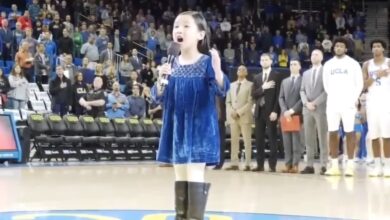
Seeing the song in a fan-recorded arena setting helps explain why the talk-show rendition feels so striking. In a large venue, Bocelli’s voice is built to carry—there’s space for the sound to bloom, for applause to surge, for the emotional arc to feel like a public celebration. The Jennifer Hudson Show moment, by contrast, feels like the camera accidentally caught a private truth. The melody that can fill an arena becomes a close conversation when it’s delivered with piano intimacy. That contrast—public monument versus private confession—clarifies why viewers felt the TV performance had an unusual gravity.
The studio recording, in turn, shows the architecture of the song: the way it was built to travel from tenderness to lift, from calm to intensity, from measured phrasing to a fuller emotional crest. But what’s fascinating is how a studio version—polished and preserved—can feel almost less immediate than a live piano take. On the show, you can sense the edges: the breath, the timing, the split-second choices that make a performance feel alive. The original recording gives you the blueprint; the talk-show rendition gives you the hand-written notes in the margins.
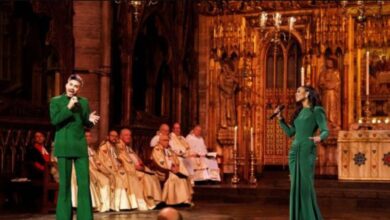
A more modern presentation of the song—especially one tied to an anniversary-era context—highlights how Bocelli’s music has moved between worlds: classical tradition, pop accessibility, and the kind of cross-genre collaborations that bring new listeners in. It also underscores a key point about the Jennifer Hudson performance: it wasn’t selling a concept. It wasn’t built around a duet hook or a dramatic arrangement twist. It was a return to fundamentals, which is why so many viewers experienced it as unusually pure. When an artist has access to big production and chooses restraint instead, that choice becomes the statement.
Placed alongside the broader performance clip, the emotional logic of the moment becomes clearer: the talk show wasn’t trying to turn Bocelli into a pop-culture novelty; it gave him room to be exactly what he is. Hudson’s presence matters here too, because she doesn’t shrink the moment with nervous banter or performative reactions. She respects the silence. She respects the pacing. Her near-tears read as a professional being caught off guard by something she didn’t expect to feel that strongly in a studio environment designed for repetition and routine. That respect is contagious, and the audience follows her lead.
The later fan-captured festival-style performances show another side of Bocelli’s relationship to this song: it’s a cornerstone he can revisit while his career keeps evolving around it. In a festival setting, the piece becomes part of a larger emotional narrative—one chapter in a night of big music, big atmosphere, and communal feeling. That’s what makes the Jennifer Hudson show version such a standout: it condenses the emotional impact of a huge concert moment into a space small enough to hear the hush between phrases. It proves that the song doesn’t need scale to feel monumental.
What ultimately makes the Hudson moment important is that it reminds people what “television performance” can mean when everyone involved treats music as more than a checkbox. It becomes a demonstration of craft—how to pace a piece, how to shape a line, how to let a room fall quiet without forcing it. It becomes a reminder that great singing doesn’t require an overload of production, and that sometimes the most viral thing is simply a real musician being allowed to do real musician work in real time.
It also matters culturally because it’s a bridge moment. Bocelli represents a strand of vocal tradition that can feel distant to casual viewers who don’t spend time around opera or operatic pop. Hudson represents a modern mainstream that knows power singing, knows emotional performance, knows what it means to connect with a broad audience. When those worlds meet in a simple piano performance, it signals that the boundary between “high” and “popular” art is more porous than people think. The clip doesn’t ask permission; it just shows the connection.
And it’s a reminder of how memory works in music. People don’t always remember the cleanest note or the loudest ending. They remember the feeling of being surprised by sincerity. They remember the moment they realized they were holding their breath. They remember the expression on a singer’s face when she stops being a host for a second and becomes a listener like everyone else. That’s why this performance keeps circulating: it’s not only a song. It’s a shared reaction, captured and replayed, a tiny proof that emotional truth still cuts through the noise.
Finally, there’s something satisfying about how the performance refuses to be complicated. No storyline, no contrived drama, no forced “TV moment.” Just a pianist-singer and a song with history, in a room that suddenly understands it’s hearing something timeless. In a media climate where so much is over-explained, this clip thrives on what it doesn’t explain. It lets you feel first and analyze later, which is exactly how great music is supposed to work.