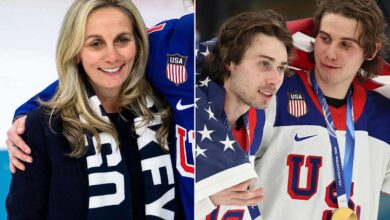
Jack Hughes Gave Up His Teeth And Took Olympic Gold For Team USA
From the opening faceoff in Milan, it was clear this was never going to be a comfortable night. A men’s hockey final between the United States and Canada at the Winter Olympics carries a different weight, one that settles into the arena and refuses to leave. Every shift felt loaded, every hit echoed a little louder, and every stoppage gave the crowd just enough time to remember what was at stake. This wasn’t about style points or momentum swings. It was about survival in a game that refused to open up.
The turning point didn’t come from a goal at first, but from pain. Jack Hughes caught a high stick to the face that immediately drew attention for all the wrong reasons. Blood, broken teeth, and a slow skate to the bench made it look like his night might be over. In most games, it probably would have been. This wasn’t most games. After treatment, Hughes returned, visibly damaged but unwilling to step away from the biggest moment of his career. There was no drama in the comeback, just a quiet decision to keep going.
Canada pushed hard, playing the kind of structured, relentless hockey that has broken opponents for generations. The United States absorbed it, leaning heavily on Connor Hellebuyck, who turned the game into a lesson in patience. Shot after shot was turned aside, not with flash, but with control. Each save chipped away at Canada’s confidence and gave the Americans just enough breathing room to stay alive. As the clock ticked down, it felt less like a game and more like a test of nerve.
When regulation ended, overtime felt inevitable. The pace tightened, mistakes vanished, and every pass carried consequences. Overtime in an Olympic final doesn’t allow hesitation. There is no margin for recovery, no second chance to correct a read. One clean moment is enough to decide everything. And in that narrow space, with the game balanced on a knife edge, Hughes found himself in the right place at the right time.
The goal itself wasn’t extravagant. It didn’t need to be. It was decisive, immediate, and final. After leaving the ice earlier with broken teeth, Hughes delivered the overtime winner that secured Olympic gold for Team USA. In a matter of seconds, years of preparation and pressure collapsed into one release of sound and motion. The bench erupted. The arena split in two. The rivalry found its conclusion for the night.
What followed was not a carefully crafted celebration, but a raw one. Hughes didn’t hide the damage or downplay the pain. He spoke openly about pride, about his teammates, and about what it meant to wear the jersey in that moment. He also joked, honestly, about needing dental work once he got home. It wasn’t performative toughness. It was the matter-of-fact tone of someone who understood exactly what the game had asked of him and accepted it.
He was quick to redirect praise, especially toward Hellebuyck, whose performance made the win possible. The final score didn’t reflect the volume of chances Canada generated, and everyone in the building knew it. This was a game where goaltending shaped the outcome long before the winning goal was scored. Hughes’ finish ended the night, but it was built on minutes and minutes of resistance in the crease.
The aftermath carried its own significance. Team USA celebrated not just a win, but a moment that resonated beyond the rink. Players and coaches spoke about representing their country and understanding the size of the stage they had just conquered. The night didn’t feel isolated; it felt connected to something larger, the way Olympic moments often do when they cross into national memory almost instantly.
There was no need to exaggerate what happened in Milan. The facts were enough. A player lost teeth to a high stick, came back, and scored the overtime goal that decided Olympic gold. A goaltender delivered under constant pressure. A team held its nerve against its oldest rival. The story didn’t require embellishment because the reality already carried weight.
The image that lingers isn’t just the goal itself, but the expression afterward. A damaged smile, equal parts pain and disbelief, captured what the night demanded. Olympic hockey doesn’t always produce beauty. Sometimes it produces endurance. On this night, endurance was enough — and Jack Hughes turned it into gold.