When Michael Bublé Turned a New York Subway Into an Unforgettable Concert
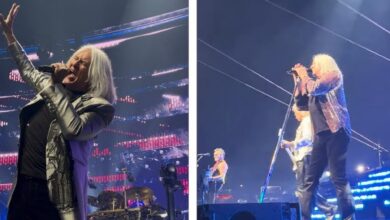
Canadian star Michael Bublé turned an ordinary New York City subway stop into an instant story people would be telling all day, stepping into the underground rush alongside the vocal group Naturally 7 for a surprise a cappella moment. In a place where most commuters are focused on getting from A to B as fast as possible, the sudden appearance of a world-famous voice created that rare pause where everyone forgets their schedule for a minute.
The traditional pop singer was in perfect form, and his warm, unmistakable tone cut through the usual station noise like it belonged there. Within seconds, the steady flow of footsteps slowed into a friendly “traffic jam” of smiling commuters, curious tourists, and locals pretending not to be impressed. It wasn’t forced or staged in a flashy way—it felt like music simply taking over a public space.
For the performance, Bublé and Naturally 7 delivered “Who’s Lovin’ You,” a classic he recorded for his album To Be Loved. Choosing that song was a smart move because it’s built for big feelings and strong phrasing, even without instruments. In the subway setting, the melody felt even more intimate—like a private concert accidentally happening in the middle of everyone’s day.
Online, the reaction matched the scene underground. The clip didn’t just get polite views—it pulled people in the way the best spontaneous performances do, because you can sense that nobody is hiding behind production. The video has since passed more than 5.6 million views, and it keeps getting revisited by viewers who love the combination of surprise, raw vocals, and a city moment that feels completely unrepeatable.
Naturally 7’s presence is what makes the whole thing more than “a celebrity singing in public.” Their harmonies are rich and gospel-leaning, and they have that rare ability to build a full sonic world using only voices. In the subway, their layered backing vocals created movement and lift, giving the performance the kind of emotional climb you usually expect from a full band, not a platform crowd.
Bublé has always been the kind of artist who seems genuinely energized by unexpected settings, and you can see that excitement in how relaxed he looks while singing. Instead of trying to dominate the moment, he rides the blend, listening and responding, letting the arrangement breathe. That’s why the crowd reaction feels earned—people aren’t just stopping because he’s famous, they’re stopping because it sounds that good.
Afterward, he described the experience as “the coolest thing ever,” and he framed subway singing as one of the most authentic, organic ways to make music. That comment landed because the performance itself proved the point: no big stage tricks, no screens, no distractions—just voices meeting the space exactly as it is. The underground setting didn’t shrink the song; it made it feel more alive.
He also pointed out why the subway felt meaningful in the first place. Over the years, so many musicians have played underground stations—some chasing a dream, some sharpening their craft, some simply trying to be heard. By stepping into that tradition for a moment, Bublé wasn’t just promoting a track; he was joining a very New York kind of musical history, where talent sometimes shows up before you expect it.
Part of what helped the performance land so well was the station itself. Bublé noted that the tiled architecture helped the acoustics, giving the vocals a natural bounce and a clean echo that made the harmonies feel bigger. In a weird way, the station acted like its own reverb chamber, softening the edges of the noise and letting the voices bloom. It’s the kind of accidental “venue” musicians secretly love.
He even said that out of all the promotional events he’d done across Europe and America, this subway moment excited him the most. That detail is telling, because it suggests the thrill wasn’t just about exposure—it was about the feeling of singing to real people who didn’t plan on being an audience. There’s a special electricity when you win over a crowd that was literally on its way somewhere else.
With a playful grin and that cheeky delivery fans know well, he joked that he finally felt like a real New Yorker. It’s a line that works because it’s half comedy, half truth: in New York, you earn your moment by showing up, doing something real, and letting the city react. For a few minutes, a subway platform turned into a concert hall, and everyone got to be part of it.
Interestingly, the fully a cappella subway version of “Who’s Lovin’ You” ended up becoming even more popular on YouTube than the studio recording for many viewers. That’s not unusual when the performance has a real story attached to it. People don’t just listen—they rewatch to catch the crowd reactions, the way the harmonies stack, and the moment the station collectively decides to stop rushing.
The song’s history makes it even cooler that it can still cause a crowd to freeze in place. “Who’s Lovin’ You” was originally written and recorded in 1960 by Smokey Robinson for his Motown group The Miracles. Even in its earliest form, it had that classic Motown combination of heartbreak and elegance, built around a melody that invites singers to step into the emotion and really live there.
It was released as the B-side to “Shop Around,” and it still managed to take on a life of its own. That kind of staying power doesn’t happen by accident—songs like this survive because the feelings inside them are universal. Over the decades, it kept getting rediscovered by new voices and new audiences, turning into the kind of standard performers reach for when they want a song that can actually test and showcase a vocal.
As the years went on, major artists kept circling back to it, each adding their own flavor while keeping the emotional core intact. It’s been covered by names like The Temptations, The Supremes, and John Farnham, which says a lot about how flexible the song is across styles. Whether it’s delivered with silky restraint or full dramatic power, the melody and message still land the same way.
The most famous rendition for many listeners came from The Jackson 5 in 1969, with a young Michael Jackson handling lead vocals and turning the heartbreak into something startlingly intense. That performance helped cement the song as a pop-soul landmark for a new era, and it’s one of the reasons the tune feels so instantly recognizable even decades later. When Bublé sings it, you hear that lineage echoing through every phrase.
That Jackson 5 release is often remembered for how strongly it connected with mainstream audiences, even appearing as the B-side to “I Want You Back” while still becoming a standout in its own right. It’s a reminder that B-sides sometimes hide the deepest gems. In a funny way, the subway performance echoes that spirit: something not “center stage” suddenly becomes the moment everyone talks about and shares.
Decades later, “Who’s Lovin’ You” found a new chapter on Bublé’s eighth studio album To Be Loved, produced by Bob Rock. That pairing mattered because it kept the recording polished while still leaving room for real vocal presence. The album went on to top the Billboard 200, marking Bublé’s fourth consecutive number-one release, and it reinforced how strongly his audience connects with timeless songwriting and classic delivery.
The success didn’t stop there. To Be Loved also hit number one in the UK and became one of the best-selling albums of the year, which helped explain why this subway performance traveled so fast online. It wasn’t just a random clip—it was a star at a career peak choosing a humble setting, backed by one of the most creative vocal groups around. That mix of excellence and spontaneity is exactly why people still replay it.