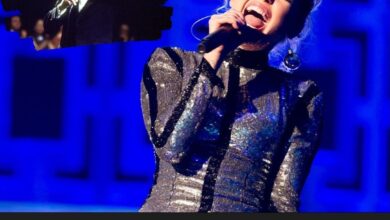
LeAnn Rimes and the night Patsy Cline’s songs felt alive again
The American Country Awards arrived in Las Vegas on December 10, 2013, carrying the usual glow of a major industry celebration, but there was a quiet anticipation in the room that night that went beyond trophies and applause. Hosted at Mandalay Bay and broadcast nationwide, the ceremony had already delivered its share of modern country moments when the atmosphere subtly shifted. This was not going to be another fast-paced tribute squeezed between commercial breaks. What followed was framed as something more deliberate, a pause in the night designed to honor a voice that still defines what emotional honesty in country music truly sounds like.
The reason for the tribute carried real weight. It marked fifty years since Patsy Cline’s death in 1963, yet her presence in country music remained unmistakable. Her influence lives in the way singers shape vowels, in how vulnerability is allowed to sit right at the center of a performance instead of being smoothed away. Even artists generations removed still measure themselves against her emotional clarity. This tribute was less about looking backward and more about acknowledging how deeply her shadow still stretches across the genre.
Choosing who would step into that shadow mattered immensely. Patsy Cline’s songs do not tolerate imitation or exaggeration. They demand restraint, control, and a willingness to let emotion speak without decoration. LeAnn Rimes was not selected because of novelty or headlines, but because her voice has long carried a rare combination of purity and emotional gravity. From the earliest days of her career, listeners had noted an almost uncanny connection between her tone and the classic country tradition, making her uniquely qualified for a moment this delicate.
As the stage lights dimmed, there was no sense of spectacle overtaking the performance. The arrangement was stripped back, allowing the focus to remain squarely on the voice and the story. When LeAnn Rimes began singing “Crazy,” the room fell into an immediate stillness. She didn’t rush the phrasing or attempt to modernize the melody. Instead, she leaned into the song’s natural ache, allowing each line to unfold with patience and intention, honoring the emotional architecture that made the song timeless in the first place.
What made the performance remarkable was not technical showmanship, though her control was undeniable. It was the emotional restraint. Rimes understood that “Crazy” is not about vocal fireworks; it is about quiet devastation. Each note felt measured, as if she were carefully placing it exactly where it belonged. The audience didn’t react with cheers mid-song. They listened, fully absorbed, aware that interrupting the moment would break its spell.
Transitioning into “Leavin’ On Your Mind” only deepened the emotional impact. The song carries a different kind of sorrow, less internalized and more openly conflicted. Rimes approached it with a subtle shift in tone, allowing the narrative to breathe while maintaining that unmistakable Patsy Cline vulnerability. Her phrasing suggested heartbreak without melodrama, capturing the sense of resignation that defines the song’s emotional core.
From a journalistic perspective, what stood out most was how the performance avoided feeling like a reenactment. This was not an attempt to sound exactly like Patsy Cline. Instead, Rimes allowed her own identity to exist within the framework of the songs. That balance is extraordinarily difficult to achieve, yet it was precisely what made the tribute feel alive rather than archival.
The camera shots during the performance told their own story. Audience members were visibly emotional, many watching without blinking, others wiping away tears. Industry veterans, artists who had built careers on the foundation Patsy Cline laid, looked genuinely moved. This was not polite admiration. It was recognition. The kind that comes when something authentic cuts through the noise of a large televised event.
Social media reaction in the hours that followed reflected the same sentiment. Viewers described feeling chills, not because of dramatic staging, but because the emotion felt real and unforced. Many admitted that they had not expected such an intense reaction from a tribute performance, yet found themselves replaying it again and again, struck by how seamlessly the past and present seemed to merge.
Critics were equally impressed, noting that Rimes managed to honor Patsy Cline without turning the performance into an exercise in comparison. Instead of inviting listeners to judge similarities, she invited them to feel the songs again. That distinction mattered. It reframed the tribute as a continuation of a legacy rather than an imitation of it.
What also made the moment resonate was Rimes’ own history. Having experienced fame at a young age, she understood the emotional cost that can accompany a powerful voice and public expectation. That understanding subtly informed her delivery, lending an added layer of authenticity that could not be rehearsed. It felt as though she wasn’t just singing the songs, but conversing with the emotions behind them.
In the days following the broadcast, clips of the performance circulated widely, reaching audiences beyond the traditional country fanbase. Viewers unfamiliar with Patsy Cline found themselves drawn in, while longtime fans expressed gratitude that the songs had been treated with such care. It became one of those rare televised moments that transcended its original context and took on a life of its own.
From a cultural standpoint, the tribute served as a reminder of country music’s emotional lineage. It demonstrated that modern success does not require abandoning the genre’s roots, and that honoring the past can be a powerful creative act rather than a restrictive one. The performance quietly reinforced the idea that some songs endure not because of nostalgia, but because they continue to speak truths that never expire.
By the time the applause finally broke the silence, the audience seemed fully aware they had witnessed something special. Not a viral stunt, not a flashy reinvention, but a genuine passing of the torch in spirit. LeAnn Rimes did not revive Patsy Cline’s legacy because it was ever dormant. She simply reminded everyone why it still matters, and why voices like that never truly leave the room.