Prince’s Kiss At Paisley Park: The Intimate Performance That Still Feels Dangerous
Paisley Park has never behaved like a conventional venue, and that difference is exactly what gives this version of “Kiss” its edge. In massive arenas, music often stretches outward, fighting distance and scale. Here, that distance disappears. The walls feel closer, the energy sharper, and the connection immediate. Every beat seems to snap tighter, every pause feels intentional. “Kiss” was already designed as a lean, daring track, built on restraint rather than excess. Dropping it into a smaller room turns that restraint into tension. The performance doesn’t feel like a routine run-through of a hit; it feels alert, reactive, and constantly in motion.
From the beginning, “Kiss” stood out as one of Prince’s boldest creative gambles. It sounds deceptively simple, yet it does enormous work with minimal ingredients. The rhythm snaps clean, the guitar bites just enough, and the vocal attitude carries more weight than layers ever could. That structure makes the song especially potent live, where timing becomes everything. In a close setting, silence isn’t empty—it’s charged. Each pause sharpens anticipation, and every return of the groove hits harder. What unfolds isn’t just a performance of a famous song, but a demonstration of control, precision, and playful confidence.
What truly separates this Paisley Park moment is the way Prince treats the audience as part of the equation. He doesn’t push energy outward; he lets it circulate. The groove pulls people in, and once they’re locked, he toys with the tension. It’s a reminder that presence isn’t about volume. Some performers expand by getting louder, but Prince expands by getting more exact. He’s flirtatious without exaggeration, commanding without force. The performance feels alive in the purest sense—like it could twist, stall, or explode at any moment and still remain perfectly under control.
There’s a particular thrill in how his live vocal delivery reshapes the song. In the studio, Prince could be razor-clean and tightly sculpted. Live, he often sounds like he’s testing the room, daring it to follow. His phrasing becomes more conversational, more teasing, less polished in the traditional sense but more expressive. He bends words, clips lines short, and lets silence act as punctuation. That’s why fans talk about moments like this in emotional terms. The impact isn’t rooted in technical perfection, but in the creation of a mood so specific it sticks like a memory rather than a recording.
The location itself plays a major role in shaping the performance. Paisley Park isn’t just a stage; it’s the center of Prince’s creative universe. It was designed around how he worked, thought, and experimented, not around touring logistics or crowd capacity. That shifts the entire psychology of the moment. On a massive stage, the goal is to deliver something consistent. In a home space, you can disrupt that consistency. You can take chances, lean into subtle gestures, and let moments unfold organically. Even with a globally recognized song, the atmosphere becomes personal, almost confidential.
This performance also underlines Prince’s mastery of minimalism. “Kiss” thrives on space, not density. Many artists fear leaving gaps in live music, so they fill every corner with sound. Prince trusted the opposite approach. He allowed the music to breathe, and that breathing became part of the rhythm. In a tight room, those spaces feel amplified, as if everyone is holding the same breath together before the beat snaps back. It’s confidence in its purest form. He doesn’t need to convince anyone the song works—he knows it does, so he bends it at will.
The song’s instant effect on a crowd only adds to its live power. Even listeners who know little beyond the chorus are pulled in almost immediately. The rhythm teaches the body how to move before the mind catches up. That’s why live versions often feel larger than the studio recording. The audience becomes part of the groove, responding instinctively to every shift. At Paisley Park, that feedback loop is even tighter. The performance doesn’t feel archived or nostalgic. It feels present, unfolding in real time between a performer at full command and a room aware it’s witnessing something rare.
The question always comes back to why this specific version keeps resurfacing when there are countless Prince clips available. The answer lies in its balance. It’s disciplined without feeling rigid, loose without tipping into chaos. It carries rawness without sloppiness and polish without sterility. This performance reminds listeners that a pop hit can still feel dangerous, that funk can still carry risk, and that true stage presence isn’t about occupying space but reshaping it. There’s a clear difference between performing a song and owning a moment, and this clip lives firmly in the latter category.
When the Paisley Park performance is placed alongside the official music video, the contrast becomes unmistakable. The video is sleek, stylized, and carefully framed, an iconic artifact of its era. It presents a world fully designed, every detail intentional. The live take, however, treats the song as a flexible instrument. You can feel the room influencing the delivery, shaping timing and emphasis. Familiar moments gain a mischievous edge, and the groove feels more physical, more reactive. It’s the difference between seeing a blueprint and watching the structure move.
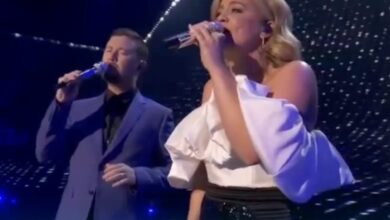
The Art of Noise collaboration with Tom Jones offers another revealing comparison. That version pushes the song toward spectacle, leaning into theatrical swagger and dramatic weight. It’s larger, louder, and deliberately bold, reframing “Kiss” into something almost cinematic. Hearing it after Prince’s original underscores how solid the song’s foundation really is. “Kiss” isn’t dependent on a single aesthetic. Its structure holds firm through reinvention, revealing new angles rather than collapsing. That adaptability is one of the clearest markers of a true classic.
Later live performances, particularly from the early 2010s, show how Prince continued to refresh the song without stripping it of its core identity. The groove remains sharp, but the delivery feels more relaxed, almost effortless. There’s no sense of struggle or obligation—just control. These versions highlight how physical the track remains. “Kiss” doesn’t merely register in the ears; it moves through the body. When the band locks in, the song becomes controlled friction, balancing clean precision with underlying heat.
What anchors the Paisley Park version at the center of all these interpretations is its placement between eras. It carries the weight of an iconic hit while refusing to behave like a museum piece. Prince never treated his past work as untouchable, and this performance reflects that mindset. He reshapes the material in real time, proving it’s still alive. That’s why people describe the clip as endlessly shareable. It doesn’t rely solely on nostalgia. It delivers impact through timing, intelligence, and presence that remain immediately effective.
At its core, “Kiss” succeeds because it’s an attitude first and a pop song second. The lyrics flirt, but the real message lives in the delivery. The vocal becomes posture, the rhythm becomes expression. When an artist truly understands that dynamic, the song turns into a platform for personality rather than just melody. Prince built that platform himself. In this performance, every glance, pause, and accent feels intentional, guided by instinct rather than routine. That kind of artistry doesn’t age.
Ultimately, this moment matters because it captures what often gets lost when Prince is reduced to a list of hits or visual highlights. His brilliance lived in nuance—in how he shaped silence, twisted rhythm into emotion, and made confined spaces feel expansive. The Paisley Park rendition of “Kiss” compresses all of that into a few minutes that remain sharp, charged, and unpredictable. It doesn’t settle. It keeps moving, just like the groove itself, refusing to be pinned down or smoothed out.