From Quad God to Storyteller: The Real Story Behind Ilia Malinin’s “Hope” Performance at Gold on Ice
Gold on Ice was not a rumor or a fan-made label. It was a real figure skating show staged in Leesburg, Virginia, at ION International Training Center, created to bring top-level skating to a “hometown” audience just weeks after the 2024 World Championships. The timing mattered: the event arrived right as the sport’s biggest names were still riding the emotional high of Montreal, and fans were hungry to see champions up close in a setting that wasn’t ruled by scores.
Ilia Malinin was central to that idea from the start. Multiple reports and community announcements around the show described him as the headliner, and coverage also pointed to him as a concept driver behind the event alongside his team. That framing helps explain why the night carried a different energy than a standard touring show: it read less like a promotional stop and more like a personal showcase built around pride, momentum, and connection with local supporters.
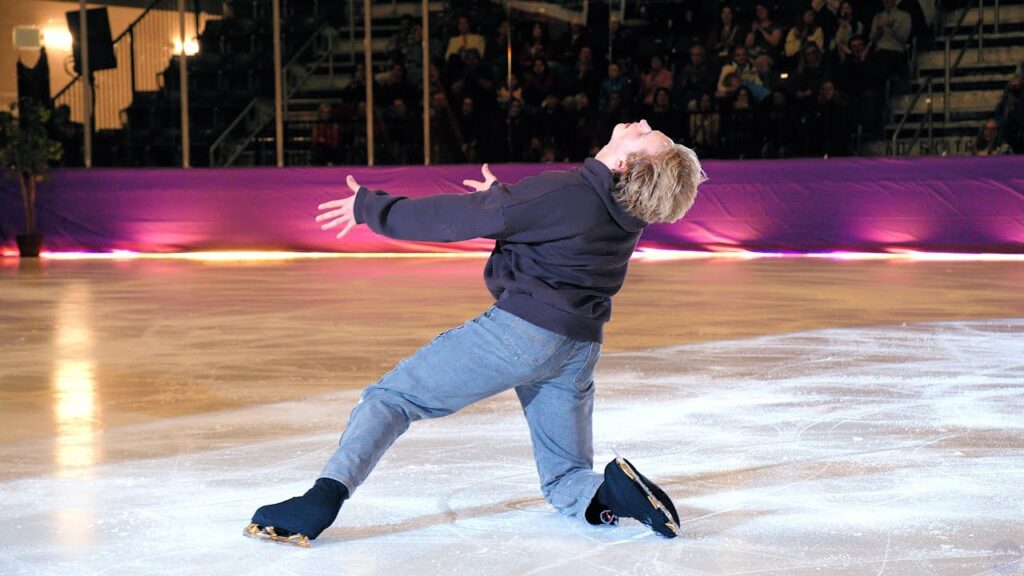
Within that context, Malinin’s exhibition to NF’s “Hope” became one of the most circulated pieces of Gold on Ice content online. The performance is widely available in full-length uploads and clips, and it is consistently labeled as taking place at the first Gold on Ice show. So the core claim is real: he did skate to “Hope” at Gold on Ice, and fans have been watching and sharing it heavily ever since.
What often gets inflated is the language surrounding it. Words like thunderous, breathtaking, soul-searing, and unfiltered are not facts; they’re reactions. But the reactions themselves are easy to understand once you watch the routine. “Hope” is built around self-reflection and survival, and it naturally invites audiences to interpret a skater’s body language and pacing as a narrative rather than a technical checklist.
That’s where this performance stands out from Malinin’s more competition-facing reputation. In judged programs, he is frequently framed as the sport’s ultimate technician, the skater who expands what feels physically possible. In an exhibition, he has room to lean into atmosphere, musical phrasing, and the slower-burning parts of performance that sometimes get overshadowed when every second is tied to base value and grade of execution.
A major reason the “Hope” routine hits the way it does is that it doesn’t depend on novelty alone. The choreography is constructed to let the music breathe, then asks him to accelerate into jumps at moments that feel emotionally timed rather than purely strategic. Even if a viewer knows nothing about the scoring system, they can sense the structure: tension, release, and a return to stillness.
People also tend to latch onto specific lyrics—especially the line about “creating something no one else can”—and then attach a legend to it. That’s where the story sometimes goes off the rails. There is no solid, verifiable evidence that Malinin “invented” a jump that he debuted in this routine as a named element, and viral writeups that claim a brand-new signature jump with a special title often read like fan fiction layered on top of real footage.
The backflip discussion is another place where social posts blur reality. For decades, somersault-type jumps were treated as illegal in ISU competition, which is why people got used to describing backflips as “illegal.” But exhibitions have always been looser, and skaters have long used backflips in shows without the same rulebook consequences. The key factual update is that the ISU later removed somersault jumps from the illegal-elements list, meaning they could be included without penalty in competition from the 2024–25 season onward.
So if someone says, “He did an illegal backflip at Gold on Ice,” the accurate translation is simpler: he did a backflip in an exhibition where it was allowed, and the broader sport was also in the middle of a real rules shift that changed how the move would be treated in competition going forward. That’s still a compelling story, but it’s different from the clickbait framing that implies he broke rules on the night.
A more honest description of Gold on Ice is that it gave fans a view of Malinin in a format where the human side is easier to feel. He is still the same athlete known for extreme difficulty, but exhibitions let him communicate pressure and ambition without the armor of “scoreboard mode.” When viewers call the routine raw, that’s usually what they’re responding to: not imperfection, but openness.
Another common exaggeration is the idea that this specific performance was a direct “message to rivals” about the 2026 Olympics. It’s tempting to write that because it sounds dramatic, but it’s not something you can responsibly claim without a direct quote from Malinin or credible reporting that ties the music choice to an explicit Olympic statement. A better, factual approach is to say the routine contributes to the broader picture of who he is as a skater: not only a jumper, but an artist building a public identity.
Where you can be firm is on who Malinin is in the sport’s timeline. He became 2024 World Champion, he is widely known by the “Quad God” nickname, and he has been credited with pushing the boundaries of quadruple-jump content, including landing the quad Axel in competition. That background is factual, and it provides the foundation for why any exhibition from him gets treated like an event rather than just a gala number.
If you want to keep the emotional tone while staying real, focus on what the footage and reputable reporting support: the show existed, the date and location are documented, the “Hope” performance is publicly viewable, and the audience response online is clearly enthusiastic. Everything else—secret insider claims, mysterious coded messages, miraculous injury comebacks—should be treated as optional color at best, and misinformation at worst.
In that “real” version, the headline writes itself without needing to invent a saga. Gold on Ice was a home-area spotlight for a newly crowned world champion, and “Hope” was the kind of music choice that invites audiences to see him as more than a technical phenomenon. The performance didn’t need propaganda to feel meaningful; it only needed a skater capable of matching big emotion with control.
And that’s ultimately why the routine keeps resurfacing. It’s not because it proved a hidden conspiracy about the Olympics or because a single jump rewrote the rulebook overnight. It’s because it captured a moment when a dominant athlete stepped into a different role—less like a points machine, more like a storyteller—on a night built for fans, not judges.