Skating Inside the Moment: Why Chock and Bates’ Calm Authority Defined Milan’s Rhythm Dance
“You could feel the difference” wasn’t a clever line fans came up with after the fact — it was the most natural way to describe the shift inside the Milano Ice Skating Arena the moment Madison Chock and Evan Bates began their individual Olympic ice dance campaign. The venue had already witnessed speed-heavy programs, dramatic accents, and high-risk skating, but something distinctly calmer settled over the ice when Team USA’s most refined duo stepped out. Their presence didn’t signal caution; it projected assurance. They weren’t trying to overpower the occasion — they were intent on claiming it. In an Olympic setting where fractions of a point can snowball into narratives, their objective seemed refreshingly direct: skate clean, skate true, and leave no ambiguity in the judges’ minds.
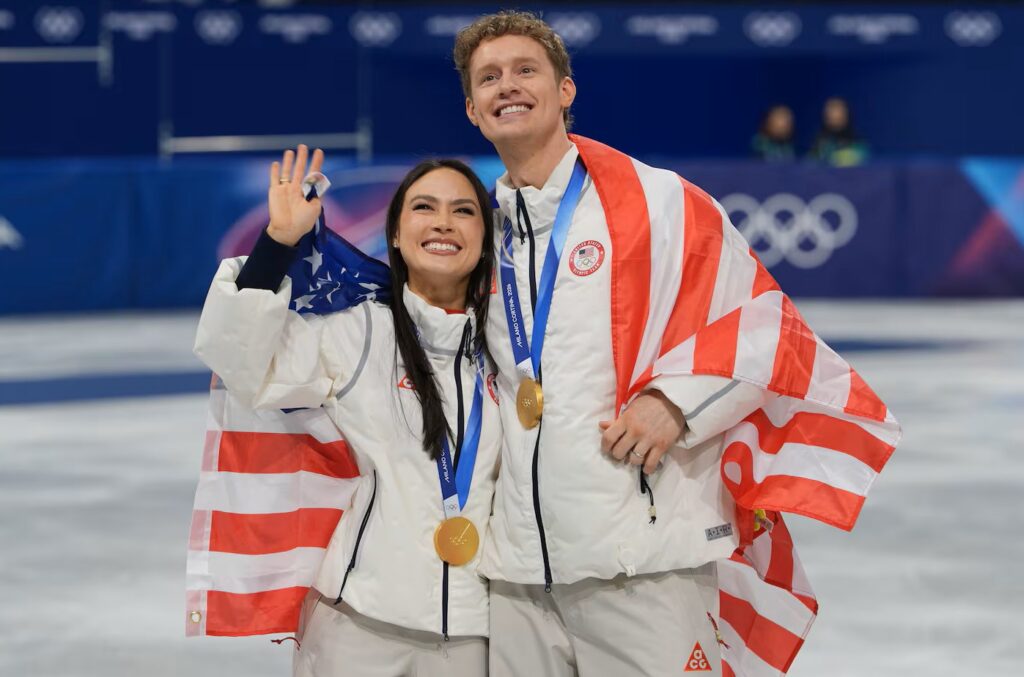
That context mattered, because Chock and Bates weren’t arriving as a curiosity or a developing story — they arrived as the benchmark. Reigning U.S. champions and three-time defending world champions, they carried the kind of résumé that subtly alters how an audience watches even the warm-up. Add in the fact that they had already anchored another team event gold earlier in the Games, and it was easy to sense why their rhythm dance carried extra gravity. The Olympics have a way of tightening even the most gifted skaters. Their task wasn’t to reinvent themselves under pressure, but to look unmistakably familiar — as if this massive stage was simply an extension of the craft they’ve honed together for years.
The evening took a turn that made it feel unmistakably Olympic when the leaderboard defied expectation. France’s newly formed duo of Laurence Fournier Beaudry and Guillaume Cizeron delivered a rhythm dance that immediately seized control of the night, earning 90.18 points and forcing every team that followed into pursuit. Their program, set to Madonna’s “Vogue,” blended fashion-forward attitude with sharp precision, landing with the impact of a headline before the final group even skated. It also underscored how quickly ice dance landscapes can shift when chemistry locks in at the right moment — especially given how early this partnership still is in its international journey.
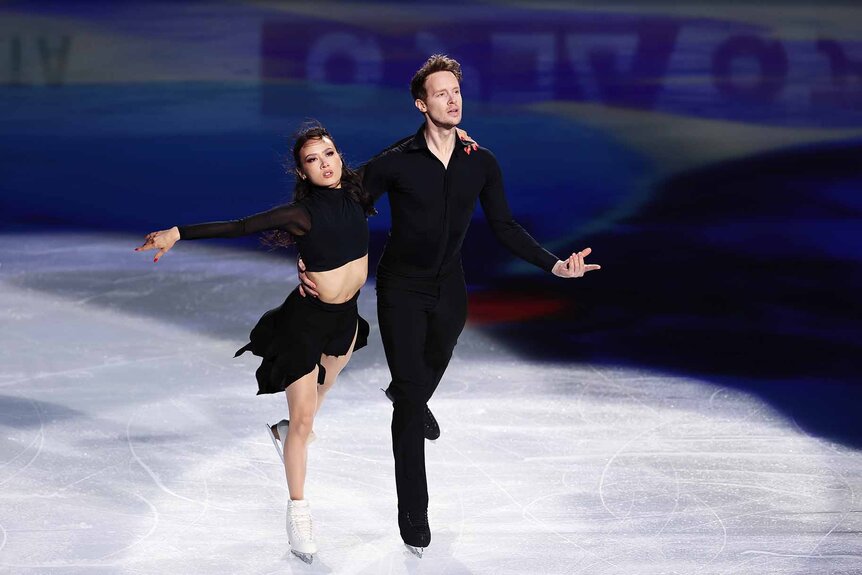
For American fans, the intrigue deepened when Chock and Bates refused to bend under that pressure. Instead, they answered with a rhythm dance that felt composed, commanding, and unmistakably theirs. Skating last, they leaned into a Lenny Kravitz-inspired program that carried rock-and-roll swagger without ever tipping into chaos. The attitude enhanced the control rather than replacing it. They moved quickly without looking rushed, expressive without appearing busy, and polished in a way that made the skating feel quietly luxurious. When the score appeared — 89.72 — it confirmed second place, less than half a point behind the lead, and set the tone for everything that followed.
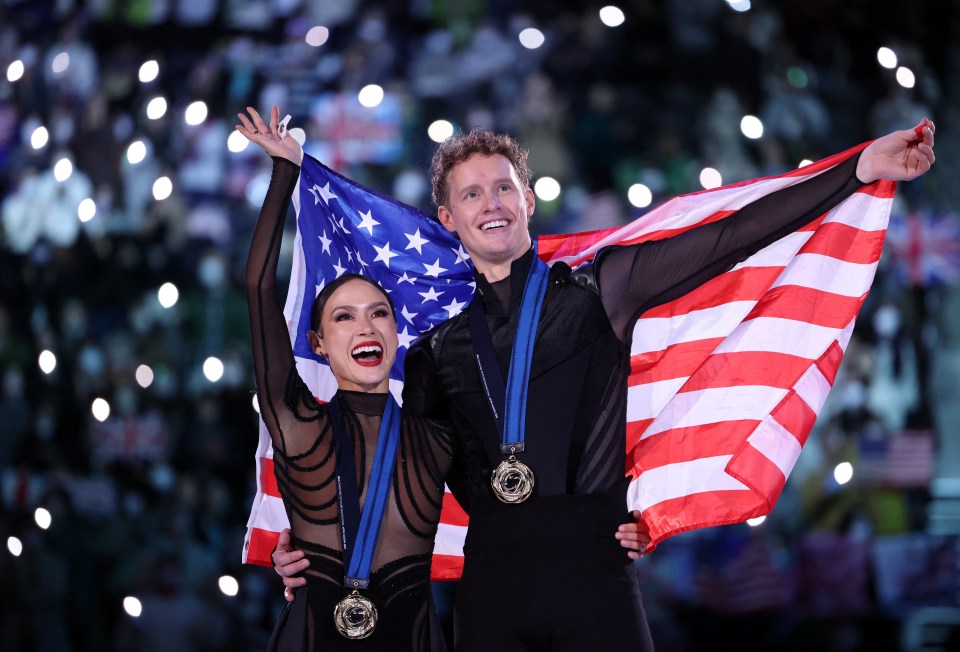
That razor-thin margin is where the Olympics become ruthlessly precise, and it stayed narrow for a reason: this was not an off night. It was a night decided by arithmetic. A technical review reduced one of their key elements — the pattern step — from Level 4 to Level 3, a downgrade that stings precisely because it has nothing to do with reputation or emotion. It’s about criteria met or missed in real time. The result was immediate: a sliver of a point separating first from second, and a reminder elite teams know well. In ice dance, brilliance doesn’t guarantee separation. The margins are the story.
What elevated the moment was how Chock and Bates carried themselves afterward — like skaters who fully understand the rhythm of a two-part Olympic event. There was no visible tension, no sense of scrambling to rewrite the plan overnight. Their posture suggested something simpler: we’re still right where we need to be. That confidence doesn’t come from arrogance, but from experience. They’ve lived through enough championship battles to know the rhythm dance sets the table, while the free dance determines who eats. The message from their camp was consistent and unshaken: deliver the best free dance, and let the math handle itself.
The contrast with the rest of the field only reinforced that sense of maturity. Many teams leaned into speed, dramatic accents, or moments designed to pop instantly on broadcast — a sensible approach in an Olympic setting that rewards memorability. Chock and Bates, however, operated on another wavelength entirely. Their focus was on transitions, timing, control, and that elusive quality where two skaters move as a single thought. Their lifts unfolded without strain, their edges held steady, and their rhythm never collapsed into a sprint. It was the kind of skating that doesn’t plead for attention — it assumes it, because nothing is out of place.
Behind them, the standings carried their own tension. Canada’s Piper Gilles and Paul Poirier settled into third with 86.18 — close enough to sense the podium, but far enough to know the free dance would need something exceptional. Great Britain’s Lilah Fear and Lewis Gibson hovered just outside the top tier, while Italy’s Charlene Guignard and Marco Fabbri energized the home crowd, staying within striking distance. That depth is what turns Olympic ice dance into a thriller rather than a procession. One missed twizzle, one shaky key point, and the entire order can reshuffle.
The moment also carried extra weight because it wasn’t Chock and Bates’ first statement of the week. Earlier in the Games, during the team event rhythm dance, they had posted a world-best 91.06 — a number that functioned as both warning and proof. When they’re clean, separation is possible. That earlier score quickly became part of the conversation surrounding this performance, not as an excuse, but as evidence of how judging nuances and daily variables can tilt outcomes. The Olympics don’t always reward your best version if it doesn’t arrive on the right night. That unpredictability is both its cruelty and its pull.
As if the week needed another wrinkle, figure skating in Milan produced an unexpected subplot that felt surreal until officials addressed it: the medal podium surface used during the team ceremony. An anti-slip coating reportedly damaged skaters’ blades, forcing emergency sharpening and sparking backlash online. It was the kind of logistical oversight athletes dread, because skates aren’t just gear — they’re the literal connection between years of preparation and minutes of performance. Chock and Bates were among those referenced in coverage of the incident, and organizers later committed to replacing the surface and coordinating support.
That odd podium episode ended up reinforcing the week’s central theme: control is fragile. You can prepare relentlessly, drill every key point, and refine your edges until the ice feels mapped — and still find yourself reacting to variables you never planned for. The strongest teams don’t just skate well; they adapt. In that sense, Chock and Bates looked like veterans not only in how they performed, but in how they moved through the surrounding noise without letting it distort their focus or tone.
Meanwhile, the French leaders brought a different kind of electricity. Fournier Beaudry and Cizeron skated with the freedom of a partnership that has something to chase and nothing to defend. Cizeron, already an Olympic champion from his previous career, has described this chapter as “bonus time,” and that mindset can unlock fearlessness. Fournier Beaudry’s path to French eligibility added another layer to the narrative, and suddenly the expected hierarchy looked anything but linear. The rhythm dance became a clash of forces: established dominance against a new pairing peaking at precisely the right moment.
That’s ultimately why the night resonated, even without medals being decided. The competition didn’t resolve the story — it sharpened it. The gap between first and second was so small it practically demanded a free dance showdown. In ice dance, the free dance offers space and time for truth to surface. It’s where connection becomes leverage, where speed must coexist with softness, and where a single hesitation can ripple through an entire program. The rhythm dance didn’t crown a winner. It set the stakes.
What lingered with fans wasn’t just technical cleanliness — plenty of teams skate clean. It was the sense that Chock and Bates weren’t negotiating with the moment. Their control read as trust: in each other, in their choreography, in their preparation, and in the belief that they didn’t need to oversell anything. The internet gravitates toward explosive spectacle, but Olympic ice dance is often decided by those who make difficulty look ordinary. Their performance carried that “grown” quality viewers kept describing — expressive without chaos, confident without aggression.
Now the focus shifts from reaction to anticipation. The free dance will determine whether France’s lead becomes a defining chapter or a first-act surprise, and whether Chock and Bates can translate that calm authority into a performance that ends the debate. The rhythm dance already laid the groundwork: a crowd that sensed the difference, a scoreboard tight enough to demand silence, and two teams arriving at the top with entirely different momentum. One fueled by disruption. The other by belief that the ending hasn’t changed.
Even before the free dance unfolds, the rhythm dance in Milan has already done what great Olympic moments do best — it made the sport legible on a human level. One team captured the night of their lives. Another skated brilliantly and still paid a microscopic price. The space between leading and chasing shrank to something that could rest on the edge of a blade. That’s why people kept repeating the phrase. Not because the performance was louder — but because it carried weight. In a week dominated by spectacle, Chock and Bates turned restraint into the headline, and the Olympics answered with its most powerful currency: unresolved drama.