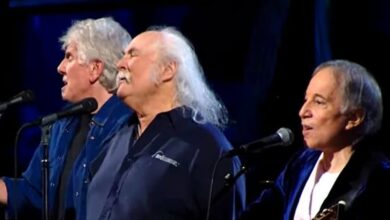
Solo Lines Meet Choral Harmony in the Singing Sergeants’ “Hallelujah”
Individual voices emerge from an ensemble setting in the Singing Sergeants’ recording of “Hallelujah.” The United States Air Force Band’s vocal group gives the melody a changing scale, moving between a clearly exposed line and the fuller sound of supporting harmonies.
The performance is available on the band’s official channel. It offers a complete view of the ensemble’s interpretation, including the gradual movement from the opening phrases toward the fuller later passages. Hearing that full development is useful for understanding the later peak.
The absence of instruments makes the arrangement’s construction easier to hear. Every sustained chord, rhythmic movement, and change in texture comes from the singers themselves. Those responsibilities make the ensemble’s work especially exposed.
The soloists bring individual colors to the melody while the ensemble provides continuity. That combination allows the song to remain personal even as the sound becomes much larger. The change between soloists adds variety without requiring a new song.
One of the most striking moments arrives as a later solo voice takes the lead around the middle of the recording. The changing vocal character gives the familiar refrain a renewed intensity. That moment belongs to the arc established by the earlier passages.
Watch the performance
The supporting harmonies are essential to that effect. They establish a foundation that can grow around the solo voice without crowding its phrasing. A supportive blend allows the lead to stay distinct.
“Hallelujah” has been interpreted by many performers, and its melody can support a wide range of settings. The Singing Sergeants emphasize what a blended choral sound can bring to it. The composition gives the ensemble a familiar framework to develop.
The performance depends on coordinated breathing and careful entrances. Those details are less obvious than a strong solo note, but they help the arrangement remain connected throughout. Coordinated entrances also shape the emotional pacing.
A cappella music also makes silence part of the texture. Brief spaces between phrases can be felt clearly because there is no instrumental layer continuing underneath. Those gaps give the next entrance a stronger sense of arrival.
The recording balances those spaces with the resonance of sustained voices. That contrast gives the music room to build without requiring a constant increase in volume. Sustained sound creates a different kind of momentum from a busy instrumental rhythm.
The ensemble’s uniformed presentation gives the video a distinctive visual identity, but the musical appeal is straightforward: a familiar song interpreted with precision and feeling. The viewer can connect that sound with the people producing it.
Alexandra Burke’s live “Hallelujah” offers a different vocal approach to the same composition. Comparing the recordings highlights the ways arrangement can change the scale of a song. A live solo performance by Burke brings those differences into particularly clear focus.
Norah Jones’s live interpretation of “Black Hole Sun” provides another example of a familiar piece transformed through restraint. Both recordings place attention on the voice and the shape of the melody. Jones’s performance uses a different repertoire but a related attention to pacing.
The Singing Sergeants’ performance rewards listening beyond its strongest climactic passage. The opening and supporting parts make that later intensity meaningful. A short highlight can make the strongest voice seem like the whole story. The complete performance shows how the ensemble prepares and supports that expressive peak.
Some listeners respond to the performance in spiritual terms, reflecting the atmosphere created by its arrangement. The recording offers a musical basis for that response: exposed solo lines, a patient build and harmonies that widen around the melody.
By the closing notes, the arrangement has shown how much variety can exist within an entirely vocal setting. “Hallelujah” becomes a shared performance shaped by individual expression and the depth of the ensemble. Returning to the quieter details gives the recording continuing interest.
More videos to explore
For a companion recording, The X Factor UK presents “Hallelujah, WHAT A PERFORMANCE from Alexandra Burke! | Live Shows | The X Factor UK.” This video offers another musical setting to explore alongside the featured performance, with attention to its own arrangement and the performers’ delivery.
For a companion recording, norahjonesVEVO presents “Norah Jones – Black Hole Sun (Live / Visualizer).” This video offers another musical setting to explore alongside the featured performance, with attention to its own arrangement and the performers’ delivery.
Further reading: Performance background and source.