Willie Nelson and His Sons Revisit a First Guitar Lesson in “Blue Eyes Crying in the Rain”
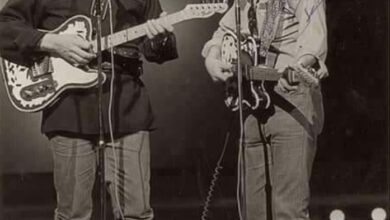
Willie Nelson, Lukas Nelson, and Micah Nelson gather around “Blue Eyes Crying in the Rain” with the ease of musicians who share a long history. The recording begins with a family memory, then lets that memory become a performance.
Lukas recalls the song as the first one his father taught him to play. That introduction gives the music a personal frame: a guitar lesson from childhood is now being revisited by an adult musician sitting alongside his father and brother.
The video appears on Willie Nelson’s official channel as “Willie Nelson and The Boys – Blue Eyes Crying In the Rain (Episode Five).” Its presentation keeps the focus on the musicians, their instruments, and the conversation that leads into the song.
The acoustic setting suits the material. With the voices and guitars close to the center of the sound, the melody does not need a large arrangement to hold attention. Small changes in phrasing can carry considerable emotional weight.
Lukas’s vocal resemblance to his father is part of the clip’s appeal, but the performance also allows differences to remain audible. A shared musical vocabulary does not make the singers interchangeable. Their individual deliveries give the family blend its texture.
Watch the performance
Willie’s presence brings another kind of familiarity. His phrasing has room to move around the steady accompaniment, making the words feel spoken as well as sung. That flexibility helps the song retain a personal quality within a carefully played arrangement.
The harmonies enlarge the refrain without turning it into a show of force. Each added voice supports the melody’s sadness. The result is a fuller sound that still belongs to the same close, quiet setting as the opening conversation.
There is something especially effective about hearing the music follow directly from the memory. The song does not arrive as an unrelated concert selection. It becomes a practical demonstration of the musical connection Lukas has just described.
The guitars help maintain that connection. Their accompaniment provides a common pulse for the singers, while the instrumental passages give the listener a different way to hear the melody’s feeling. The conversation continues through playing as much as through words.
Willie’s lead guitar line adds a distinctive voice of its own. A brief pause or a slightly delayed note can create tension within a simple phrase. The interest comes from placement and character rather than from filling every available space.
The song is closely associated with Nelson’s catalog, and his own website describes its importance as his first number-one single. Here, its scale is reduced to a family session, showing how familiar material can still hold a fresh personal meaning.
The recording also makes listening between musicians visible. They respond to the shared pulse and to one another’s phrasing. That attention is what allows the arrangement to feel relaxed without losing its shape or sense of direction.
On another listen, follow the point where the harmony enters. The transition changes the emotional color rather than merely increasing the volume. A family resemblance in the voices becomes part of a musical relationship the listener can hear.
Then concentrate on the instrumental space between vocal phrases. The guitar does not need to reproduce the exact rhythm of the words to support them. Its different timing provides a gentle counterweight to the vocal melody.
The clip’s intimacy comes from those relationships: memory and performance, lead and harmony, voice and guitar. None of them is presented as a separate attraction. Together, they make the familiar song feel like something being shared across generations.
Nelson and his sons leave the listener with a quiet family portrait made through music. A first guitar lesson has grown into a shared performance, while the song’s restrained expression keeps that connection at the center of the recording.
More videos to explore
Willie Nelson and Family’s Farm Aid 2024 “Last Leaf” offers another performance where an experienced voice shapes a reflective song. Its concert setting contrasts with the close family session above.
Nelson’s “Last Leaf” music video provides a second way to hear that song’s theme of endurance. Compare its recorded presentation with the acoustic interplay between the three Nelsons.
Further reading: Performance background and source.