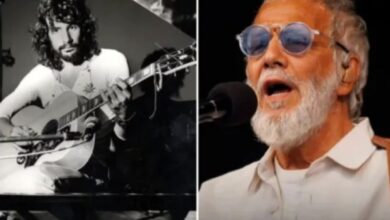
John Prine’s “Sam Stone” on Austin City Limits — The Quiet Performance That Still Echoes Decades Later
Some performances grow louder with time rather than fading away. They do not rely on spectacle or elaborate staging. Instead, they endure because the song itself carries something honest enough to outlive the moment it was first played. That is exactly what happened when John Prine performed “Sam Stone” during his appearance on Austin City Limits in 1988. The setting was simple, almost understated, yet the performance would remain one of those rare television moments that listeners continue to revisit years later.
John Prine walked onto the stage with the same quiet confidence that had defined much of his career. There was no attempt to dramatize the moment. No grand introduction or elaborate production surrounded him. Instead, the focus rested entirely on the songwriter and the guitar in his hands. That simplicity had always been part of Prine’s strength as a performer. His songs rarely needed embellishment, because the stories inside them were already powerful enough.
By the time of that 1988 appearance, “Sam Stone” was already well known among fans of Prine’s songwriting. The song originally appeared on his self-titled debut album in 1971, a record that introduced audiences to a young songwriter with a remarkable ability to capture the lives of ordinary people. Even then, Prine was only in his early twenties, yet he was writing songs that carried an emotional weight far beyond his age.
“Sam Stone” tells the story of a soldier returning home from the Vietnam War and struggling to rebuild a life after the trauma of combat. Rather than focusing on battlefield imagery, the song shifts attention to what happens after the soldier returns home. It explores the quieter, more personal struggles that follow war: isolation, addiction, and the difficulty of reconnecting with family and normal life. Prine approached the subject without preaching or dramatic exaggeration.
During the Austin City Limits performance, Prine delivered the song in the same calm and steady way he always had. His voice remained gentle and conversational, almost as if he were telling a story directly to each person in the room. The arrangement was minimal, allowing the lyrics to stand at the center of the performance. Every line arrived clearly, without distraction.
One of the most memorable moments in the song arrives with the lyric, “There’s a hole in Daddy’s arm where all the money goes.” Over the years, that single line has become one of the most widely recognized lyrics in John Prine’s catalog. Its directness captures the devastating reality of addiction in just a few words. The image is simple, but the emotion behind it is impossible to ignore.
In the Austin City Limits studio, the reaction from the audience reflected the weight of that lyric. The room grew noticeably quiet as the song unfolded. There were no dramatic reactions or interruptions. Instead, listeners seemed to absorb the story as it progressed, allowing the silence between the notes to carry as much meaning as the music itself.
Part of what made John Prine such a respected songwriter was his ability to treat difficult subjects with compassion rather than judgment. In “Sam Stone,” the character is not presented as a villain or a cautionary tale. Instead, Prine portrays him as a person struggling with the aftermath of experiences that changed him forever. That human perspective gave the song its emotional depth.
Austin City Limits has long been known for presenting artists in an intimate performance setting, and Prine’s appearance fit perfectly within that tradition. The program allowed musicians to perform their songs without unnecessary production or distractions. For a songwriter like John Prine, whose lyrics carried the heart of the performance, that kind of environment was ideal.
Throughout the song, Prine maintained the same quiet delivery that had made his recordings so powerful. There were no dramatic vocal flourishes or attempts to heighten the emotion artificially. Instead, he trusted the song itself to communicate everything that needed to be said. That trust in the writing is one of the reasons his work continues to resonate with listeners decades later.
The themes inside “Sam Stone” remain relevant because they address experiences that continue to affect many families. Veterans returning from war often face challenges that are not immediately visible. By focusing on the personal side of those struggles, Prine created a song that speaks to the emotional aftermath of conflict rather than the conflict itself.
As the performance continued, the audience remained completely engaged. The quiet atmosphere in the studio reflected the respect listeners had for the story unfolding in front of them. In moments like that, a performance becomes less about entertainment and more about shared understanding.
When the final notes faded, the impact of the song lingered in the room. The performance had not relied on dramatic staging or high volume. Instead, its strength came from the honesty of the songwriting and the sincerity of the delivery. Those qualities have always defined John Prine’s music.
Looking back today, the 1988 Austin City Limits performance of “Sam Stone” remains a clear example of what made John Prine such an important voice in American songwriting. His ability to write about difficult realities with empathy and clarity allowed listeners to see familiar struggles from a new perspective.
More than three decades later, the performance still resonates with audiences discovering the song for the first time. The quiet moment on that stage continues to remind listeners that sometimes the most powerful music does not need to raise its voice. It simply tells the truth and allows the listener to sit with it.