Lady Gaga Says She’s “So Humbled” After Surprise Super Bowl Halftime Cameo With Bad Bunny
On February 8, 2026, Super Bowl LX wasn’t just a championship night at Levi’s Stadium in Santa Clara, California—it became a pop-culture pressure cooker where every second of halftime was destined to be replayed, memed, debated, and celebrated. Bad Bunny’s Apple Music halftime show arrived with the kind of anticipation that feels less like “a performance” and more like a national appointment: you don’t just watch it, you attend it. The stadium was already buzzing from the game, but halftime carries its own electricity—one part concert, one part spectacle, one part group chat come to life. And in the middle of that, a global superstar decided to bring two more into his orbit, setting up a sequence of surprises that made the show feel like it was unfolding in real time rather than being delivered like a sealed product.
The build-up had its own playful tension days earlier, when Bad Bunny did what great headliners do: he teased without revealing. At the official halftime show press conference on February 5, he sidestepped questions about surprise guests with a grin and a shrug, turning the mystery into part of the entertainment. He framed the night as a party bigger than any one cameo—a celebration meant to feel like family, friends, and the broader Latino community in the room together. The strategy was classic: keep the door open, keep the rumors spinning, let the audience write the imaginary version of the show in their heads. Then, on game night, he could either meet expectations or flip them. He chose the flip, but in a way that felt celebratory rather than chaotic.
When the halftime set finally ignited, it didn’t tiptoe in. It came out swinging with “Tití Me Preguntó,” the kind of opening that instantly declares the tone: loud joy, fast movement, and a crowd that doesn’t need to be convinced. It’s one thing to perform a hit; it’s another to use it as an opening statement, like a flare shot into the sky. The staging looked built for momentum—something that could travel across the field, pull the cameras into motion, and keep the energy from sagging. The show wasn’t trying to be delicate. It was trying to be alive, with rhythm doing the heavy lifting and the crowd responding like they’d been waiting all night to exhale.
And then there was the larger statement hovering over the entire production: history. Bad Bunny became the first artist to deliver a Super Bowl halftime show entirely in Spanish, a choice that didn’t come dressed as a lecture or a scolding. It arrived as confidence—an insistence that the biggest stage in American sports can hold more than one language without needing translation to feel the impact. The spectacle did what the best halftime shows do: it gave people who already love him exactly what they came for, while also forcing casual viewers to engage with something they might not normally seek out. It wasn’t “permission” for Spanish on the field; it was a takeover that treated Spanish as already belonging there.
One of the most talked-about creative decisions was the return of “La Casita,” a set piece fans recognized as a hot-spot moment from his tour. Dropping it into the Super Bowl environment was a clever bit of world-building: it made the performance feel like it had a home, a neighborhood, a personality—something more specific than generic stadium futurism. And because halftime is partly about camera storytelling, “La Casita” gave directors and dancers a place to create scenes instead of just formations. It’s the difference between a performance that looks like a screensaver and one that looks like a short film. The set implied intimacy inside a massive broadcast, which is exactly the kind of contrast that gets people leaning closer.
Then came the cameos—less “celebrity standing around” and more “party guests who wandered onto the dance floor.” The show included star-studded appearances from names like Jessica Alba and Pedro Pascal, and it also included Cardi B—Bad Bunny’s “I Like It” collaborator—adding to the sense that the field had temporarily turned into a festival. The cameos worked because they didn’t feel like they were interrupting the show; they felt like they were inside the vibe. Halftime is often guilty of cameo inflation—faces popping up for applause breaks—but this one leaned into the idea of a communal celebration, where the crowd’s excitement is part of the staging.
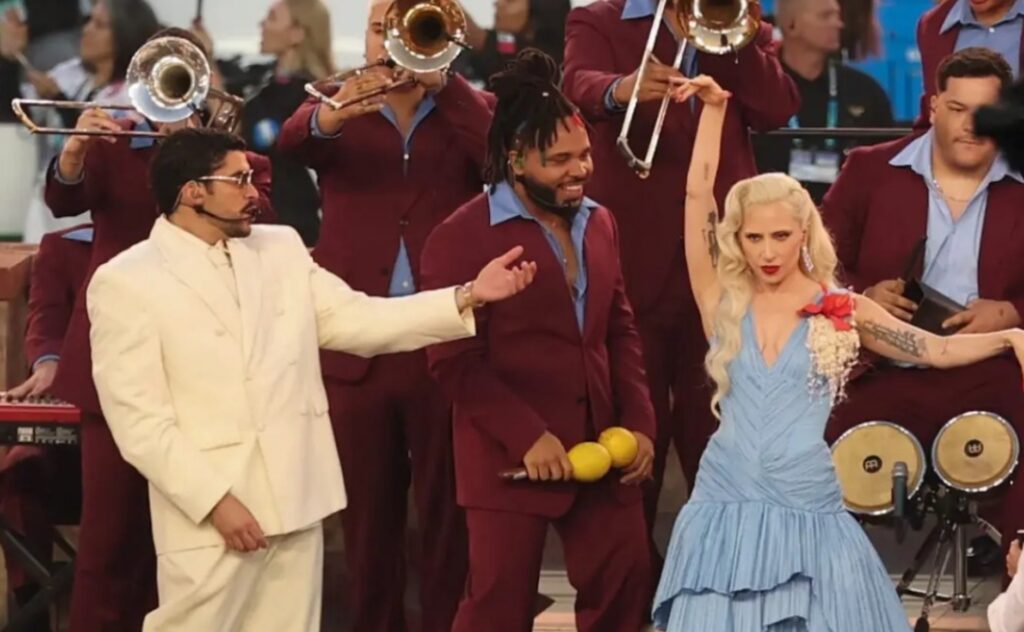
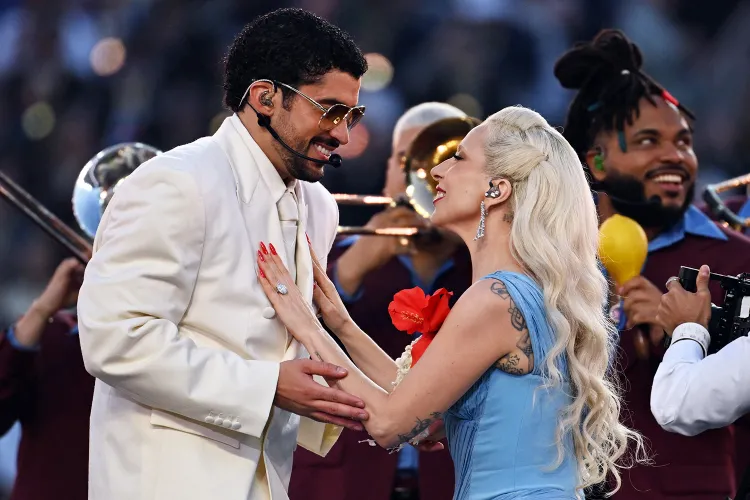
But the moment that flipped the entire night into headline territory was the surprise entrance of Lady Gaga. Midway through the performance, she appeared in a baby blue gown with red accessories, looking like she had stepped out of a stylized dream sequence. Instead of arriving with a predictable pop-rock blast, she performed a salsa rendition of “Die with a Smile,” her 2024 duet with Bruno Mars—only this time she delivered it solo, reshaped by a live band and the Latin pulse of the set. The choice was smart for two reasons: it honored the headliner’s world rather than forcing her own, and it let viewers experience a familiar song in a new body. In a halftime show, reinvention is oxygen.
The staging around Gaga didn’t treat her like a visiting monument. Bad Bunny joined her, danced with her, and let the moment breathe like a shared celebration instead of a “special guest presentation.” That’s why it hit: it looked less like a corporate handoff and more like two artists meeting inside the same rhythm. Gaga has done the Super Bowl before—she headlined in 2017—and that history could have made her cameo feel like a victory lap. Instead, the performance felt like she was stepping into someone else’s party and genuinely enjoying it. Viewers didn’t just see “Gaga appears”; they saw her adapting in real time, matching the energy, letting the band and choreography reframe her song in a way that served the show’s larger identity.
And right before Gaga’s performance, the show pulled off the kind of twist that’s so unexpected it sounds like a rumor until you see the footage: a real couple got married during halftime. The pair—Thomas “Tommy” Wolter and Eleisa “Elli” Aparico—appeared as part of the production, tying the knot on the field in a moment that was both theatrical and oddly tender. In a broadcast built on scale, weddings are the ultimate intimacy hack; they instantly make the audience feel like they’re watching something personal. The timing was also brilliant: placing it just ahead of Gaga’s song created a little emotional lift, a breath of sincerity before the next surge of spectacle. Halftime shows rarely pause for tenderness. This one found a way.
If Gaga’s entrance was the shock, Ricky Martin’s appearance was the roar of recognition. As Bad Bunny’s second surprise guest, Martin brought a classic superstar presence—effortless charisma with the weight of decades of pop history behind it. He performed “LO QUE LE PASÓ A HAWAii,” a track connected to Bad Bunny’s latest album DeBÍ TiRAR MáS FOToS, threading together generations of Latin stardom on the biggest possible stage. The pairing was also a savvy cultural statement: it wasn’t nostalgia for nostalgia’s sake. It was a reminder that Latin music isn’t a trend that arrived yesterday; it’s an ecosystem with elders, icons, and new kings sharing the same spotlight.
While the guests and set pieces dominated the headlines, the show’s physical daring had its own storyline. According to the halftime show’s director, Hamish Hamilton, Bad Bunny refused to wear a harness for his stunts—and one detail that made people’s palms sweat was the report that he climbed a utility pole without safety guardrails. Whether you’re the kind of viewer who loves risk or hates it, that kind of choice changes how the performance lands. It adds danger to choreography, turning “cool staging” into “is this actually happening?” Halftime shows often simulate risk with clever camera tricks. The talk around this one suggested real risk was part of the package, which is exactly the sort of thing audiences obsess over the next day.
And then there was the viral moment that sparked conversation far beyond the music: a sensual routine between two male dancers that many viewers interpreted as a deliberate nod to queer visibility and fluidity. The dancer reactions that followed emphasized representation, joy, and the idea that the stage can make room for people who rarely get that kind of mainstream spotlight. It became one of those cultural flashpoints halftime shows are uniquely built to produce—something that lasts longer than any single song because it taps into identity, values, and the emotional temperature of the moment. Even people who didn’t watch the game ended up watching that clip, because halftime is where the Super Bowl becomes a global conversation.
Then came the numbers—because in 2026, every major performance is measured in both emotion and analytics. Ratings data reported after the game said halftime viewership dipped compared to the game’s peak, yet the show still pulled massive attention, with the broader Super Bowl audience hitting historic highs during gameplay. More fascinating was the social media aftermath: the NFL cited a record-breaking burst of views across platforms in the first day after the performance. That’s the modern halftime reality: even if you miss it live, the internet reruns it for you, over and over, until you feel like you were there. The halftime show isn’t just a broadcast moment anymore—it’s a digital event that keeps unfolding long after the stadium lights change.
But the emotional capstone for this particular story didn’t come from ratings or replay counts—it came from Lady Gaga’s reaction afterward. She took to social media to thank Bad Bunny directly, writing that she was “so humbled to be a part of this moment,” and calling the performance powerful, important, and meaningful. The tone mattered: it didn’t read like a generic PR thank-you, but like someone genuinely moved by the scale and spirit of what they’d participated in. She also gave love to Ricky Martin and the wider cast, acknowledging that halftime is never just the headliner and the guest—it’s an army of dancers, musicians, stylists, directors, and crews building a moving city in minutes.
Even Gaga’s behind-the-scenes posts became part of the narrative, because halftime culture thrives on proof. Fans don’t just want the performance; they want the backstage hug, the quick photo in costume, the candid moment that confirms the vibe was real. Her carousel included images embracing Bad Bunny, shots of her outfit, and group moments that reinforced the feeling of a collaborative celebration rather than a transactional cameo. In a world where people are trained to suspect everything is manufactured, behind-the-scenes content functions like a receipt. It tells viewers: this wasn’t just a camera trick; these people actually shared the moment.
What made the night special, in the end, was how many different kinds of “event” it managed to be at once. It was a history-making Spanish-language halftime show, a cameo showcase, a pop reinvention moment for Gaga, a legacy-pop jolt with Ricky Martin, a stunt-driven spectacle, a viral cultural conversation, and—somehow—a wedding. Most halftime shows pick one or two of those lanes and ride them hard. This one stacked them. It didn’t feel like a performance that happened and ended; it felt like a series of moments that kept generating new headlines as the week went on. And Gaga’s words landed as the perfect final note: awe from an artist who knows exactly how hard it is to make the Super Bowl feel genuinely alive.