When The Heartbeat Returns: Budweiser’s Clydesdales And “American Icons” Take Back The Super Bowl Spotlight
Budweiser has long treated the Super Bowl as more than just a commercial break—it’s a cultural stage, and the Clydesdales are its most enduring stars. When those horses appear on screen, the message reaches beyond beer. It signals heritage, patience, craftsmanship, and a certain vision of American identity that feels rooted in something older than the broadcast itself. In the Super Bowl LX cycle, that identity returns with renewed intention. The environment is louder now, more polarized, more saturated with spectacle. Against that backdrop, Budweiser’s decision to lean into emotional symbolism instead of celebrity cameos feels deliberate. The gamble is clear: sincerity, executed with care, can still command attention in an age that often rewards irony over earnestness.
At the center of the 2026 campaign is a deceptively simple idea—trust the symbols people already understand. This isn’t about reinvention for the sake of novelty. It’s about refinement. As Budweiser marks its 150th anniversary, the creative direction leans into legacy, but not in a dusty, museum-like way. The visuals are cinematic and atmospheric rather than archival. Snow-dusted fields, warm barn light, slow-moving shadows—these aren’t nostalgic props, they’re mood-setters. The Clydesdales function less like mascots and more like visual anchors. Their physical presence slows the rhythm of the edit. Their sheer scale forces the camera to breathe. You cannot rush a 2,000-pound animal into emotional authenticity. It has to unfold naturally.
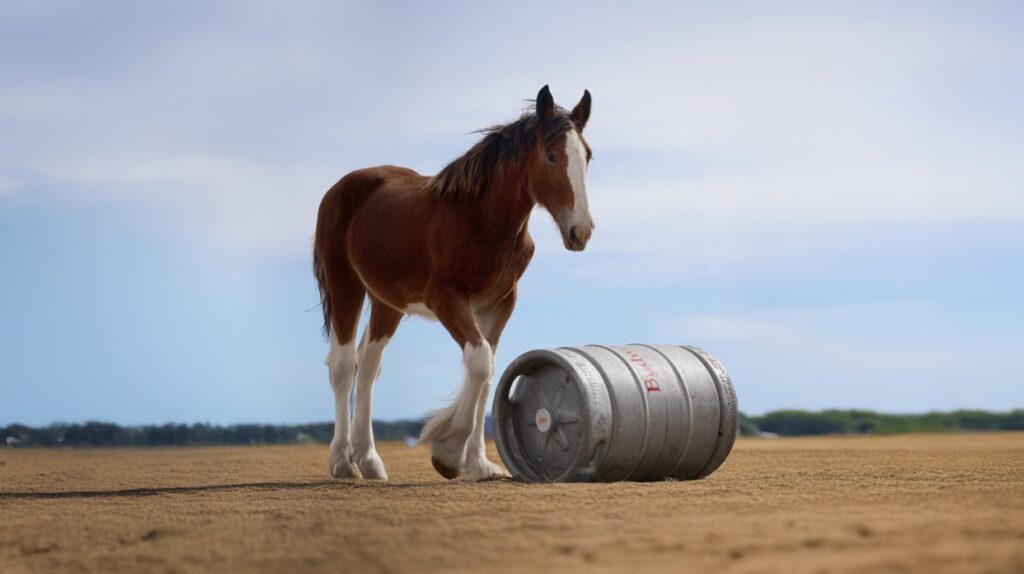
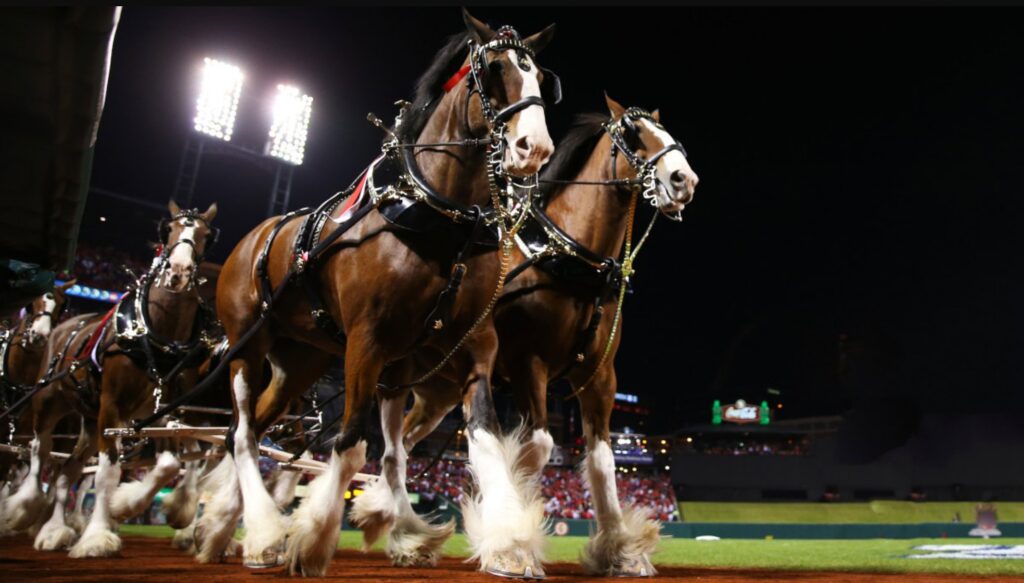
Looking back, the Clydesdales’ first Super Bowl appearance in 1975 marked the beginning of a long-running narrative thread. At first, they symbolized delivery power and old-world reliability. Over time, they transformed into something more cinematic—almost mythic. In the strongest of their Super Bowl appearances, the horses are not background decoration. They are protagonists. The product often becomes secondary to the emotional arc. That evolution is important. It explains why Budweiser continues to invest in living symbols rather than trending personalities. The horses do not expire with fashion cycles. They do not age out of relevance. They represent continuity, and in advertising, continuity is rare currency.
Super Bowl LX adds a new layer by pairing the Clydesdales with another powerful national symbol: the bald eagle. The full spot, titled “American Icons,” presents the story as a quiet fable. A young horse and a young eagle share space, weather, and movement in a way that feels symbolic without becoming heavy-handed. The narrative avoids overt explanation. Instead, it relies on visual storytelling and emotional timing. This is where the music choice becomes critical. Lynyrd Skynyrd’s “Free Bird” isn’t just background sound—it’s structural scaffolding. The song’s slow build and soaring release mirror the emotional trajectory of the commercial itself. The rise in tempo becomes the rise in feeling.
Before unveiling the full narrative, Budweiser introduced intrigue with teasers like “Stable.” The setup was intentionally restrained: five Clydesdales in a barn, turning their heads in unison toward a rattling metal bucket. No reveal. No obvious joke. Just tension and a simple message—“Heads Will Turn.” In a landscape crowded with loud, comedic teasers, this quiet mystery stood out. It trusted the audience to be curious. It trusted anticipation. That restraint felt almost radical in a digital environment designed for instant gratification.
The milestone statistics reinforce the broader story Budweiser is telling. This campaign marks the Clydesdales’ 48th national Super Bowl commercial appearance. That kind of longevity is more than trivia—it’s positioning. Very few advertising properties survive for decades while remaining culturally recognizable. Budweiser’s strategy has been consistency over flash. Instead of chasing whatever is momentarily viral, the brand has chosen to nurture a long-term symbol until it becomes inseparable from the event itself. When viewers see the horses, they don’t need context. The meaning is already embedded.
What distinguishes the 2026 iteration from previous campaigns is tonal discipline. After years of corporate messaging being pulled into cultural crossfire, “American Icons” feels intentionally steady. It avoids commentary and instead focuses on imagery that predates modern debates—animals, landscapes, sky, weather. Some interpret this as a safe move. Others see it as confidence. Regardless, the effect is clear: the ad avoids sarcasm and irony, choosing instead to commit fully to emotion. That kind of straightforwardness can either fall flat or land powerfully. In this case, the craftsmanship supports the choice.
There is also a pacing decision that separates this campaign from many of its Super Bowl peers. Modern commercials often rely on rapid edits, visual overload, and surprise cameos. Budweiser moves slowly. It allows shots to breathe. It builds tension before release. That patience aligns perfectly with the structure of “Free Bird.” The commercial feels less like a punchline and more like a crescendo. When the emotional peak arrives, it feels earned rather than triggered.
The power of “Free Bird” in this context lies in its architecture. The live versions reveal how the song gradually transforms from introspective to explosive. That transformation mirrors Budweiser’s visual storytelling. The early stillness gives way to lift. The melody expands. Emotion accumulates. By the time the song reaches its iconic climax, the imagery is already aligned with that emotional trajectory. The music doesn’t overpower the visuals; it amplifies them.
The studio recording of “Free Bird” is cleaner and more controlled, yet it retains the same emotional blueprint. This is the version embedded in cultural memory—the one countless listeners associate with open highways, nostalgia, and expansive skies. Budweiser’s choice to use it carries built-in resonance. Familiar music can easily feel manipulative in advertising, but here it’s integrated with restraint. The song is not treated as a gimmick. It’s treated as narrative structure.
Looking at other emotionally charged live performances provides useful contrast. The strongest stadium moments—whether rock anthems or patriotic songs—share a similar quality: they commit without irony. They rely on atmosphere rather than spectacle. They trust simplicity. That same principle applies to “American Icons.” The camera finds stillness within scale. It focuses on connection rather than chaos.
Large-scale national performances can easily slip into melodrama, but the enduring ones resist that temptation. They choose clarity over excess. Budweiser’s 2026 spot adopts that same discipline. It doesn’t try to overwhelm the viewer. It allows the symbolism to speak plainly. The Clydesdales and the eagle are not new inventions—they are cultural fixtures. The difference lies in how carefully they are framed.
Across teasers, the full commercial, and the musical foundation, the through-line is consistency. Budweiser isn’t reinventing itself. It’s refining what it has always represented. The Clydesdales stand as living proof of brand patience. The eagle reinforces the national symbolism without dialogue. The music carries the emotional arc. Whether audiences interpret it as heartfelt tradition or strategic restraint, the craftsmanship remains undeniable. In a Super Bowl landscape defined by noise, Budweiser chose steadiness—and that steadiness may be what makes the moment endure.