The Eagle Wasn’t CGI: The Real Story Behind Lincoln, the Bird Who Stole Budweiser’s Super Bowl Moment
If you watched that eagle rise into the air at the end and immediately thought, “That can’t be real,” you weren’t alone. Many people assumed it had to be CGI. But the truth is far more compelling. The bird is real, and his story feels almost too perfectly suited for a Super Bowl moment. His name is Lincoln, and long before millions saw him soar in a Budweiser commercial, he was a vulnerable bald eagle whose survival depended entirely on human intervention at exactly the right moment.
Lincoln’s journey began in Tennessee under circumstances most wild animals never recover from. His early days weren’t cinematic or symbolic—they were about basic survival: being fed, being protected, staying alive. Those practical details are precisely what give his later story its emotional weight. When an animal doesn’t experience a normal upbringing in the wild, the impact is permanent. For Lincoln, the most critical loss was never learning how to hunt and survive independently.
That missing skill changes everything for a bald eagle. Hunting isn’t something an eagle simply picks up later in life. It’s learned early, refined over time, and passed down through experience. When that chain is broken, nature doesn’t pause to compensate. It moves forward without mercy. That reality explains why Lincoln’s early life didn’t end with a dramatic return to the wild, no matter how much everyone involved hoped it might.
Eventually, Lincoln came under the care of the American Eagle Foundation, an organization dedicated to rescuing birds of prey and educating the public about them. Their mission isn’t about spectacle or display. It’s about making difficult, realistic decisions—understanding what an animal can and cannot do, and shaping a life that still has value and purpose when returning to the wild is no longer possible.
The most painful part of Lincoln’s story is also the most revealing. He was released back into the wild twice, and both attempts failed. Not because he lacked the desire to be free, but because freedom without survival skills is a slow crisis. Each time, he was found weak, undernourished, and unable to sustain himself. Those moments force caretakers to make the hardest call of all: this eagle cannot safely live on his own.
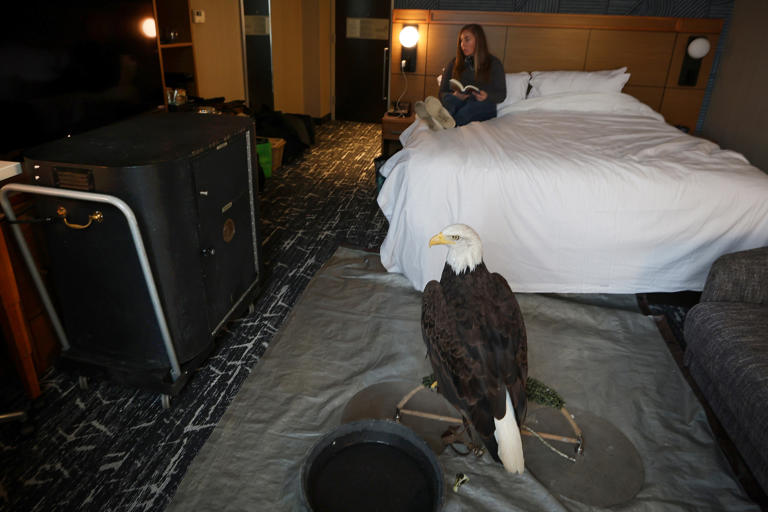
From there, the narrative shifts from rehabilitation to purpose. A non-releasable eagle still needs stimulation, structure, movement, and meaning. This is where training comes in—but not in the performative sense people often imagine. It’s about building strength, confidence, and predictable patterns so the bird can move safely in controlled environments, tolerate noise and distance, and remain calm in situations that would overwhelm a wild eagle.
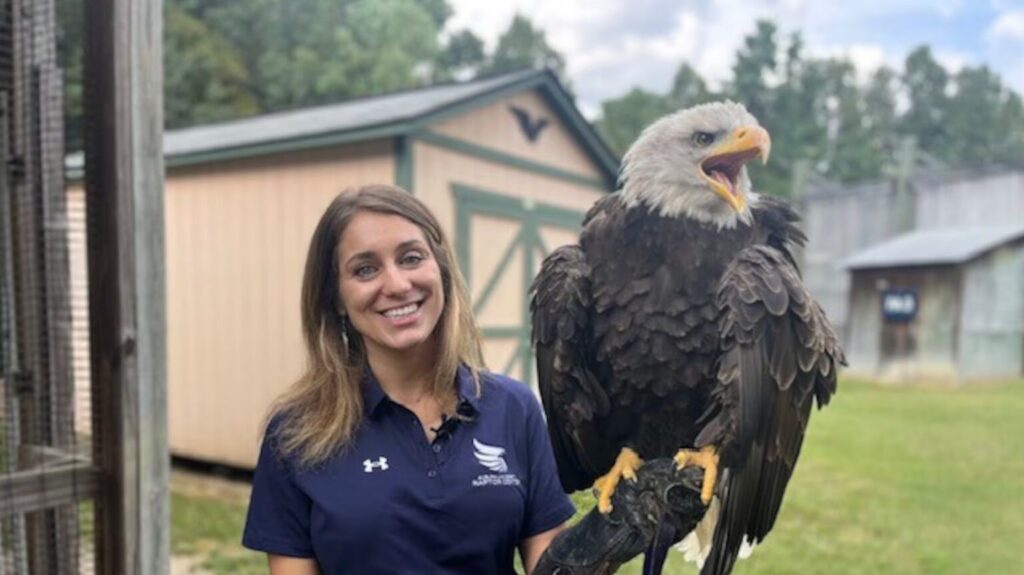
This is where time becomes essential. Lincoln wasn’t prepared to fly in stadiums overnight. He didn’t become a symbol in a single season. Accounts from those involved describe years of careful work—slow exposure, consistent routines, controlled repetition—until he could perform something that looks effortless to an audience but is actually built on trust and precision.
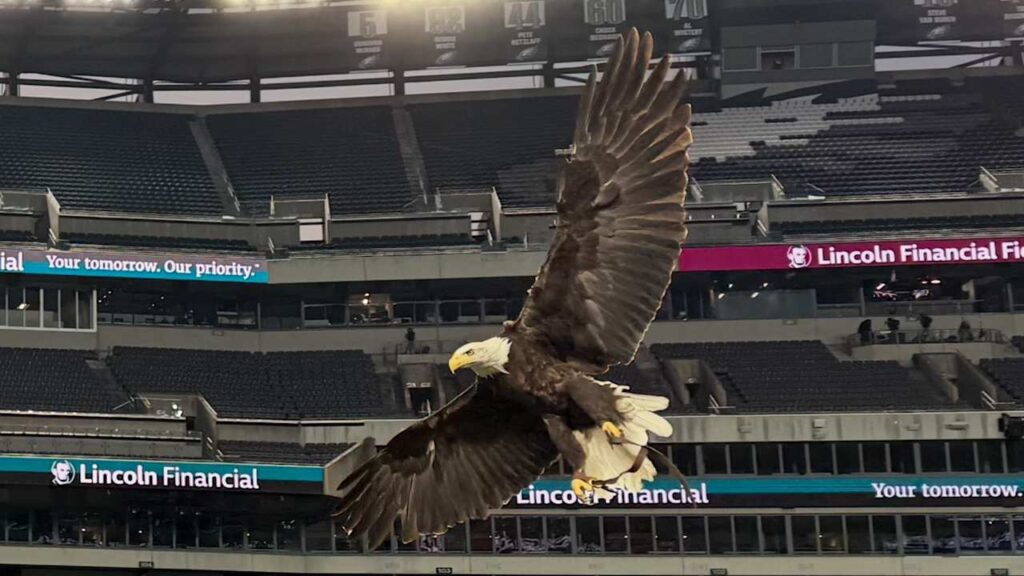
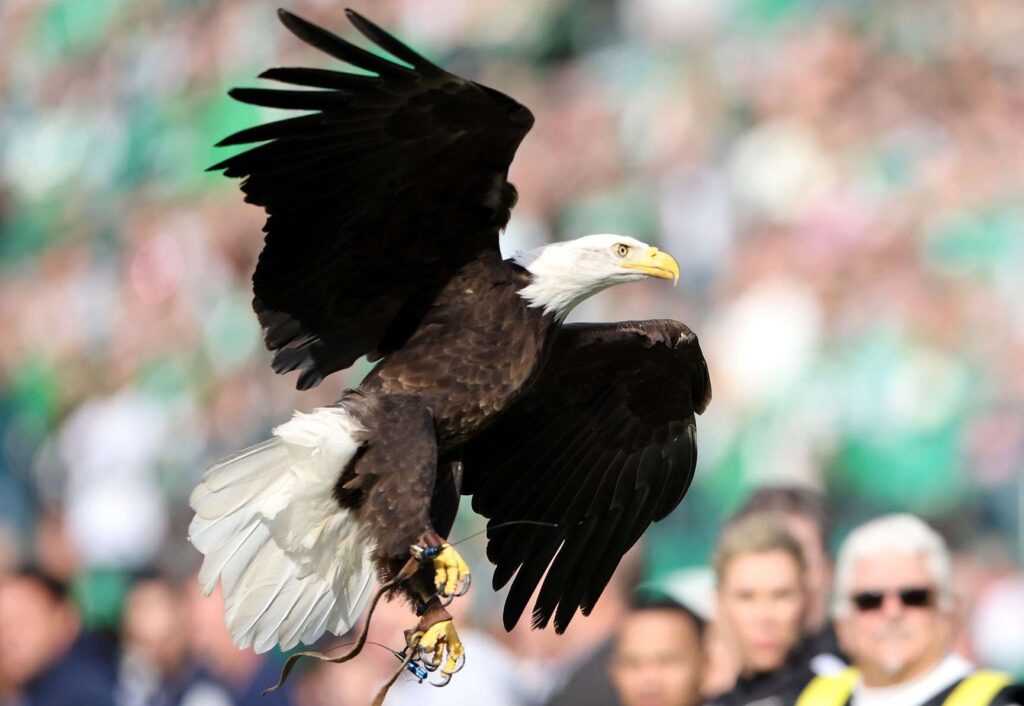
Flying an eagle inside a stadium may sound simple until you consider what a stadium really is for an animal: echoing noise, shifting light, sudden motion, unpredictable energy, open air, and tens of thousands of people reacting at once. One unexpected movement can become dangerous. So when Lincoln launches, circles, and returns calmly, it isn’t just impressive—it’s the visible result of years of invisible preparation.
That’s why Lincoln’s connection to Philadelphia Eagles home games feels so natural. He isn’t a cartoon mascot or a gimmick. He appears during moments of shared focus—often around the national anthem—when an entire stadium grows quiet and looks upward together. In a culture built on noise, it becomes a rare pause, a collective breath.
The symbolism deepens when you consider the setting itself: Lincoln Financial Field. When Lincoln flies there, it doesn’t feel staged. It feels ceremonial. Fans often describe the experience as hair-raising—part sports tradition, part patriotic imagery, part raw animal presence. The reaction isn’t applause for a trick. It’s awe.
That authenticity is exactly why Budweiser’s camera found him. In an age of hyper-polished ads filled with CGI and artificial “realness,” Lincoln brought something unmanufactured. When a real animal moves, the truth is in the motion. The wingbeats aren’t animated. The lift isn’t edited into existence. You feel the weight, the physics, the reality—and that registers emotionally, even if viewers can’t articulate why.
So when Budweiser chose to close its Super Bowl story with Lincoln, it wasn’t just because eagles look powerful. It was because his real-life journey already carried the themes the ad needed: rescue, resilience, second chances, and a version of freedom shaped by care rather than wilderness.
The music choice sealed that emotion. “Free Bird” isn’t just a song—it’s cultural memory. As it builds, it mirrors the ascent on screen. Combined with a real eagle in flight, the moment stops feeling like advertising and starts feeling like something shared and human. That’s why so many people felt it before they even understood it.
One detail viewers keep repeating says everything: the eagle wasn’t AI. That matters because audiences are exhausted from asking what’s fake. Lincoln answers that fatigue with a simple truth. He exists. He has a history. His flight means something. And that meaning lands harder than any visual effect ever could.
If Lincoln’s story can be summed up in a single line, it’s this: he couldn’t survive in the wild, but he didn’t become a tragedy. He became a connection—between people and a feeling we rarely slow down enough to experience anymore. That’s why his final flight didn’t feel like a trick. It felt earned.
And that’s the real behind-the-scenes truth. The most powerful creative decision wasn’t an edit, a lens, or a visual effect. It was choosing a living animal with a real past, letting that reality carry the moment, and trusting the audience to feel it. Lincoln’s flight isn’t just an ending shot. It’s proof of a life redirected—from survival in the wild to purpose in a world that still needs symbols that are genuinely real.