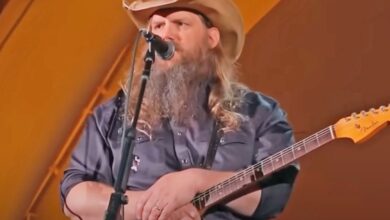
Jelly Roll Didn’t Celebrate His GRAMMY Wins — He Told the Truth That Stopped the Room Cold
The room didn’t just quiet down at the 68th GRAMMY Awards on February 1, 2026 — it recalibrated. Crypto.com Arena had been running on that familiar awards-show current: cheers, camera cuts, big reactions, and the constant sense that the night is always moving. Then Jelly Roll stepped up after winning Best Contemporary Country Album for Beautifully Broken, and the energy changed in a way you can’t script. This wasn’t a victory lap, and it didn’t sound like one. It felt like the kind of moment that interrupts an entertainment broadcast and reminds everyone that the people onstage are real human beings carrying real histories.
By the time he reached the microphone, Jelly Roll wasn’t arriving as a one-time surprise winner. Official GRAMMY listings show he left the night with three wins at the 68th ceremony — including Best Contemporary Country Album (Beautifully Broken), Best Contemporary Christian Music Performance/Song (“Hard Fought Hallelujah” with Brandon Lake), and Best Country Duo/Group Performance (“Amen” with Shaboozey). That “three for three” sweep mattered because it meant he wasn’t just being rewarded for a single hot moment. The Academy was essentially stamping multiple sides of his identity at once: the country storyteller, the faith-forward collaborator, the arena-ready performer. Still, the second his speech began, he made it clear the trophies were not the center of the story.
The most cinematic part of the night, ironically, happened away from the stage before the big speech even aired. Bunnie Xo — his wife and loudest believer — captured behind-the-scenes clips of the evening that spread quickly online. In some coverage, she’s literally shown getting ready in curlers and a robe, then running to him when the wins sink in, wrapping him in a tearful, full-body hug that feels more like relief than celebration. That visual became a kind of prequel to the acceptance speech: the private version of the same truth he would later say out loud. You could watch it and understand, instantly, that for them this was never “just awards.” It was survival turning into proof.
When the televised moment arrived, Jelly Roll didn’t lean into jokes or a carefully polished speech cadence. He looked emotional from the start — and then he looked right at Bunnie, calling her his “beautiful wife,” and suddenly the whole arena felt like it had shrunk into a living room. He spoke like someone who has rehearsed gratitude a thousand times in his head and still can’t find words big enough. The applause didn’t interrupt him much, because the audience could tell: interrupting would break the spell. This wasn’t the kind of speech people half-listen to while waiting for the next category. It demanded attention.
Then he said the sentence that made the moment stop being “inspiring” and become genuinely raw. He credited Bunnie and Jesus, and he stated plainly that without her he would have killed himself. It landed with a bluntness you don’t usually hear on a broadcast built around glamour. It wasn’t phrased like a slogan. It wasn’t wrapped in metaphor. It was a man admitting what the darkest version of his life looked like — and saying, on the record, that love kept him alive. That’s the kind of confession that doesn’t leave much oxygen in a room. People don’t cheer right away. They process. They feel it. They swallow hard.
He didn’t stop at the confession, either — he explained the shape of the transformation. In coverage of the speech, he described being incarcerated and the small things that carried him: a Bible, a little radio, and the belief that music and faith could still reach someone like him. This is where the speech became more than a personal thank-you. It turned into testimony — not in the preachy sense, but in the “I have lived the opposite and I came back” sense. He wasn’t presenting himself as cleaned up and perfect. He was presenting himself as a work-in-progress who got given a second chance and refuses to waste it.
And then came the line that people replayed: “Jesus is for everybody.” The way he framed it — according to multiple recaps — was pointedly nonpartisan and non-tribal. He emphasized that Jesus isn’t owned by one political party and isn’t owned by a music label. That matters because it’s the difference between a religious message and a human one. He wasn’t trying to sort the room into teams. He was trying to widen the door. In the context of an awards show where even small statements can be interpreted as cultural battles, his tone was almost disarming: no argument, no finger-pointing, just grace from someone who knows what it feels like to think you’re beyond grace.
The impact inside the arena was visible. Reports described Bunnie crying, and you could see the kind of emotion that isn’t “proud spouse at awards” but “person who remembers the nights nobody else saw.” That’s what made the moment travel through the crowd. People weren’t reacting only to Jelly Roll’s words; they were reacting to the shared evidence of love sitting right there in the seats, watching him do the thing they once only dreamed he could do. Even if you didn’t know their story, you could feel the stakes. When someone thanks their partner like that, it tells you the partner wasn’t just around for the glow-up. They were around for the fire.
Part of why the speech hit so hard is that Jelly Roll’s whole public persona has always carried the tension between rough edges and tenderness. He’s never marketed himself as untouchable. He’s marketed himself as reachable — as the guy who messes up, keeps going, and still tries to be good. That’s why, even with three trophies on the line, the most memorable thing he offered wasn’t confidence. It was honesty. The night could have been framed as “the industry finally accepts him.” Instead, he framed it as “I’m alive, I’m loved, and I’m grateful.” That reversal is why the room went quiet: people recognized authenticity immediately.
Outside the arena, the speech turned into a rapid-fire clip economy moment — not the shallow kind, but the rare kind where the internet spreads something because it feels true. People recaps highlighted the exact quotes. Fans reposted the “Jesus is for everybody” line. Others replayed the part where he looked at Bunnie and thanked her like his life depended on it — because, in his own words, it did. In an age where award-show speeches are often forgotten before the next commercial break ends, this one became a shared emotional reference point almost instantly.
The post-show coverage added another layer: Jelly Roll’s relationship to politics, or rather his refusal to pretend he’s an expert. In interviews reported after the ceremony, he described himself in blunt terms and said he felt disconnected from politics, referencing his upbringing and the years of chaos and prison that shaped him. That context matters because it reinforces what made his acceptance speech believable. He wasn’t trying to sound like a polished commentator. He was speaking as a man who came from far outside the typical entertainment pipeline and still feels like he’s learning how to stand on that stage.
It also matters that the wins themselves weren’t all delivered in one clean televised arc. Some of the awards happened off-camera, which is exactly how award shows work, but it made their night feel more human. Instead of one perfectly orchestrated “winner moment,” there were bursts of news backstage, reactions in dressing rooms, and then the big onstage release when he finally had the mic. That staggered rhythm is why Bunnie’s behind-the-scenes footage resonated. It showed the messy, tender in-between moments — the ones that feel like real life, not a highlight reel.
Even the categories he won tell the story of why this moment stood out. Best Contemporary Country Album recognizes a body of work, not just a single viral track. Best Country Duo/Group Performance signals he can share spotlight and still shine. Best Contemporary Christian Music Performance/Song places him in a space where faith isn’t an accessory, it’s part of the message. Then his speech connected all of it in one sentence: the music, the love, the belief system, the survival. It wasn’t a random assortment of wins anymore. It was a narrative that suddenly made sense to everyone watching.
What made the moment special, ultimately, wasn’t that Jelly Roll got emotional on television. Lots of artists cry. What made it special was that he used the biggest platform of his career to tell the truth about how close he came to not being here — and then used that truth to offer something outward, not inward. He didn’t weaponize his pain. He translated it into gratitude, humility, and an open-handed message about redemption. He turned a trophy moment into a testimony of love. And the audience didn’t just applaud it — they went quiet first, because quiet is what you do when a room suddenly realizes it’s witnessing something real.