Dave Grohl and Daughter Violet Lead an Emotional Nirvana Reunion at FireAid 2025
FireAid on January 30, 2025 didn’t feel like a normal concert the moment it began. Built as a large-scale benefit for communities affected by devastating California wildfires, the event carried a weight that went far beyond entertainment. Fans arriving in Inglewood understood they weren’t just there to sing along or chase nostalgia — they were part of a collective response. That atmosphere changed how everything landed inside the venue. Performances felt less polished and more honest, speeches felt heavier, and every surprise carried emotional stakes. Benefit shows have always had that rare permission to blur spectacle and sincerity, and FireAid leaned fully into that space.
The scale of the night made it feel unpredictable in the best possible way. With multiple stages, nonstop transitions, and a lineup packed with major artists, the evening unfolded like a relay race of emotion. One moment leaned celebratory, the next reflective, then suddenly explosive again. That constant motion created the perfect environment for something genuinely unexpected to land without feeling forced. Big charity events are one of the few places where the rules loosen enough for history to quietly step onstage — not announced, not teased, just happening in real time while the crowd slowly realizes what they’re witnessing.
That realization hit hard when the familiar silhouettes of Dave Grohl, Krist Novoselic, and Pat Smear took their places. There was no dramatic buildup, no over-explanation. It simply happened. A Nirvana reunion — carefully handled, deeply respectful, and instantly electric. For a band whose legacy is inseparable from authenticity and emotional truth, the setting felt right. This wasn’t nostalgia for nostalgia’s sake. It was a moment rooted in purpose, appearing at a night dedicated to loss, recovery, and community. The audience response wasn’t screaming hysteria; it was stunned recognition.
What made the reunion especially powerful was its structure. No one tried to replace Kurt Cobain. Instead, the songs were shared, passed hand to hand through rotating guest vocalists — a choice that honored the band’s past without pretending it could be recreated. That approach has become a defining feature of Nirvana’s rare reunions over the years, and at FireAid it felt particularly meaningful. The songs weren’t frozen in time. They were alive, adaptable, and still capable of carrying new voices without losing their emotional core.
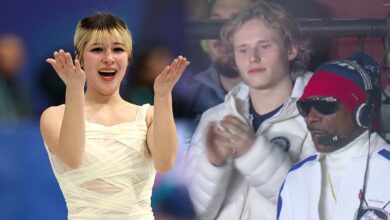
Then came the moment that shifted the entire room: Violet Grohl stepping forward to sing. The crowd response changed instantly — not louder, but deeper. Seeing Dave Grohl’s teenage daughter take the microphone wasn’t framed as a gimmick or a viral stunt. It felt organic, almost inevitable, especially given how openly Grohl has spoken about music as something that binds generations rather than separates them. Violet didn’t approach the moment timidly or overconfidently. She approached it honestly, with focus and visible emotion, standing at the center of songs that shaped rock history while making them unmistakably her own.
Her performance carried a different kind of electricity — not aggression, but clarity. Fans watching could feel that this wasn’t about proving anything. It was about presence. Violet’s voice didn’t imitate Cobain’s phrasing or delivery, and that restraint made the performance stronger. She allowed the songs to breathe, to ache, to resonate in a way that matched the night’s purpose. Watching Dave Grohl behind the kit, visibly emotional yet fully locked in, added another layer entirely. It wasn’t just a reunion; it was a passing of something intangible but deeply felt.
The internet reaction was immediate and intense, but not cynical. Clips spread fast, not because the moment felt shocking, but because it felt sincere. Comment sections filled with fans saying this was their favorite Nirvana reunion — not the loudest, not the most famous, but the most human. People talked about seeing a father and daughter share a stage without spectacle, about watching a band allow its legacy to evolve rather than calcify. In a culture used to manufactured “moments,” this one stood out by refusing to announce itself as one.
FireAid’s broader mission only amplified the meaning. Knowing the performance existed to raise money and awareness — not sell tickets or promote a tour — stripped away the usual industry noise. The reunion wasn’t framed as a comeback or a tease for more. It existed entirely in the present tense. That’s why it landed so hard. Nirvana’s music has always lived in the space between pain and release, and that emotional language translated seamlessly into a night focused on healing and rebuilding.
The set also reminded longtime fans why Nirvana reunions, when they happen, are treated differently. They aren’t about rewriting history or reliving a peak. They’re about honoring connection — between band members, between generations, between music and lived experience. Seeing those songs performed in a modern context, with a young voice carrying them forward, made the legacy feel active rather than archived.
By the time the set ended, the audience wasn’t cheering wildly so much as exhaling. It felt like something had been shared rather than consumed. That’s a rare outcome for any live performance, let alone one involving a band as mythologized as Nirvana. FireAid created the conditions, but the artists filled the space with something unrepeatable.
In the days that followed, the performance continued to circulate, not fading into background content. Fans returned to it, rewatched it, discussed it. That longevity says more than view counts ever could. The reunion didn’t rely on shock value. It relied on honesty, restraint, and emotional alignment with the moment it occupied.
In the end, FireAid didn’t just deliver a headline-worthy reunion. It delivered a reminder of why music still matters when the stakes are real. A band rooted in truth, a father sharing the stage with his daughter, a crowd gathered for something bigger than themselves — all converging briefly before moving on. Those are the moments that last, long after the lights go down.