A Night of Remembrance and Resilience: Reba McEntire Leads a Powerful GRAMMYs In Memoriam Tribute
The 2026 GRAMMY night in Los Angeles had the usual glow of a music industry holiday—flashbulbs, couture, cameras hunting for reactions—but the emotional center of gravity arrived when the show turned its attention to the people who aren’t in the room anymore. The In Memoriam segment is always a tonal shift, a hard pivot away from celebration and into gratitude, reflection, and that quiet ache you feel even while the broadcast keeps moving. This year, it didn’t feel like a quick montage or a box to check. It unfolded like a carefully staged mini-story inside the larger spectacle, built to remind everyone watching that the music outlasts the moment, but the people behind it never become “just credits.” Grammy Awards
It helped that the arena itself seemed to understand the assignment. Inside Crypto.com Arena, the atmosphere carried a different kind of hush as the segment approached—less “who’s trending,” more “who mattered.” The camera language changed too: fewer frenetic cuts, more lingering faces, more pauses where you could feel the audience absorbing what they were seeing. The show didn’t pretend the losses were distant. It treated them like fresh weather passing through the room. That’s the tightrope the GRAMMYs always walk: honor the living without turning the dead into background décor. This time, the balance leaned toward sincerity, and that made everything that followed land with extra weight.
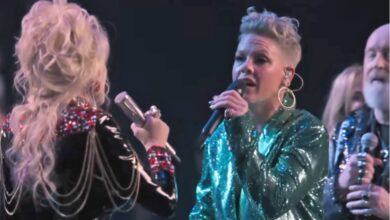
Then Reba McEntire stepped into the spotlight, and the segment immediately gained a human anchor. She’s a performer who can project warmth without forcing it, and she has that rare ability to sing “to” a room, not “at” it. The arrangement gave her space—enough air in the music for the meaning to show up. You could feel the room recalibrate around her. Not because she was doing something flashy, but because she was doing something honest: delivering a performance that understood grief doesn’t need theatrics, it needs steadiness. From the first lines, it sounded like a tribute that wasn’t trying to chase a viral moment, but would become one anyway.
She wasn’t alone, either. With Brandy Clark and Lukas Nelson alongside her, the performance took on the feel of a shared vigil—three voices carrying one idea, passing it back and forth like a candle flame that refuses to go out. The blend mattered: Clark’s grounded storytelling energy, Nelson’s earthy tone, and Reba’s unmistakable authority created a texture that felt both classic and current. It didn’t read like a random booking. It read like a deliberate choice: put artists onstage who understand how to sing for an audience that’s remembering, not partying.
The song choice, “Trailblazer,” played like a tribute designed to broaden the frame beyond one person. In an awards show built on titles and categories, “Trailblazer” made the point that legacy isn’t just about chart peaks or trophies. It’s about who cleared a path for the rest. The performance moved with a patient pace, letting the words do their work. There were moments where you could feel the audience breathing together, which is not something live televised events achieve easily. It didn’t feel like the room was being told to feel something; it felt like the room was being invited to.
And then came the gut-punch detail that made this “unforgettable moment” more than a nice description. During the performance, the name of Brandon Blackstock appeared behind Reba as part of the memorial visuals. That’s where a lot of viewers got confused online, because some posts called him Reba’s “son.” The reality is more specific and, in some ways, more layered: he was her former stepson, connected through her past marriage to his father. But grief doesn’t care about technical labels, and the show didn’t present it like tabloid math. It presented him as a life lost in the music community—a person whose absence matters to the people who knew him, and to the family ties that don’t disappear just because relationships change.
That context made the camera shots of Reba hit differently. You could see the composure that performers build over decades, and you could also sense the personal weight that sits behind the professionalism. The moment worked because it didn’t ask you to know every detail of her family history to understand what you were watching. Anyone who’s ever tried to “keep it together” in public recognized the energy: the voice stays steady, the posture stays calm, and somewhere behind the eyes there’s a private storm. The show didn’t sensationalize it with melodrama. It let it be what it was—quietly huge.
The 2026 GRAMMY night in Los Angeles had the usual glow of a music industry holiday—flashbulbs, couture, cameras hunting for reactions—but the emotional center of gravity arrived when the show turned its attention to the people who aren’t in the room anymore. The In Memoriam segment is always a tonal shift, a hard pivot away from celebration and into gratitude, reflection, and that quiet ache you feel even while the broadcast keeps moving. This year, it didn’t feel like a quick montage or a box to check. It unfolded like a carefully staged mini-story inside the larger spectacle, built to remind everyone watching that the music outlasts the moment, but the people behind it never become “just credits.” Grammy Awards
It helped that the arena itself seemed to understand the assignment. Inside Crypto.com Arena, the atmosphere carried a different kind of hush as the segment approached—less “who’s trending,” more “who mattered.” The camera language changed too: fewer frenetic cuts, more lingering faces, more pauses where you could feel the audience absorbing what they were seeing. The show didn’t pretend the losses were distant. It treated them like fresh weather passing through the room. That’s the tightrope the GRAMMYs always walk: honor the living without turning the dead into background décor. This time, the balance leaned toward sincerity, and that made everything that followed land with extra weight.
Then Reba McEntire stepped into the spotlight, and the segment immediately gained a human anchor. She’s a performer who can project warmth without forcing it, and she has that rare ability to sing “to” a room, not “at” it. The arrangement gave her space—enough air in the music for the meaning to show up. You could feel the room recalibrate around her. Not because she was doing something flashy, but because she was doing something honest: delivering a performance that understood grief doesn’t need theatrics, it needs steadiness. From the first lines, it sounded like a tribute that wasn’t trying to chase a viral moment, but would become one anyway.
She wasn’t alone, either. With Brandy Clark and Lukas Nelson alongside her, the performance took on the feel of a shared vigil—three voices carrying one idea, passing it back and forth like a candle flame that refuses to go out. The blend mattered: Clark’s grounded storytelling energy, Nelson’s earthy tone, and Reba’s unmistakable authority created a texture that felt both classic and current. It didn’t read like a random booking. It read like a deliberate choice: put artists onstage who understand how to sing for an audience that’s remembering, not partying.
The song choice, “Trailblazer,” played like a tribute designed to broaden the frame beyond one person. In an awards show built on titles and categories, “Trailblazer” made the point that legacy isn’t just about chart peaks or trophies. It’s about who cleared a path for the rest. The performance moved with a patient pace, letting the words do their work. There were moments where you could feel the audience breathing together, which is not something live televised events achieve easily. It didn’t feel like the room was being told to feel something; it felt like the room was being invited to.
And then came the gut-punch detail that made this “unforgettable moment” more than a nice description. During the performance, the name of Brandon Blackstock appeared behind Reba as part of the memorial visuals. That’s where a lot of viewers got confused online, because some posts called him Reba’s “son.” The reality is more specific and, in some ways, more layered: he was her former stepson, connected through her past marriage to his father. But grief doesn’t care about technical labels, and the show didn’t present it like tabloid math. It presented him as a life lost in the music community—a person whose absence matters to the people who knew him, and to the family ties that don’t disappear just because relationships change.
That context made the camera shots of Reba hit differently. You could see the composure that performers build over decades, and you could also sense the personal weight that sits behind the professionalism. The moment worked because it didn’t ask you to know every detail of her family history to understand what you were watching. Anyone who’s ever tried to “keep it together” in public recognized the energy: the voice stays steady, the posture stays calm, and somewhere behind the eyes there’s a private storm. The show didn’t sensationalize it with melodrama. It let it be what it was—quietly huge.
The wider In Memoriam roll reinforced that same idea: the industry is a giant machine, but it is powered by individuals—writers, producers, performers, managers, the people who make the invisible parts happen. Watching the montage alongside the live performance, you could feel how the segment was trying to honor the full ecosystem of music, not just the marquee names. That’s what makes a memorial segment feel real: when it acknowledges that art isn’t only made by the faces on the album cover. It’s made by a network of lives, and when those lives end, the music world changes shape.
And yet, the show also understood that remembrance can’t be one-note. It built the segment with peaks and contrasts, including a blast of rock energy that arrived like a lightning strike. The tribute to Ozzy Osbourne brought the room from hush to roar without losing respect. Post Malone, Slash, Duff McKagan, and Andrew Watt teaming up for “War Pigs” had the feel of a tribute that wasn’t trying to “soften” Ozzy for an awards audience. It honored him in his own language—loud, confrontational, alive—even as the context made it clear this was goodbye.
That’s the clever architecture of a strong memorial segment: it remembers people the way they were, not the way a broadcast wants them to be. Ozzy’s tribute reminded viewers that reverence doesn’t have to mean quiet. Sometimes reverence is volume. Sometimes it’s distortion. Sometimes it’s the audience feeling their chest vibrate and realizing, all at once, how much that sound shaped their life. In the middle of a formal awards show, it felt like the building temporarily turned into a venue again—a place where music isn’t polite, it’s physical.
From there, the night pivoted into another kind of historical electricity: a reunion that pulled decades of cultural memory into one broadcast minute. Lauryn Hill and Wyclef Jean reuniting as Fugees wasn’t just a booking; it was an event inside the event. Their presence framed the tribute portion as something bigger than a slideshow. It said: we’re not only naming the dead, we’re showing what their impact still does to the living. When you bring artists with that much cultural gravity into a memorial segment, you turn remembrance into performance history.
The tributes to D’Angelo and Roberta Flack carried that idea beautifully, because both artists represent a kind of musical excellence that’s hard to imitate and even harder to replace. The segment didn’t treat them like “content.” It treated them like pillars. The selections and staging leaned into emotional clarity rather than spectacle, which is a risky move on a show that’s built to entertain. But it worked, because the performances felt less like reenactments and more like thank-you notes delivered in real time.
Later touches—like Jon Batiste appearing in that tribute flow, and the inclusion of other legendary voices such as John Legend and Chaka Khan in the broader memorial sequence—added layers of intergenerational respect. It’s one thing to play clips of late icons; it’s another to watch living artists step into the space those icons created and acknowledge the debt. That’s what makes an awards show moment feel “special” instead of “produced.” You can sense when the artists onstage are fans, not just performers executing a cue.
The broadcast also threaded in nods that expanded the memorial beyond the immediate performance block. Moments involving Bruce Springsteen, Bob Weir, and John Mayer helped underline a broader theme: this is a community talking to itself across time. And when tributes like these are done well, they don’t just remind the audience of who is gone—they remind the audience of who is connected. The GRAMMYs, at their best, become less about competition and more about lineage.
That lineage theme is what made the Reba-centered portion hit as the emotional spine, even amid louder tributes. Because her performance wasn’t simply “a nice song.” It was a reminder that music is often how people process loss when ordinary language fails. The camera didn’t need to force tears; the meaning was already there. Viewers at home could feel it too, because everyone has their own In Memoriam list—names that don’t belong to the industry, but belong to their life. A segment like this works when it helps you remember your own people while honoring theirs.
And to be clear about the detail in your prompt: Brandon Blackstock was included in the memorial visuals, and Reba’s connection to him is real and personal—but he was her former stepson, not her son. That correction doesn’t reduce the moment; it sharpens it. The power of the tribute is precisely that modern families are complicated, and love doesn’t always follow neat labels. In a room full of industry relationships, contracts, and careers, the broadcast briefly centered something more human: the fact that grief shows up where it shows up, and sometimes you have to sing right through it on live television.
By the time the segment ended and the show moved on, the audience had been taken through an emotional arc that felt unusually complete for an awards broadcast: tenderness, reverence, thunder, history, and quiet again. The best In Memor
iam tributes don’t leave you depressed; they leave you grateful—grateful the music existed, grateful the people existed, grateful you were alive at the same time. This one managed that balance. It honored the names, but more importantly, it honored the idea that music is a shared memory bank—and every year, the vault gets heavier.
Sources: ([People.com][1])
* [People.com](https://people.com/grammys-2026-ozzy-osbourne-gets-tribute-in-memoriam-segment-11893945?utm_source=chatgpt.com)
* [EW.com](https://ew.com/fugees-lauryn-hill-wyclef-jean-lead-grammys-2026-dangelo-roberta-flack-tribute-11897140?utm_source=chatgpt.com)
[1]: https://people.com/grammys-2026-ozzy-osbourne-gets-tribute-in-memoriam-segment-11893945?utm_source=chatgpt.com “Ozzy Osbourne Gets Star-Studded Tribute from Post Malone, Slash and More During 2026 Grammys In Memoriam Segment”
The wider In Memoriam roll reinforced that same idea: the industry is a giant machine, but it is powered by individuals—writers, producers, performers, managers, the people who make the invisible parts happen. Watching the montage alongside the live performance, you could feel how the segment was trying to honor the full ecosystem of music, not just the marquee names. That’s what makes a memorial segment feel real: when it acknowledges that art isn’t only made by the faces on the album cover. It’s made by a network of lives, and when those lives end, the music world changes shape.
And yet, the show also understood that remembrance can’t be one-note. It built the segment with peaks and contrasts, including a blast of rock energy that arrived like a lightning strike. The tribute to Ozzy Osbourne brought the room from hush to roar without losing respect. Post Malone, Slash, Duff McKagan, and Andrew Watt teaming up for “War Pigs” had the feel of a tribute that wasn’t trying to “soften” Ozzy for an awards audience. It honored him in his own language—loud, confrontational, alive—even as the context made it clear this was goodbye.
That’s the clever architecture of a strong memorial segment: it remembers people the way they were, not the way a broadcast wants them to be. Ozzy’s tribute reminded viewers that reverence doesn’t have to mean quiet. Sometimes reverence is volume. Sometimes it’s distortion. Sometimes it’s the audience feeling their chest vibrate and realizing, all at once, how much that sound shaped their life. In the middle of a formal awards show, it felt like the building temporarily turned into a venue again—a place where music isn’t polite, it’s physical.
From there, the night pivoted into another kind of historical electricity: a reunion that pulled decades of cultural memory into one broadcast minute. Lauryn Hill and Wyclef Jean reuniting as Fugees wasn’t just a booking; it was an event inside the event. Their presence framed the tribute portion as something bigger than a slideshow. It said: we’re not only naming the dead, we’re showing what their impact still does to the living. When you bring artists with that much cultural gravity into a memorial segment, you turn remembrance into performance history.
The tributes to D’Angelo and Roberta Flack carried that idea beautifully, because both artists represent a kind of musical excellence that’s hard to imitate and even harder to replace. The segment didn’t treat them like “content.” It treated them like pillars. The selections and staging leaned into emotional clarity rather than spectacle, which is a risky move on a show that’s built to entertain. But it worked, because the performances felt less like reenactments and more like thank-you notes delivered in real time.
Later touches—like Jon Batiste appearing in that tribute flow, and the inclusion of other legendary voices such as John Legend and Chaka Khan in the broader memorial sequence—added layers of intergenerational respect. It’s one thing to play clips of late icons; it’s another to watch living artists step into the space those icons created and acknowledge the debt. That’s what makes an awards show moment feel “special” instead of “produced.” You can sense when the artists onstage are fans, not just performers executing a cue.
The broadcast also threaded in nods that expanded the memorial beyond the immediate performance block. Moments involving Bruce Springsteen, Bob Weir, and John Mayer helped underline a broader theme: this is a community talking to itself across time. And when tributes like these are done well, they don’t just remind the audience of who is gone—they remind the audience of who is connected. The GRAMMYs, at their best, become less about competition and more about lineage.
That lineage theme is what made the Reba-centered portion hit as the emotional spine, even amid louder tributes. Because her performance wasn’t simply “a nice song.” It was a reminder that music is often how people process loss when ordinary language fails. The camera didn’t need to force tears; the meaning was already there. Viewers at home could feel it too, because everyone has their own In Memoriam list—names that don’t belong to the industry, but belong to their life. A segment like this works when it helps you remember your own people while honoring theirs.
And to be clear about the detail in your prompt: Brandon Blackstock was included in the memorial visuals, and Reba’s connection to him is real and personal—but he was her former stepson, not her son. That correction doesn’t reduce the moment; it sharpens it. The power of the tribute is precisely that modern families are complicated, and love doesn’t always follow neat labels. In a room full of industry relationships, contracts, and careers, the broadcast briefly centered something more human: the fact that grief shows up where it shows up, and sometimes you have to sing right through it on live television.
By the time the segment ended and the show moved on, the audience had been taken through an emotional arc that felt unusually complete for an awards broadcast: tenderness, reverence, thunder, history, and quiet again. The best In Memor
iam tributes don’t leave you depressed; they leave you grateful—grateful the music existed, grateful the people existed, grateful you were alive at the same time. This one managed that balance. It honored the names, but more importantly, it honored the idea that music is a shared memory bank—and every year, the vault gets heavier.