Four and a Half Minutes: The Olympic Free Skate That Broke Ilia Malinin’s Reign
As Ilia Malinin entered the final stretch of his Olympic free skate, the result itself had already faded into the background. What lingered was the look on his face — not fear, not disbelief, but the slow, unmistakable awareness that a future he had carefully commanded for nearly three years had slipped away in the span of four and a half unraveling minutes.
For the new wave of men’s figure skaters, the 21-year-old Malinin had become something more abstract than a competitor. He was a shifting technical boundary. The Quad God. An athlete designing entire programs around elements others still treated as hypothetical, pushing skating toward something that resembled experimental physics. Like Simone Biles, watching from a VIP section that night, Malinin’s truest opponent had always been himself.
The three-year undefeated streak — spanning 14 competitions — was merely the foundation of the Malinin legend. Raised in the suburbs of northern Virginia, the prodigy didn’t just defeat rivals; he dominated them psychologically. Nearly two years earlier in Montreal, after claiming his first world title with a high-voltage routine set to the Succession theme, Malinin sat nearby as Japan’s Yuma Kagiyama made a stunning admission to reporters: “If we both skate perfectly, I don’t think I can win.”
So when Kagiyama repeated the Olympic silver he earned in Beijing — despite his own error-filled skate — Malinin didn’t just surrender a gold medal. He lost the version of himself that had made defeat feel theoretical, almost irrelevant.
The shock wasn’t that Malinin finished an unimaginable eighth on a night when nearly all his closest challengers skated below their peak, effectively handing him opportunity after opportunity. Nor was it simply the mistakes themselves. Olympic titles are lost on tiny edges and mistimed takeoffs every cycle. What elevated this into a historic collapse was how rapidly the performance ceased to resemble the machine-like precision that defined his reign and instead spiraled into disorder. A popped axel where the sport’s most difficult jump belonged. A failed combination. A hard fall where recovery usually followed. Another missed jumping pass at the moment when inevitability once set in. From the kiss-and-cry area, Malinin’s coach and father could only look away.
For most of the past three seasons, Malinin’s skating functioned like a controlled explosion. Nail the early quads and the program radiated outward, each element applying pressure to the field. On this night, the explosion never arrived. Instead, everything collapsed inward.
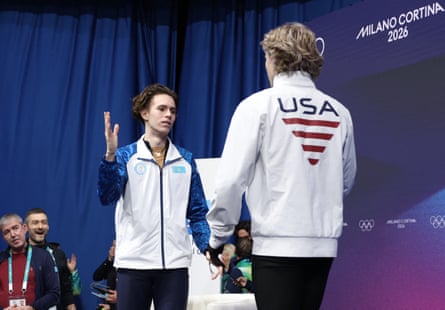
“The pressure of the Olympics really gets to you,” Malinin said afterward. “The pressure is unreal. It’s really not easy.”
Pressure — a word he returned to again and again while speaking in the charged atmosphere of the mixed zone late Friday night — is often dismissed as a cliché. But in sports dependent on timing and muscle memory, pressure is physical as much as psychological. It accelerates time. Shrinks margins. Turns instinct into hesitation. Elite athletes often describe peak moments as oddly serene, as if the world slows down. Malinin’s reflection suggested the exact opposite experience.
“It definitely wasn’t a pleasant feeling,” he said. “All the years of training, building toward this — it went by so fast. I didn’t even have time to process what to do. Everything just happens instantly.”
He continued: “My life has had a lot of ups and downs, and right before I took my starting position, all of those experiences and memories just rushed in. It was overwhelming. I didn’t know how to manage it in that moment.”
Malinin arrived in Milan not merely as the favorite, but as the engineer of skating’s technical future: the only athlete landing the quad axel, the only one constructing programs around seven quads, the only skater capable of making ‘almost clean’ feel dominant. He had even hinted at developing a quintuple jump for the near future. Yet warning signs appeared throughout the week — underwhelming team event skates and restless late-night activity online. At the elite level, performance is instinctual. When instinct cracks, the entire structure can collapse.
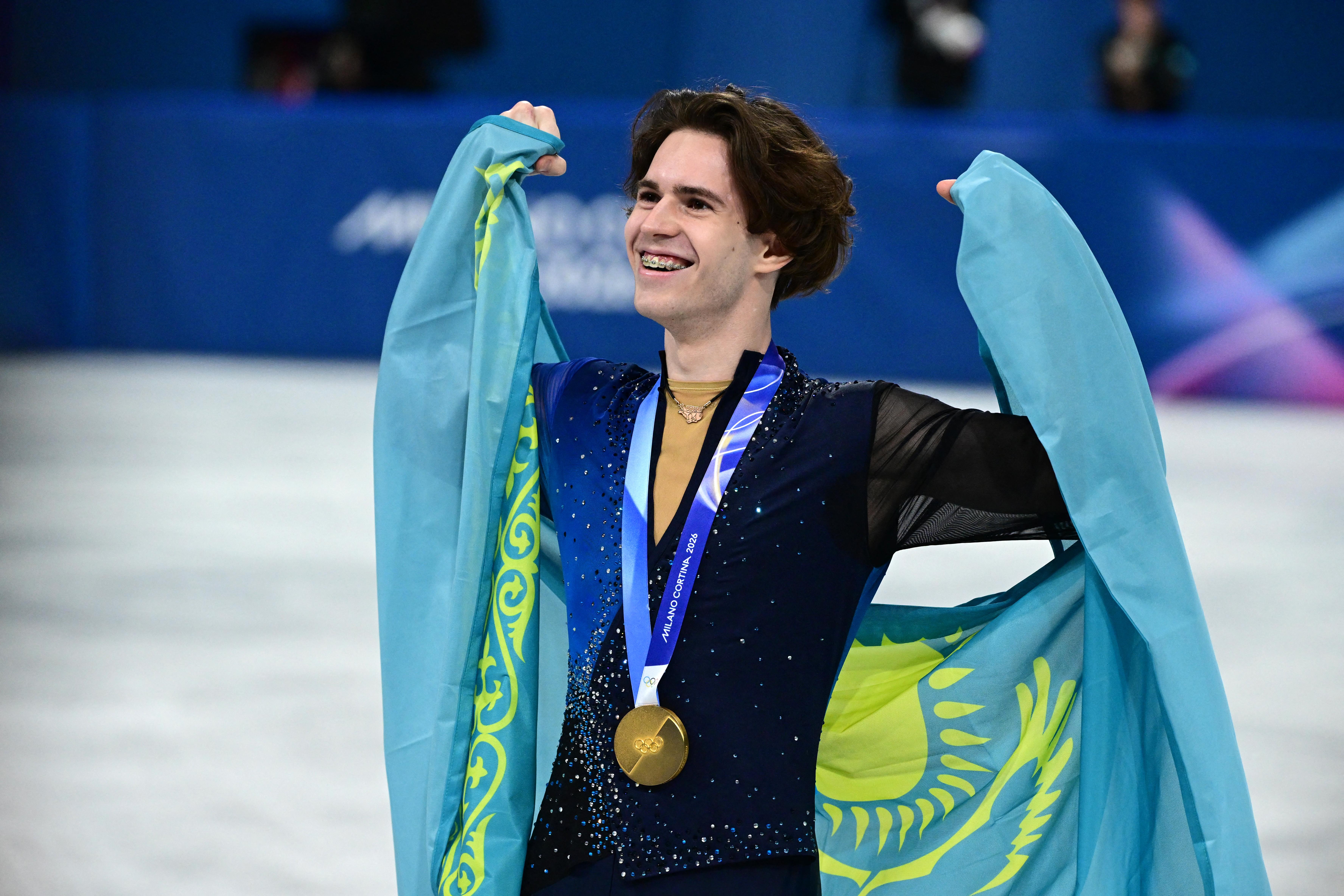
Instead, Olympic gold went to Kazakhstan’s Mikhail Shaidorov, who sat fifth after the short program and delivered exactly what the Olympics have always rewarded: a composed, efficient skate — ambitious, but controlled. Five quads. Clean execution. No deductions. No chaos. Outside the venue, fans wrapped in Kazakh flags sang into the rainy night, celebrating their new national hero — Gennady Golovkin translated to ice.
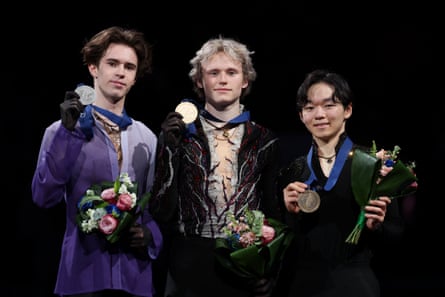
The contrast between Shaidorov and Malinin felt philosophical. Malinin embodies skating’s frontier — maximum risk, maximum difficulty, maximum imagination. Shaidorov, also 21, represented its oldest truth: the skater who survives their program usually prevails. That tension has always defined Olympic skating, where theoretical limits matter less than executing excellence under suffocating scrutiny.
“I felt really confident going into the free skate,” Malinin said. “And then it was right there… and suddenly it slipped away.”
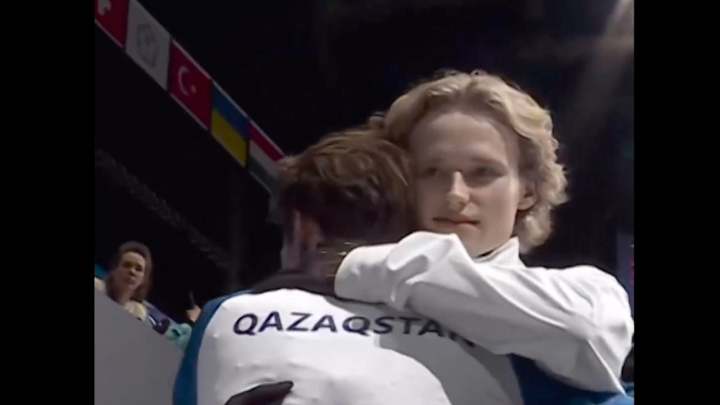
Now facing a four-year wait before another Olympic chance in the French Alps in 2030, Malinin learned a brutal lesson: the Olympics care nothing for momentum, narratives, or revolutions. They care only about what happens in a single, unforgiving window. For the Quad God, that window closed before he could recalibrate.
The defeat, while deeply painful, will not define his career. He already captured team gold at these Games, remains the most technically gifted skater in the sport, and the athlete most likely to shape its future. Nathan Chen’s presence in the press tribune served as a reminder that Olympic disappointment can be a chapter, not a conclusion.
But if Malinin represents where skating can go, Friday night was a reminder of where it still lives — a sport decided without mercy, without romance, by who can hold themselves together long enough to strike the final pose.