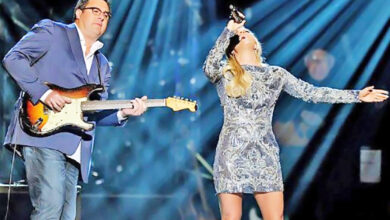
Michael Bublé And Josh Groban’s Surprise Sing-Off Turns A Concert Into Viral Comedy
The moment works because it starts as a throwaway joke and ends as a full-blown, arena-sized comedy bit that only two artists with total control could pull off. Michael Bublé has always treated his concerts like a night out with a mischievous host—part singer, part stand-up, part ringleader—and this was one of those sequences where he leaned into that identity with extra confidence. He framed it like a “career announcement,” teasing the crowd with the idea that he was tired of being boxed into jazz and standards. The setup felt intentionally absurd, like he was daring the audience to believe him for five seconds. That fake seriousness is what made the next beat land so hard, because everyone could feel he was winding up for something.
Then he swerved into the “new direction” with a punchline that had nothing to do with reinvention and everything to do with pure showmanship: he decided his fresh era would involve becoming Josh Groban. It wasn’t a casual nod or a quick vocal quote. He committed to the bit with exaggerated seriousness, pushing his voice into that operatic-pop power lane and pairing it with mannerisms that made the impersonation instantly readable even if you weren’t a superfan. The humor wasn’t cruel—it was affectionate, the kind of impression you do when you’ve studied someone enough to know their musical fingerprints. The crowd reaction builds in real time because they can sense he’s stretching it on purpose, milking the theatricality until the joke becomes a mini-performance.
The true “how is this even happening?” jolt arrives when Josh Groban appears behind him like a magician’s reveal. It’s the kind of entrance that instantly changes the oxygen in the room, because now the joke has consequences. Suddenly, Bublé isn’t doing an impression in a vacuum—he’s doing it in front of the person he’s imitating, with thousands of witnesses. That’s why the crowd pops the way it does: it’s not just funny, it’s risky. Groban’s body language sells the moment perfectly, too. He doesn’t rush in or break the spell. He lingers, watches, and lets the audience enjoy the disbelief before he even lifts a finger.
Groban’s reaction is what turns a hilarious cameo into a classic two-person scene. He plays it straight at first—bemused, slightly offended in a theatrical way, the classic “I can’t believe you’re doing this” expression—then he shifts into retaliation with the calm confidence of someone who knows he can win the room without trying too hard. When he steps forward, the power dynamic flips instantly. The audience already loves the surprise, but now they’re getting the bonus: Groban isn’t just there to wave. He’s there to spar. And because both singers are actual vocal monsters, the “sparring” isn’t just jokes—it’s musicianship used as comedy.
The funniest part is how the impressions become less about voice alone and more about musical identity. Bublé’s whole persona is swing, swagger, and that smooth, wink-at-the-audience charm. Groban’s lane is bigger, more dramatic, more cinematic. So when they start mimicking each other, it’s like watching two languages collide and somehow translate perfectly. Groban exaggerates Bublé’s rhythmic bounce and phrasing, leaning into the movement and the showman gestures. Bublé pushes the melodrama and the sustained notes, turning it into an operatic flex. The contrast is the engine: neither style is “wrong,” but seeing each one filtered through the other makes both seem even more distinct.
What makes it feel special, beyond the laughs, is that it’s a rare glimpse of two polished, brand-heavy artists letting the brand slip—on purpose—without losing control of the room. A lot of viral concert moments are accidents, mistakes, or awkward surprises. This one feels like skilled improvisation in the sense that they’re reacting, timing, and adjusting to the crowd’s energy second by second. You can hear the audience go from “this is funny” to “wait, this is actually happening” to “I can’t breathe,” and that escalation is part of the entertainment. The humor stays friendly, but it never turns soft. They keep raising the stakes until the whole arena is locked in.
It also works because it’s rooted in genuine respect. The impressions are sharp, but they don’t feel mean-spirited. They feel like inside jokes between artists who understand what it takes to own a stage in different ways. That’s why their fans embraced it instead of turning it into a weird rivalry clip. People love seeing performers with big reputations act like real people for a minute—competitive, playful, slightly petty in a comedic way, and totally delighted by each other’s talent. The fact that it happened in the flow of a concert, rather than a scripted TV sketch, makes it feel even more like a gift: a lightning-bolt interaction you didn’t plan to see.
By the time it spread online, the clip had everything the internet likes to reward: a clear setup, a perfect surprise reveal, a second surprise (the retaliation), and a payoff that keeps topping itself. It’s short enough to rewatch, big enough to share, and specific enough to feel authentic. Most importantly, it captures something fans don’t always get from studio-perfect careers: the sense that both men are entertainers first, not just vocalists. That’s the “different side” people talk about—the looseness, the timing, the willingness to look silly for the sake of a better moment. In a world of carefully managed performances, this felt like two stars choosing chaos in the funniest possible way.
Watching the crowd’s reaction is half the experience, because the laughter doesn’t just sit on top of the music—it becomes part of the rhythm. You can feel the exact moment the room realizes Groban is actually there, and how that realization changes the energy of every next note. The camera work, the stage spacing, the little head shakes and pauses—those tiny human details are why the clip plays like a story instead of a random funny bit. It’s also why it keeps getting rewatched: the punchlines aren’t only in what they sing, but in when they choose to stop, stare, and let the audience explode before continuing.
Hearing the original “You Raise Me Up” afterward helps explain why it’s such a tempting target for an impression in the first place. The song lives in a space that invites big emotion—long lines, dramatic climbs, and that soaring, chest-opening kind of chorus that practically dares a singer to go full power. In the concert moment, that emotional “bigness” becomes comedic fuel when Bublé exaggerates it, because the audience recognizes the style immediately. But the original track also shows why Groban’s lane is so effective: it’s not just volume. It’s control, clarity, and the confidence to let a melody carry sincere weight without irony.
This live version deepens the context because it shows the joke isn’t the whole relationship—it’s the surface of a real musical overlap. When they share a stage and trade songs, you can hear why the impersonations are so accurate: each of them understands the other’s phrasing and performance instincts well enough to parody them. It also highlights what the viral clip turns into comedy: the difference between Bublé’s conversational cool and Groban’s cinematic lift. In a straight performance, those differences feel complementary; in the “sing-off,” they become the contrast that makes every imitation funnier.
Bublé’s impression skills have always been part of his stage identity, and clips like this show why the Groban moment landed so naturally. He doesn’t just mimic a tone; he mimics posture, timing, and the invisible “rules” of a style. That’s why he can flip from crooner smoothness into a heightened vocal character and make the audience understand the joke instantly. When someone has that level of control, an impression stops being a cheap gag and starts feeling like a mini masterclass in performance language—how singers signal genre, attitude, and persona before they even finish a line.
Groban’s side of the equation matters just as much, because his humor is often built on the same principle: take the seriousness people project onto him and puncture it with precision. When he leans into comedy, the contrast is the point—this huge voice paired with an unexpectedly playful, self-aware vibe. That’s why his retaliation in the concert moment feels so satisfying. He isn’t just “showing up.” He’s proving he can play in Bublé’s entertainment lane too, and that the polished image doesn’t stop him from being ridiculous on purpose when the moment calls for it.